Introduction: Bridging Tech and Fishing
At the StrictlyVC event held earlier this week in Los Angeles, a conversation unfolded that felt distinctly out of place compared to the typical pitches about SaaS, GenAI, or the latest consumer app. Shinkei Systems founder Saif Khawaja and Founders Fund partner Delian Asparouhov sat down to discuss a topic rarely broached at such a high-level venture event: the ethics of how we harvest fish, and how technology can solve for the resulting quality degradation. The discussion served to humanize an industrial process often removed from the consumer's gaze, framing the issue of "fish stress" as both an animal-welfare concern and a substantial food-science efficiency problem that is ripe for technological disruption.
The Technological Solution: Poseidon and Automated Ike Jime
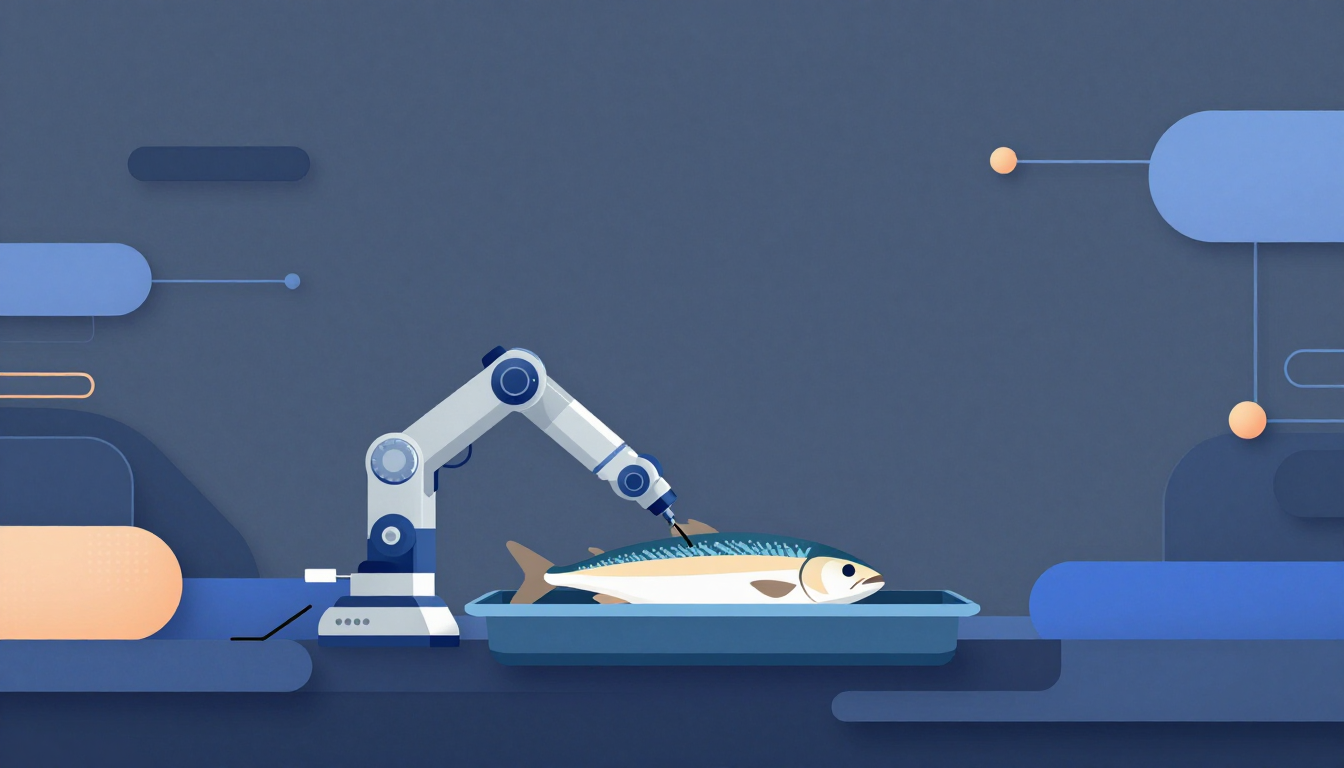
At the center of Shinkei’s mission is the Poseidon robot, a refrigerator-sized device designed for on-board installation on fishing vessels. The hardware demonstrates the power of integrating computer vision and robotics in the harsh environment of a commercial fishing boat. Upon a net’s arrival, the Poseidon system scans each fish, identifies its species, and precisely locates the brain.
It then initiates an automated, accelerated version of ike jime. This centuries-old Japanese technique, traditionally performed dockside by elite, highly-trained fishermen, involves the immediate, surgical destruction of the fish's brain and the severing of its gills. By doing this instantly, the Shinkei robot prevents the fish from thrashing or suffocating—processes that typically cause death to occur over minutes to hours. This is about precision engineering applied to an ancient artisanal craft, bringing industrial consistency to a process that formerly required high levels of training to execute properly.
Beyond Animal Welfare: Quality and Waste Reduction
While the humane nature of the harvest is a significant selling point, the primary driver for Shinkei—and the reason for industry interest—is food science. When a fish dies slowly, it is flooded with stress hormones and lactic acid. These chemical byproducts quickly degrade the quality of the flesh and drastically shorten its shelf life.
By automating the ike jime process on the boat, Shinkei effectively halts this quality decay at the moment of catch. This allows for a massive extension in shelf life, moving from a standard 5-to-7-day window to 12-to-14 days. Khawaja noted that the company has even tested fish three weeks after catch with no significant quality issues.
This is a profound shift for an industry where, by Khawaja’s estimation, approximately 18% of product is lost to spoilage between the dock and the retail store, prior to any retail-level waste. When you consider the environmental and financial cost of that waste, the technology begins to look less like a "humane" luxury and more like a necessary investment in global food sustainability.
Business Model and Vertical Integration
Shinkei Systems is not merely a hardware or robotics vendor; they have positioned themselves as a vertically integrated harvester and processor. Their model involves providing the Poseidon robots for free to fishing partners and, in turn, purchasing the robot-processed catch at a significant premium over standard market rates.
This ensures Shinkei retains full control over the quality and the supply chain. The fish is then transported to the company's 16,000-square-foot facility in Tacoma, Washington, where it is broken down, packaged, and sold under the company’s consumer-facing brand, Seremoni. Marketing their product as “ceremony grade” fish, Shinkei is explicitly aiming at the high-end sashimi and restaurant markets. This vertical integration allows them to capture value that would typically be lost in intermediate processing stages.
Market Proof and Future Outlook
The proof is increasingly visible in affluent dining and retail spaces, most notably with Erewhon’s Manhattan Beach location, which has been piloting Shinkei-supplied fish in its prepared-foods bar. Khawaja claims that the company’s client list already includes restaurants holding a total of 50 Michelin stars.
Perhaps most impressively, Shinkei claims to be doing something historically unprecedented in the global seafood trade: Japan, which has long viewed American seafood as distinctly inferior to its domestic product, is now importing this US-caught, robot-processed fish into its own markets. This is a testament to the quality improvements Shinkei has realized through automated ike jime.
As the industry grapples with the question of whether consumers will pay a premium for “humanely killed” seafood in the way they have for humanely raised land meats, Shinkei is betting that the quality, shelf-life, and consistency—quantified by their new in-plant sensor systems—will carry the day.
A Philosophical and Industrial Shift
Khawaja’s own origin story is compelling. He grew up taking fishing trips with his family in the Middle East, and the concept for Shinkei crystalized during his college years when he encountered an essay titled “If Fish Could Scream.” The central thesis—that fish suffer in silence because they lack vocal cords—drove him to see the industrial fishing process anew.
He didn't just want to build a better fish-processing facility; he wanted to address the "invisible" suffering that occurs during the harvesting process. By combining his philosophical understanding with the hard engineering of the Poseidon system, he has bridged a gap that very few founders have addressed.
The industrial challenges here are also worth noting. A fishing vessel is not a clean, climate-controlled factory floor; it is a pitching, salt-encrusted environment with unpredictable harvest volumes and varied fish sizes. Operating computer vision and high-precision mechanical actuators under these conditions was a significant engineering feat. The success Shinkei has seen is not just in achieving the ike jime process, but in maintaining it under extremely challenging operating conditions.
This technology also has a broader implication for climate tech. By reducing spoilage by approximately 18% in the supply chain, the overall carbon footprint of seafood production is lowered. If Shinkei can scale its model across various fisheries, the reduction in waste has a multiplier effect on sustainability.
Industry experts have been skeptical of "humane harvest" premiums for seafood in the past, largely because consumers often struggled to see the direct benefit. With Shinkei, the benefit is immediate: better tasting, longer-lasting, more consistent food. The humane harvest is essentially "baked into" the quality outcome. Erewhon customers aren't just buying it to feel good about the fish; they're buying it because the black cod on the prepared foods bar exceeds the quality they've come to expect from standard supply chains.
The company's expansion into an in-plant sensor system is another crucial element of this strategy. By being able to project an individual shelf life for each fish, they are creating a new level of data-driven transparency for seafood that has been notoriously difficult to achieve. The industry, historically, has dealt in "lots" and "estimates." Shinkei is shifting the conversation toward individual unit quality.
Finally, the success with Michelin-starred restaurants and the Japanese import market demonstrates that this approach is not just a niche play for affluent grocery stores. If the highest bar for seafood quality in the world is finding value in US-caught, automated-harvest product, then Shinkei’s mission is on a very solid trajectory toward widespread adoption. If Shinkei proves fully scalable, the "invisible suffering" of our seafood could soon become a relic of a less efficient, less compassionate past—a transformation that marries hard industrial progress with a profound philosophical rethinking of our relationship with the life we harvest from the sea. The venture world loves "outlier" bets, and Shinkei Systems is quickly making a case that this outlier is becoming the new standard.