
The Assembly Line Is a Lie
Here's the story neuroscience kept telling for decades: your eyes capture raw pixels, hand them off to the visual cortex at the back of your head to sketch out shapes and edges, and then pass that rough draft forward to the prefrontal cortex where actual thinking happens. Sensory areas are data relays. The front of the brain does the work.
That story is wrong. Or at least, it's embarrassingly incomplete.
Last year, the same Columbia Engineering team published fMRI scans showing that your earliest visual areas don't just relay information — they reinterpret it. Show a participant the exact same shape, ask them to sort by one rule, and their primary visual cortex lights up one way. Switch the rule without changing the stimulus, and that same region behaves completely differently. The physical input is identical. The brain's representation of it isn't.
So how does the front of the brain actually pull that off? How do top-down instructions reach the very first processing stations and rewrite their output in real time?
The answer, published this week in PLOS Biology, is both elegant and specific. It's a circuit motif the team isolated by building a neural network from scratch, constraining it to biological reality, and then systematically breaking parts of it to see what held the system together.
Building a Brain You Can Take Apart
Dr. Nuttida Rungratsameetaweemana's lab doesn't build open-ended AI models the way a typical ML group would. Their recurrent neural networks are biologically constrained from day one — distinct pools of excitatory neurons that drive firing and inhibitory neurons that suppress it, organized into a hierarchy with a sensory module receiving raw input and a higher-level cognitive module issuing top-down instructions.
The constraint is the point. If your model has capabilities the brain doesn't actually have, anything you discover inside it is just engineering cleverness, not biology. By limiting the network to features known to exist in real neural tissue, whatever mechanism it evolves to solve a task is a hypothesis worth testing against living brains.
The team trained this network on a rule-switching task analogous to what human participants had done inside an fMRI scanner. And when they looked inside the trained model, one pattern jumped out: the network had solved flexible processing by relying on a very specific wiring arrangement. Inhibitory neurons that suppress other inhibitory neurons.
Disinhibition, in the old terminology. Inhibition-on-inhibition.
The Double Brake
Think of your neurons as having two controls: gas pedals and brake pads. Excitatory cells are the gas — they push other neurons toward firing. Inhibitory cells are the brakes — they hold things back.
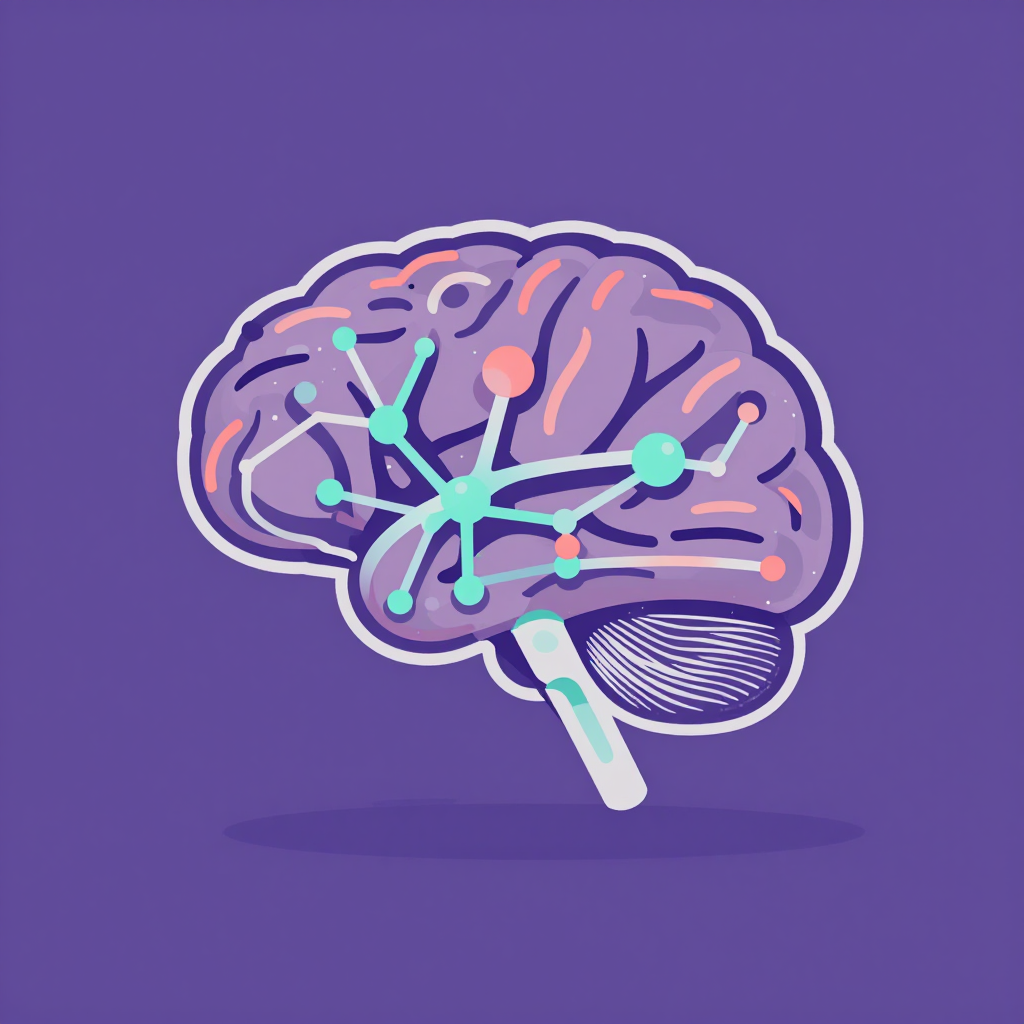
An inhibition-on-inhibition connection is when one brake pad clamps down on another brake pad. You're braking the brakes, which means you temporarily release the gas in a highly targeted way. It's not chaos — it's precision control through double suppression.
In the Columbia model, this double-brake motif turned out to be the exact cellular pathway that higher cognitive modules use to send contextual instructions down to the sensory entry points. When the task rules change, the top-down module doesn't shout at the visual cortex to pay attention. It reaches into the inhibitory network, releases specific local brakes, and lets particular excitatory pathways fire that wouldn't have fired otherwise.
The result: the same raw visual input gets processed differently depending on what the brain is currently trying to do with it.
Breaking the Circuit to Prove It
Hypotheses are cheap. Causal tests aren't.
To confirm that disinhibition was actually essential — not just correlated with flexible processing — the team systematically weakened those inhibition-on-inhibition connections in their model. The network's ability to switch between tasks collapsed immediately. Other connection types? Weaken those, and performance stayed largely intact.
That asymmetry is the kind of evidence that makes a computational neuroscientist sit up. If you can break one specific wiring pattern and watch the function fail while everything else keeps working, you've probably found the mechanism, not just a bystander.
But computational models are still models. The real test required living tissue.
Validation in Living Mouse Cortex
The team recorded active neural firing directly from the visual cortex of living mice performing the same kind of rule-based task. Then they selectively silenced the inhibitory anchor cells that their model had identified as the disinhibition circuit's key nodes.
The result matched the prediction exactly: silencing those cells instantly degraded the cortex's ability to track task context. The visual cortex lost its flexibility. It reverted toward a more passive, relay-like mode of operation.
This is the kind of experiment that takes years to set up and months to execute. The fact that the computational prediction held against living neural tissue is what separates this from a clever simulation.
The Hippocampus Patient Who Changed Everything
Rungratsameetaweemana traces the intellectual origin of this work to 2015, when she began working with patients who are missing their hippocampus entirely — the brain region responsible for forming and holding onto new memories.
If the brain were truly modular, losing that critical memory hub should have crippled a wide range of cognitive functions. It doesn't. These patients can still perform complex tasks, adapt to new rules, and navigate situations that should require intact memory circuits.
That was the first real evidence for Rungratsameetaweemana that early sensory regions are doing far more than relaying information. They're active processing workspaces with massive functional redundancy. You can lose a major hub and the system still adapts because the lower-level regions already contain enough computational structure to compensate.
This principle — redundancy as a design feature rather than a bug — is what makes the brain so robust and so difficult to replicate with conventional AI.
What This Means for Leaner AI
Here's where the work gets genuinely exciting for anyone who's watched a large language model consume enough electricity to power a small town and produced exactly one paragraph of mediocre text.
Current state-of-the-art AI systems like ChatGPT are computational giants. They require warehouse-sized data centers and staggering electrical energy because they're trained on nearly the entire internet. The human brain navigates thousands of complex, fast-changing daily situations on roughly the energy needed to run a dim laptop lightbulb — and without being trained on the whole internet.
The brain got there through evolution, through redundancy built into its wiring at the circuit level. The inhibition-on-inhibition motif is one of those efficiency tricks.
Rungratsameetaweemana's team isn't trying to build transformers. They're building recurrent neural networks — architecturally quite different from today's LLMs — and working out these biological principles one by one to make AI leaner and more adaptive. The goal isn't to copy the brain's output. It's to copy its efficiency.
If you can distill even a fraction of the brain's circuit-level tricks into artificial networks, the energy gap between human cognition and machine cognition starts to close in a way that raw scale never will.
The Next Layer: Human Deep Brain Recordings
The team has already moved back to humans. They're working with clinical collaborators who monitor epilepsy patients using electrodes placed deep inside the brain, recording neural activity directly while those patients perform cognitive tasks.
These fine-grained measurements will provide data to test the team's hypotheses against real human neural activity — not mouse cortex, not computational models, but the actual brain regions involved in human rule-switching and flexible perception.
That's the final validation step. And if the pattern holds across species, we may be looking at a genuinely universal mechanism for how cognition reshapes perception — one that's been hiding in plain sight inside the brain's inhibitory network all along.