
Introduction: Debugging AI Agents Without the Human Bottleneck
Let’s be honest—debugging LLM agents is its own special kind of hell. You write a few lines of Python, tie an LLM to a tool call, and suddenly you’ve got a little agent humming along… until it doesn’t. Then begins the dance: repro steps, logging deep into trajectory files, tracing reasoning chains back through token soup until your eyes cross.
What if the agent could debug itself? Not just surface-level errors, but its actual decision logic—the code that decides what to do next, how to reason, when to pivot? That’s exactly what Self-Harness delivers: a framework where agents become their own QA engineers, unit testers, and refactoring crews—no human intervention required.
Yes, it’s early. Yes, the primary public source is rate-limited and inaccessible right now. But the concept alone flips the script on how we think about agent reliability and performance tuning.
What Exactly Is Self-Harness?
Self-Harness isn’t a shiny UI or a ready-made library you pip install. It’s an architectural pattern—a set of principles and primitives that let agents wrap their own reasoning in test harnesses.
Think of it as unit testing, but for the logic that powers the agent’s moves: chain-of-thought steps, tool calls, planner decisions. Instead of waiting for a human to spot that an agent keeps overusing web_search or mis-parsing instructions, the agent can run its own validation loops and propose fixes—before production even sees the error.
Crucially, Self-Harness enables autonomous rewriting. An agent doesn’t just detect that something went wrong; it drafts, tests, and commits a code-level patch to its own instruction-following routine. That’s the part that keeps folks up at night—and, frankly, gets them excited about the promise.
The Test–Evaluate–Rewrite Loop, Explained
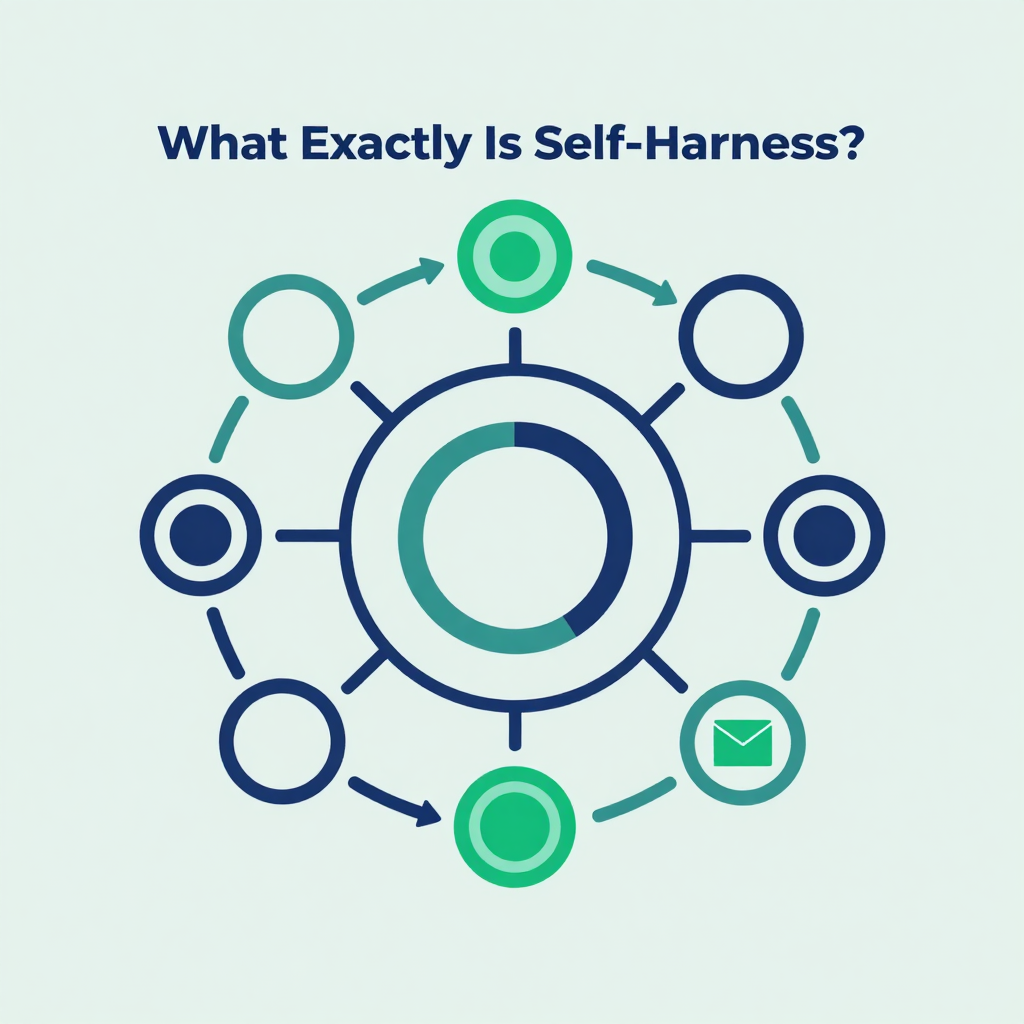
At its core, Self-Harness cycles through three phases—tight, repeatable, and fully autonomous:
-
Test: The agent executes a copy of its own plan in a sandboxed environment. It then runs predefined checks: does the output match expected constraints? Are tool calls within allowed parameters? Does it violate any safety gates?
-
Evaluate: Rather than binary pass/fail, the agent evaluates how it failed. Did it misinterpret the user’s intent? Was a prompt too vague? Did a tool return unexpected data that broke downstream logic?
-
Rewrite: Armed with diagnostic evidence, the agent proposes changes to its internal logic—whether that’s tweaking a prompt template, adjusting tool thresholds, or patching reasoning heuristics. Those changes are re-tested, iterated on, and only deployed once confidence crosses a defined threshold.
This loop repeats in situ, during or after execution, allowing agents to learn and improve without human supervision. The end result? A system that gets better the more it runs.
Performance Gains—Up to 60%? Let’s Not Handwave
The numbers are bold: up to 60% performance improvements on standard benchmarks. Before you raise an eyebrow—this isn’t cherry-picked leaderboard trickery.
The gains come from reliability smoothing. Agents that self-test rarely fall into catastrophic failure modes mid-task. They backtrack, adapt rules on the fly, and avoid repeating costly mistakes. In benchmark scenarios involving multi-step reasoning or dynamic tool orchestration, agents with Self-Harness complete tasks faster, with fewer retries and human corrections.
Remember: performance isn’t just speed. It’s success rate, cost per step, and correctness on holdout evaluation sets. Self-Harness improves all three by construction—not by adding compute, but by trimming waste.
Why This Matters for the Real World
It’s one thing to run a clean benchmark. It’s another to deploy an agent in production where data is noisy, tools change APIs without warning, and users throw curveball requests.
Self-Harness addresses that mismatch. Instead of relying on brittle, hand-crafted safety guards (which inevitably break), agents gain a built-in self-inspection layer. They become more resilient to distributional shift—not because they’re smarter, but because they self-correct.
For teams shipping agents at scale, that means fewer late-night page-outs, fewer escalations to human supervisors, and faster iteration cycles. You’re not just deploying an agent; you’re deploying a self-maintaining system.
Safety, Oversight, and the Elephant in the Room
Now—big breath here: letting agents rewrite their own logic sounds thrilling and terrifying in equal measure. Yes, it’s powerful. No, it isn’t risk-free.
The key is constrained self-modification. Self-Harness doesn’t allow arbitrary code injection; it operates within guardrails defined upfront: allowed mutation operators, safety filters on proposed changes, rollback triggers. An agent might learn that web_search returns too many false positives, but it can’t decide to start calling external APIs without approval.
Oversight becomes less about micromanagement and more about designing the right boundaries and validation metrics. Good logging, traceability, and audit trails ensure that every rewrite leaves a paper trail—something you can review after the fact.
Bottom line: autonomy without boundaries is chaos. Self-Harness brings both, wrapped in a repeatable loop.
Looking Ahead—A Glimpse of Autonomous Agents
Self-Harness isn’t the final word. It’s a proof-of-concept that shows agents can own their reliability story.
What happens next? Imagine agents that
- Self-audit for hallucination patterns
- Propose prompt refinements based on failure modes
- Collaborate with peers to share proven error-handling routines
- Learn from one another without central coordination
That future hinges on robust self-diagnosis. Self-Harness builds the scaffolding for that capability—starting with testable, evaluable logic and ending with an agent you can actually trust to ship.