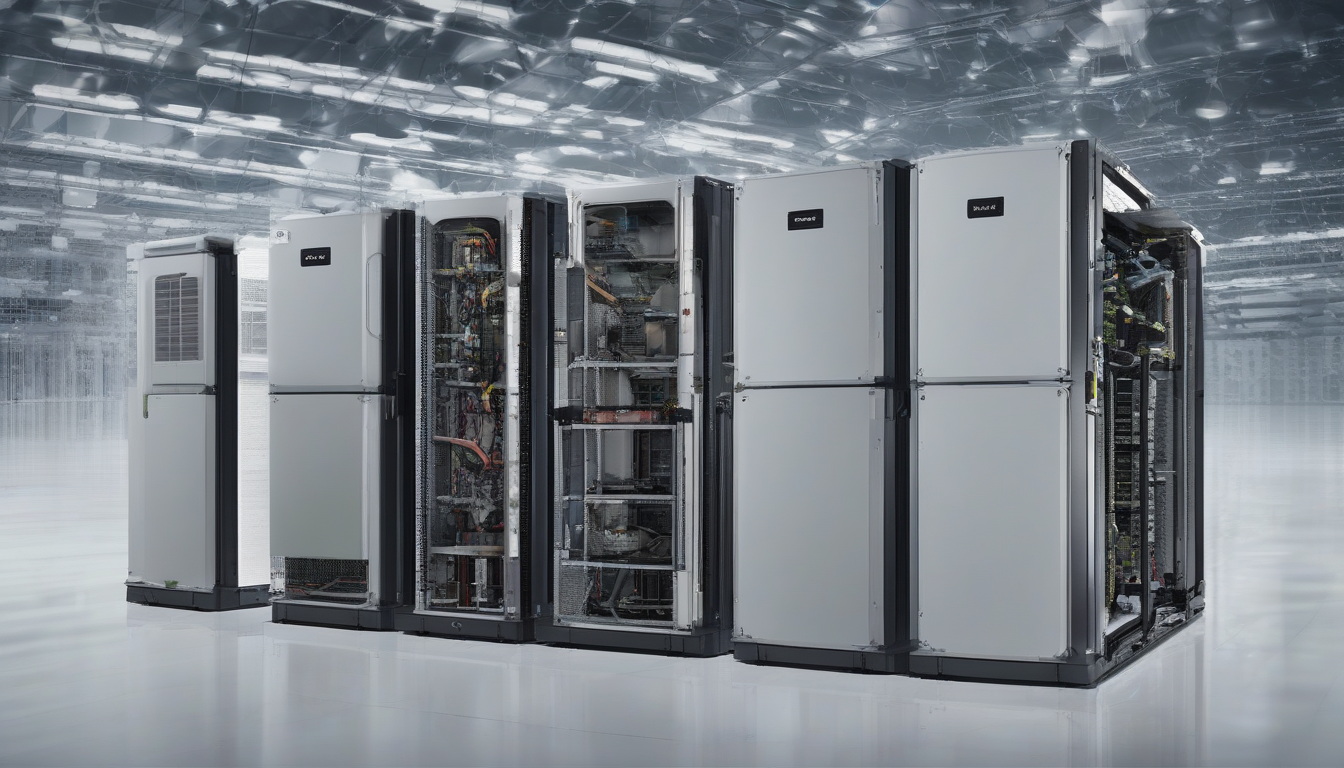
Refrigerant Cooling: A Key Tool for AI Cloud Infrastructure Companies in India
The sheer thermal density of modern AI compute is not just a challenge—it’s an outright bottleneck. As datacenters push higher wattages for systems like Nvidia’s B200 accelerators, the old-guard methods of cooling are simply running out of room. We’ve been watching this heat issue boil over for years, but a new development from Accelsius signals that we might finally be moving beyond inefficient traditional methods.
Accelsius is claiming it can achieve up to 14°C cooler GPU temperatures by converting a liquid-cooled Dell PowerEdge server to run on specialized refrigerants. This isn't just about shaving a few degrees; it’s about rethinking the fundamental relationship between temperature, throughput, and power efficiency in our most demanding compute environments.
The Two-Phase Breakthrough
The core of the Accelsius proposition, as detailed in recent industry reports, hinges on flipping from single-phase cooling to two-phase cooling. While single-phase liquid cooling is the standard today, it's increasingly struggling to keep pace with the power demands of modern, ultra-dense AI infrastructure.
Accelsius’ approach is quite clever. By utilizing a refrigerant-based system—similar to the technology running your refrigerator—they can support facility water temperatures as high as 54°C. If a facility operator pushes the flow rate, that number can climb to 59°C. This is a game-changer because, in the world of datacenter operations, every 1°C increase in facility water temperature translates to roughly 4% in annual energy savings.
When the company stress-tested this approach on a Dell PowerEdge XE9680L equipped with eight Nvidia B200 accelerators, the results were striking: a 19°C drop at the cold plate and a 9°C to 14°C drop at the system level. This is the kind of thermal headroom that allows operators to either run their chips at higher performance, or, perhaps more importantly, eliminate the need for costly conventional chillers. Beyond GPU Hunger: How Weka Refines AI Infrastructure to Stop Inference Waste highlights how cooling is just one part of a larger efficiency puzzle, but this breakthrough directly addresses the most immediate thermal constraint.
What This Means for AI Cloud Infrastructure Companies in India and Globally
For AI cloud infrastructure companies in India and across the globe, this is a massive operational lever. As India positions itself as a critical hub in the global cloud and AI landscape, building out infrastructure that can handle these high-density, high-heat loads without astronomical electricity costs is mandatory, not optional.
If you can replace thirsty evaporative coolers with drier, less energy-intensive systems by merely raising the allowable facility water temperature, you’re not just saving money—you’re increasing your operational resiliency. For operators in regions with high energy costs or strict environmental regulations, this adaptability is a tangible competitive advantage. The ability to run at higher temperatures without sacrificing chip performance is the kind of efficiency that will define the next generation of sovereign AI infrastructure deployments.
Breaking Down the Agentic AI Component
We’ve seen a shift where infrastructure planning is increasingly driven by the requirements of agentic AI systems. It’s a departure from the static compute workloads of the past. To understand why this cooling breakthrough matters so much, we have to grasp what these systems actually are.
Embodied Agents Explained
An embodied agent is essentially an intelligent system that doesn't just live in the cloud; it interacts with the physical world. These agents utilize sensors to perceive their surroundings and actuators to perform physical actions—think of autonomous robotics in a warehouse setting or robotic arms in precision manufacturing. They require compute that is not only high-performance but also highly responsive, necessitating a tighter feedback loop between the compute infrastructure and the physical environment it enables.
Defining Agentic AI
While the term gets tossed around a lot, clarity is essential. When IBM looks at agentic AI, they focus on its capacity for autonomous decision-making and task execution with minimal human intervention. It’s not just about doing what you're told—it’s about planning a complex workflow across multiple steps and adjusting that plan in real-time if conditions change.
Google Cloud’s perspective highlights the key differentiators: traditional AI models are largely conversational or task-specific. Agentic AI, by contrast, is designed to plan, execute, and adapt using a broader set of tools. They act as distinct, autonomous agents that orchestrate complex, multi-stage workflows to accomplish a high-level goal, which fundamentally shifts the demands on the underlying AI infrastructure—it needs to be stable, fast, and intensely reliable under sustained, high-load conditions. The Convergence of Precision: How Agentic AI is Architecting the Next Era of Science explores this evolution further.
The Road to Adoption
Despite the technical promise, Accelsius—and others in this space—face significant real-world challenges. Retrofitting servers is the easy part; the real hurdle is OEM buy-in and serviceability at scale.
Nvidia’s NVL72 rack, for example, cramming 72 GPUs and myriad other components into a single liquid-cooled system, makes cold plate design incredibly complex. Furthermore, the specialized coolant distribution units (CDUs) required for two-phase systems are not yet as ubiquitous as those for standard single-phase cooling.
Then, there’s the coolant itself. The industry is rightfully wary of the PFAS-based chemicals that haunted earlier generations of immersion and two-phase cooling. Accelsius claims its “NeuCool” blend meets ASHRAE A1 safety standards—meaning it’s both non-flammable and non-toxic—which is a necessary hurdle cleared.
Ultimately, the datacenter cooling industry is in flux. We are witnessing a transition where the efficiency of the cooling technique is no longer secondary; it is central to the profitability and feasibility of the entire AI datacenter buildout. Whether Accelsius’ refrigerant-based approach becomes the standard or just another effective niche method remains to be seen, but the clear message is that the cooling bottleneck is being addressed, one degree at a time.