
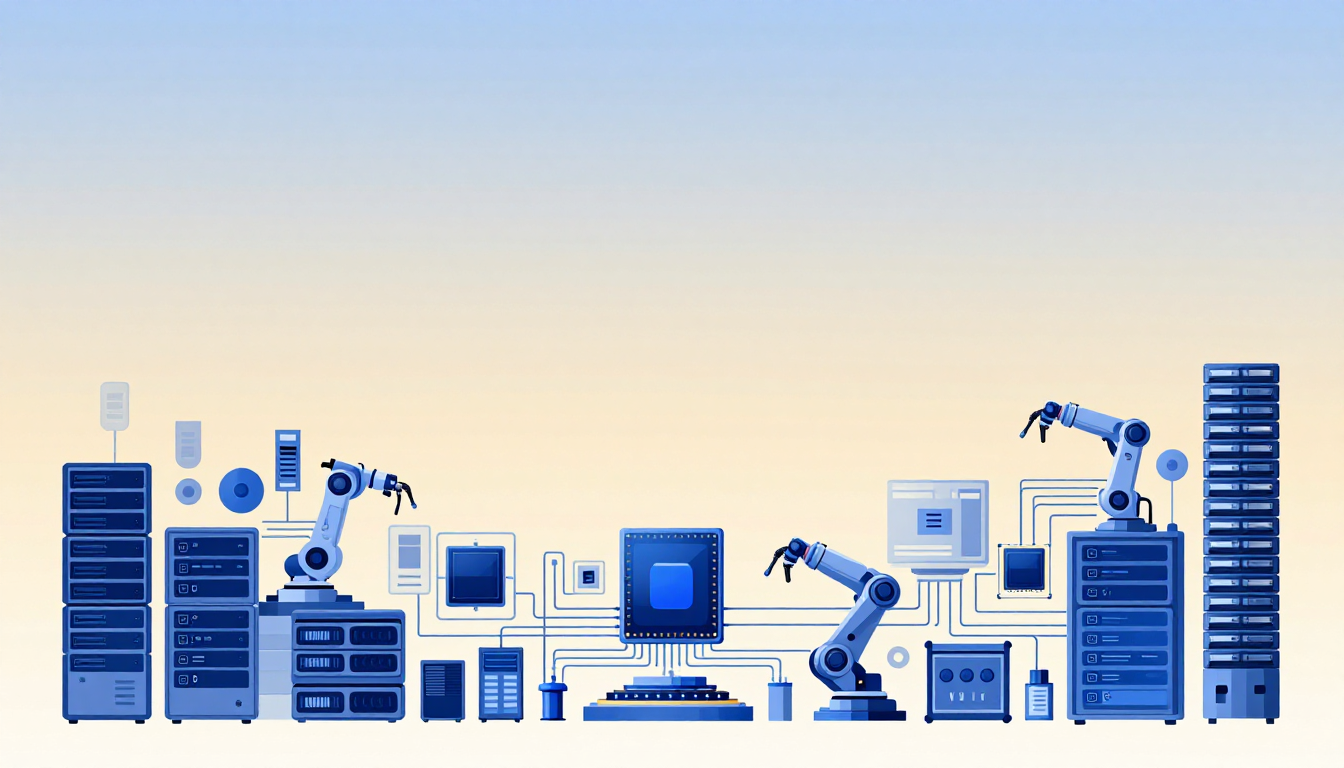
The Tokyo Pivot: Japan's $6.2B Bet on Physical AI
Jensen Huang didn't come to Tokyo in mid-July to sell chatbots. He spent July 15 and 16 walking factory floors in his mind, pitching the software brains that would one day steer autonomous excavators, robotic assembly lines, and heavy industrial machinery. The message was blunt: AI's next chapter belongs on shop floors, not in boardrooms.
Thirty years ago, a $5 million lifeline from Sega kept a near-bankrupt Nvidia from folding. Today, the leverage has flipped. Japan's manufacturing giants need Nvidia's chips to survive a demographic collapse. Nvidia needs Japan's factory floors to prove that AI model scaling works in the physical world, not just in digital abstraction.
The irony isn't lost on anyone. Japan wants absolute sovereignty over its automation infrastructure. It refuses to let its factories run on American cloud APIs or Chinese foundational models. Yet the compute hardware powering this national effort—the Vera Rubin silicon—is 100% American, built by Nvidia. Sovereignty, it turns out, is purchased in Silicon Valley.
Noetra: Japan's Own Foundation Model
Japan's answer to foreign dependence is Noetra, a domestic consortium of roughly 44 core companies. SoftBank, Sony, NEC, and Honda anchor the effort. The government is committing up to 1 trillion yen—about $6.2 billion—over five years. Noetra's mandate isn't to build another consumer chat model. It's building physical AI foundation models designed to handle real-world physics, spatial sensor streams, and real-time machine actuation.
METI planners structured the program in three phases:
- Fiscal 2026: A specialized reasoning model optimized for Japanese-language context and enterprise operational logic.
- 2028: An omni-modal model processing text, sensor images, live video, and industrial audio telemetry simultaneously.
- 2030: "Real-world Native AI" executing direct physical control over complex robotic hardware, released to outside developers in staged phases.
The strategy is clear: keep the software domestic, control the data, and let foreign silicon do the heavy lifting. It's a pragmatic compromise, not an ideal one.
The Vera Rubin AI Factory: 140 Megawatts of National Compute
Training trillion-parameter models for physical hardware requires infrastructure that goes far beyond standard data centers. Nvidia and its Japanese partners are building what they call the world's first national AI infrastructure—a dedicated facility scheduled for 2028 with staggering specs:
- Processor count: 13,750 Vera CPUs paired with 27,500 Rubin GPUs
- Power allocation: A dedicated 140-megawatt utility envelope
- Purpose: Training ground for Noetra's trillion-parameter physical models
A 140-megawatt compute footprint dedicated to industrial models shows how far physical AI has strayed from standard inference workloads. Robotics demands continuous low-latency sensor ingestion and high-density simulation clusters. This isn't a data center. It's a national strategic asset.
The Vera CPU architecture, with its 88 cores and aggressive single-threaded performance, is designed specifically to keep GPUs fed without idle cycles. For a deeper look at how these so-called "agentic CPUs" actually function in practice, see our analysis of why AI CPUs are just well-optimized general-purpose processors.
Cosmos 3 Edge: Models That Live on Machines
Data centers train. Factories execute. Bridging that gap is Cosmos 3 Edge, unveiled during Huang's Tokyo visit. While original Cosmos models launched in May 2026 focused on cloud simulation, Cosmos 3 Edge runs directly on machine hardware via Nvidia's Jetson Thor edge processors. Microsecond latency for real-time robotic adjustment. No cloud dependency.
The participating roster reads like a who's-who of Japanese industry: Fanuc, Yaskawa, Kawasaki Heavy, Fujitsu, Hitachi, NEC, Sony, SoftBank, Kubota, and the Advanced Intelligence for Robotics Alliance (AIRoA). Honda R&D and Omron are already building shared control systems that pair human workers with autonomous robotic arms.
Toyota is pursuing a parallel strategy. Having committed its next-generation vehicles to Nvidia's Drive platform at CES in January 2025, Toyota is extending Nvidia hardware across its entire manufacturing operation. Physics-grounded digital twins simulate factory line throughput before physical tooling is set. Machine vision reads real-time plant logistics. On the road, Toyota takes a deliberate approach—prioritizing advanced driver assistance systems that keep human drivers in the loop rather than leaping to fully driverless architectures like Waymo or Tesla.
The Demographic Math: 10 Million Robots or Decline
Japan's urgency isn't tech optimism. It's demographic arithmetic. A rapidly aging workforce and shrinking labor pool mean severe industrial shortages across logistics, construction, and precision manufacturing. Tokyo's response is aggressive: the AI Robotics Strategy, released in March, targets 10 million AI-equipped robots across 18 industrial sectors by 2040.
The investment is massive—$65 billion in combined public and private physical-AI funding. The economic ambition is global dominance. Tokyo wants Japanese suppliers to capture over 30% of the global AI robotics market by 2040, a market METI projects at ¥20 trillion (roughly $133 billion).
Prime Minister Sanae Takaichi joined Huang's launch event via video link, emphasizing that AI and semiconductors sit at the center of her administration's ¥370 trillion ($2.3 trillion) economic growth agenda. Trade Minister Ryosei Akazawa stood alongside Huang in Tokyo to reinforce the commitment.
Working the Whole Room
Huang didn't just keynote. He worked the room—literally. Over two days, he hosted executive lunches with CEOs of Toyota, Fanuc, Yaskawa, Fujitsu, and Kawasaki Heavy, followed by informal evening sessions over skewers and whisky in a Kanda izakaya with component and materials suppliers.
It's the same playbook he deployed in Taiwan (a homecoming keynote, fried chicken, and deep relationships) and Seoul (a 50,000-GPU deal last fall). This time, it was Tokyo's turn. The robots. The supply chain. The chips underneath.
Japan gets the digital muscle to salvage its industrial base. Nvidia locks in the ultimate proving ground for physical AI. Both sides know exactly what they're getting. The question is whether the math holds up when those 10 million robots actually need to exist.
Source: What to watch for after Jensen Huang's Japan visit — TechCrunch, July 19, 2026