
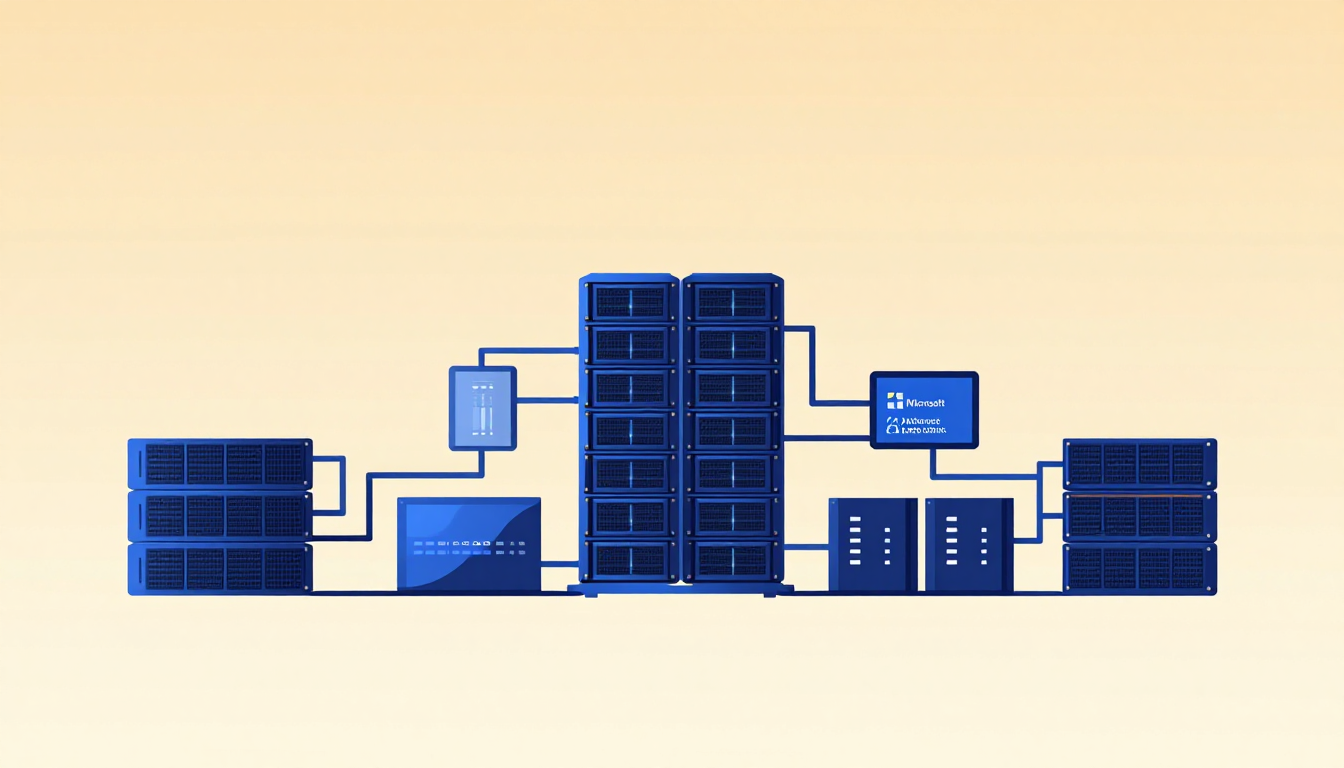
AMD’s Helios: A Rack-Scale Challenge to Nvidia’s AI Empire
AMD isn’t pulling punches anymore. At its sold-out Advancing AI conference in San Francisco on July 23, 2026, Chair and CEO Dr. Lisa Su took direct aim at Nvidia’s enterprise moat by unveiling Helios, a new rack-scale AI system engineered for the world’s largest AI labs. Scheduled to ship later this year, Helios represents AMD’s boldest bid yet to redefine how data center compute is packaged, interconnected, and deployed at scale.
Su called Helios the tech industry’s “highest-performance AI rack,” emphasizing that it was “built to train and run the most demanding frontier models in the world at massive scale.” The system will be deployed by leading AI companies at gigawatt-scale, a level of density that forces the entire data center ecosystem to rethink power distribution, cooling, and interconnect design.
The Rise of Rack-Scale Computing Over Discrete Nodes
Standalone server nodes simply won’t cut it for training multi-trillion parameter frontier models. Traditional data center setups—where discrete servers are networked over standard switches—introduce latency bottlenecks that starve high-throughput GPUs. Rack-scale systems solve this by treating an entire physical rack of processors, memory, and interconnect fabrics as a single, unified computing engine.
Helios combines multiple processing nodes, high-bandwidth memory, and high-speed fabrics within tightly integrated enclosures. This design maximizes bandwidth and minimizes the physical distance between chips, allowing data centers to process compute-intensive training and inference workloads without hitting network walls. First previewed in 2025 and showcased onstage at CES 2026, Helios was built from the ground up for gigawatt-scale deployments. For engineers managing massive cluster topologies, rack-scale delivery means faster provisioning, lower thermal overhead per flop, and far more predictable scaling curves.
Nvidia has historically dominated this market with its Vera Rubin and Grace Blackwell rack-scale systems. AMD is clearly looking to get in on the action. And Helios’ performance metrics appear to give it a real chance, beating out Vera Rubin by a number of metrics, according to reporting from The Register.
Hyperscaler Commitments: Microsoft, Anthropic, OpenAI, and Meta
AMD didn’t show up to San Francisco with mere promises—it brought an enviable list of enterprise customers. OpenAI, Meta, Oracle, Anthropic, and Microsoft have all committed to deploying Helios systems across their global infrastructure.
Microsoft CEO Satya Nadella confirmed that Azure will expand its core compute infrastructure using Helios racks. Meanwhile, Anthropic struck a strategic partnership with AMD to deploy up to two gigawatts of GPU capacity powered by the Helios architecture. These aren’t pilot programs. They’re multi-gigawatt commitments that signal hyperscalers are actively diversifying their AI hardware supply chains.
The hardware performance numbers back up the industry hype. According to reporting from The Register, Helios benchmarks beat Nvidia’s flagship Vera Rubin system across several key compute and efficiency metrics. In an environment where training cluster efficiency dictates competitive advantage, even marginal gains in performance per watt translate to tens of millions of dollars saved. AMD’s ability to demonstrate superior metrics against Nvidia’s newest architecture gives enterprise infrastructure buyers real leverage during procurement rounds.
Agentic AI and the $1.4 Trillion Accelerator Market
During her keynote, Dr. Lisa Su outlined a massive shift in how compute is consumed, projecting that the AI accelerator market will reach $1.4 trillion by 2030. That projection would place AI accelerators near the valuation of today’s entire global semiconductor market.
The primary catalyst behind this explosive demand isn’t basic chat completion—it’s agentic AI. Unlike traditional single-prompt models that generate output in a single pass, autonomous agents operate in long, multi-step loops. As Su put it: “When you ask the agent to do something, it actually has dozens of steps, and it has to reason, and it has to call tools, and it has to access data, and it has to keep doing it over and over until it solves the problem, and so you need lots of GPUs to do all that.”
This algorithmic complexity drives sustained GPU demand. Su highlighted that because these workloads are still very much in their infancy, GPUs will maintain their dominant share of the accelerator market due to their silicon programmability. “We do expect that GPUs are going to make up the vast majority of that market,” she said, noting that constantly evolving workloads favor adaptable hardware over fixed-function chips.
To support these future data center needs, AMD also previewed its next-generation Venice-X CPU, scheduled for launch in 2027. The Venice-X is designed specifically for data centers and high-computing workloads, complementing the Helios rack architecture with next-gen processing power.
What Helios Means for Data Center Infrastructure
The entry of Helios into high-density data centers signals a turning point for infrastructure architects and site reliability engineers. Operating gigawatt-scale racks isn’t just about plugging in faster chips; it requires rethinking power distribution, liquid cooling topologies, and interconnect diagnostics.
When clusters draw power at gigawatt scales, thermal dynamics and power delivery become the primary failure vectors. Infrastructure teams will need to balance compute density with cooling efficiency, managing workloads across heterogeneous clusters that now feature both Nvidia and AMD rack architectures. AMD’s aggressive push forces the entire ecosystem—from data center builders to orchestration software teams—to standardize around open, highly programmable rack-scale standards.
For engineering leaders, the arrival of Helios provides much-needed supply chain diversification while raising the bar for density and performance in next-generation AI infrastructure. The question isn’t whether rack-scale systems represent the future—it’s whether incumbents can pivot fast enough to stay relevant.