The Quiet Costs of Intelligence
If you’ve ever wondered why the human brain feels like both a miracle and a liability—equal parts genius and glitch—you’re not alone. What if the very thing that sets us apart—the sheer size of our cortex—also left us uniquely vulnerable to psychiatric conditions? That’s the provocative idea some neuroscientists have floated for decades: that schizophrenia and autism are, in part, the evolutionary cost of language, social complexity, and big thinking.
A 2014 study in Frontiers in Human Neuroscience tested this head-on, sifting through genomes across primates and beyond. The answer? Humans aren’t the sole carriers of these risk genes, and what we are carrying looks a lot like our closest relatives… with one surprising exception. Let’s dig into what that means for treatment, for evolution, and for how we think about mental illness in a species that can even ask the question.
The Animal Model Problem—And Why It Matters to You
For years, drug developers had no choice but to work in the dark. Psychiatric drugs are notoriously hard to test because animal models often fail to replicate human symptoms.
Why? Simple: we don’t really know what anxiety feels like to a mouse. Or whether a rat even experiences paranoia.
That’s why the question of evolutionary conservation—whether the same genes underpin brain disorders across species—mattered so much. Without it, every new antidepressant or antipsychotic was flying blind.
Here’s what changed: genome-wide association studies (GWAS). These large-scale scans identified hundreds—over 7,500, to be exact—of genes linked to schizophrenia alone. Of those, more than 700 were high-priority candidates for this study. For autism? Over 500 genes entered the mix. Crucially, many overlapped between disorders.
That overlap turned out to be the key to testing the “big brain tax” theory: if these genes only emerged after humans split from other apes, then maybe they’re a by-product of our special cognitive edge.
Turns out—they’re not. At least, not entirely.
Chimps, Dolphins, and the Myth of the Unique Human Illness
The research team cast a wide net: nine primate species (chimpanzee, bonobo, gorilla, orangutan, gibbon, macaque, baboon, marmoset, squirrel monkey), plus dozens of mammals. You name it—hedgehog, armadillo, manatee, rhinoceros, dolphin—you get the picture.
The headline finding? The relative frequency of schizophrenia and autism risk genes didn’t spike in Homo sapiens compared to our ape cousins. That’s a bit of a relief—means these variants aren’t uniquely human “bugs” in the system.
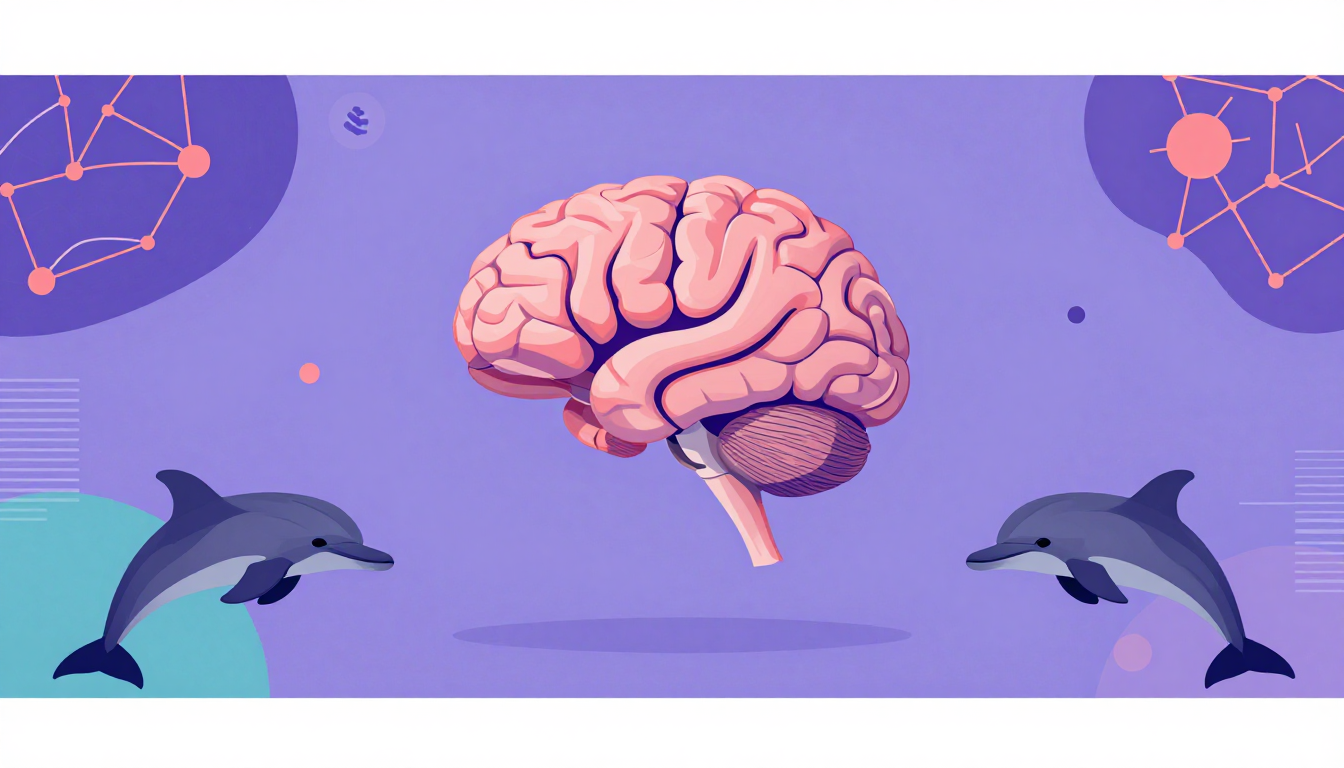
There’s a catch, though: the same genetic patterns weren’t evenly spread. One lineage stood out—Tursiops truncatus, the bottlenosed dolphin.
Yes, dolphins showed significantly different evolutionary constraints on those very same genes. Why? Because toothed cetaceans and primates share a curious parallel: both evolved big brains for social reasons. Not just bigger, but smarter socially—complex communication, group coordination, cultural learning.
If you’ve ever seen a dolphin pod coordinate hunting or recognize themselves in a mirror, you’ll appreciate that this isn’t accidental. Their neural complexity evolved along similar pathways to ours—and with the same trade-offs.
Language, Sociality, and the Genetic Trade-Off
The theory linking brain expansion to psychiatric vulnerability wasn’t pulled out of thin air. In fact, it goes back at least to Terrence Crow’s 1997 paper in Schizophrenia Research, where he proposed that schizophrenia might be the “price we pay for language.”
Think about it: language requires precise timing, theory of mind, and the ability to hold abstract symbols in working memory. Faulty connectivity or dysregulated neurodevelopment can cascade quickly—especially when the system is operating at maximum load.
The data supports this. The genes under selection during human brain expansion overlap heavily with those tied to autism and schizophrenia. It’s not that these disorders caused language or intelligence; rather, the genetic architecture enabling those traits appears brittle when perturbed.
But here’s where it gets interesting: dolphins don’t talk like us, and yet their genome shows signs of the same selective pressure on neural genes. Could they, too, face a different expression of neurodivergent traits—just not diagnosable with our DSM criteria?
Are Mental Illnesses Uniquely Human? A Hard No.
The short answer: no. Mental illnesses aren’t uniquely human, even if our diagnostic labels often are.
What makes this tricky is behavior. How do you tell if a dolphin has depression? A mouse, hallucinations? We lack the behavioral proxies to map onto our clinical definitions.
But genes don’t lie. And if the same risk loci appear across primates and cetaceans, then the biological substrate for these conditions is deeply rooted—older than our species.
The takeaway? Psychiatric disorders aren’t modern failures. They’re ancient vulnerabilities baked into complex brains—something we share with whales, apes, and probably more species than we’ve yet considered.
So What Does This Mean for Treatment?
If these disorders aren’t uniquely human, then animal models can be valid—if chosen wisely. That’s a big deal.
Right now, most rodent models hit the same wall: high failure rates in human trials. Maybe it’s time we looked beyond mice. Dolphins, for all their logistical challenges, represent a natural experiment in independent brain expansion. If their neural wiring parallels ours—and their risk genes match—then they’re worth studying, even if just to spot where the divergences occur.
Plus, this reframing shifts blame. Schizophrenia and autism aren’t just “broken circuits.” They’re the flip side of enhanced cognition—traits we celebrate in one context, struggling with in another. That framing matters for stigma, for care, and for funding.
The Bottom Line: Evolution Doesn’t Optimize—It Compromises
Natural selection doesn’t seek perfection. It keeps what works enough—what gets you to reproduce before the wolves show up. Our brains, brilliant as they are, reflect that trade-off: faster processing, deeper empathy, longer childhood—but also higher failure modes when development slips.
The data suggests that mental illness isn’t a design flaw; it’s the expected wear-and-tear of running high-performance hardware at the edge of its limits. The fact that dolphins show similar patterns tells us this isn’t a human quirk—it’s a shared burden of complexity.
So next time someone asks if mental illness is just modern stress, you’ve got something more compelling to say: no. It’s the price we pay for having big, interconnected brains—and maybe it’s a price all socially intelligent mammals share.