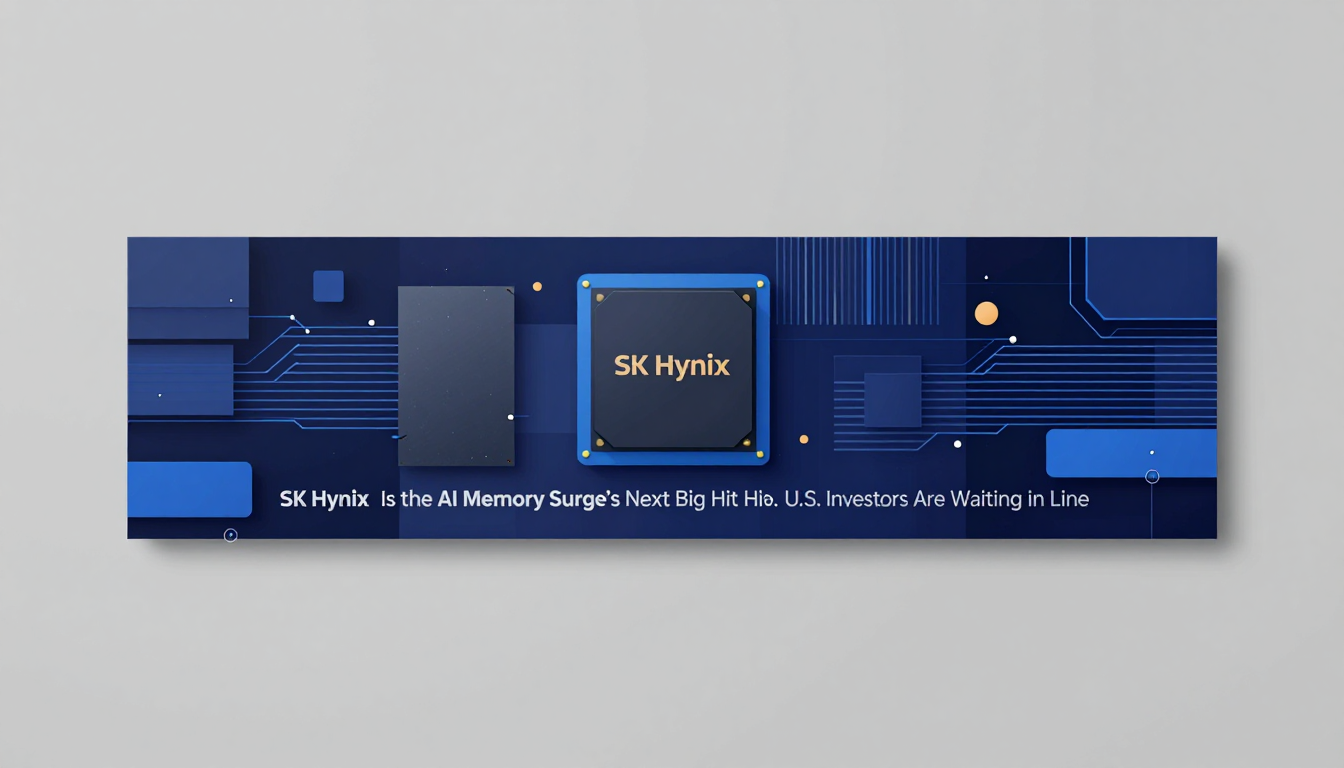
The AI Memory Rush Has a New Star
If you’ve shopped for a laptop or phone lately, you already feel it—the sting of a price tag that seems to keep climbing with every config option. That’s RAMageddon, and it’s not just annoying—it’s a structural shift in the tech economy.
South Korea’s SK Hynix isn’t just catching that wave. It’s building its own surfboard and heading for the breakers of Wall Street.
On Monday, the company confirmed plans to sell nearly 17.8 million shares in a U.S. IPO, raising as much as $28 billion through American depositary receipts (ADRs). Each ADR represents just a tenth of a common share, making this one of the rare cross-Pacific capital raises that actually matters to everyday investors. The pricing event is scheduled for Thursday, with trading beginning Friday.
You don’t have to be a chip expert to get why this matters. When AI models run, they guzzle memory the way a sprinter guzzles oxygen. High-bandwidth memory (HBM), DRAM, and NAND flash are the invisible muscles behind every LLM training run, every video-generation pipeline, every real-time summarizer. And SK Hynix—alongside Samsung and Micron—controls the taps.
Like its U.S. counterpart Micron, SK Hynix has seen revenue and stock price spike in tandem with AI hype. First-quarter revenues jumped nearly 200% year-on-year, and the stock has surged roughly 260% so far this calendar year. It’s no surprise investors see SK Hynix as the closest thing to a “Nvidia for memory,” especially after Micron’s own 700% run and $1 trillion+ valuation.
But here’s the catch: SK Hynix isn’t just waiting for demand to arrive. The company and its peers have committed over $550 billion to new manufacturing capacity. That’s a lot of money—and if the AI hardware cycle turns faster than the fabs come online, you’re looking at excess supply and souring margins in short order.
Which is why this IPO isn’t just about capital. It’s a bet that memory demand will keep outpacing even the most optimistic supply forecasts for at least the next three to five years.
From Seoul to Silicon Valley, in Ten Shares
ADRs are ancient tech—think of them as international stock wrappers that let U.S. brokers trade foreign shares without sending wires to Korea on a Friday afternoon. But when SK Hynix started shopping its ADR deal, it wasn’t pulling the old playbook out of the vault. It was launching a targeted charm offensive on U.S. asset managers who still think Korean equities are all about Samsung and Hyundai.
The offering will list on a major U.S. exchange (likely the NYSE), and early indicators suggest strong demand. Bloomberg’s reporting puts the raise at $28 billion, which—given SK Hynix’s last Friday closing price in Seoul—is plausible if the placement book runs hot.
Here’s why that matters: U.S. investors haven’t had direct access to a major Korean memory player since Samsung’s last big refiling. SK Hynix is filling that gap with cleaner financials, a sharper focus on AI-specific memory products, and a management team that’s been training for this moment. Analysts are already calling it the most significant Korean IPO since 2019.
If you’ve watched Micron’s valuation balloon, this is SK Hynix’s chance to prove it can match that premium—without the geopolitical baggage of being the nation’s largest conglomerate. This IPO isn’t about raising capital to survive; it’s about raising capital to dominate the next phase of AI infrastructure.
RAMageddon Isn’t a Trend—It’s a Tax
Let me be blunt: you’re paying for AI whether you realize it or not.
Every $20 price bump on your next laptop, every skipped-upgrade on your smartphone, every forced leap to a higher-tier MacBook Air—it’s not inflation, and it’s not greed (not entirely). It’s memory.
DRAM accounts for roughly 30% of a budget smartphone and nearly a quarter of an entry-level laptop’s BOM. When SK Hynix and its peers divert supply to hyperscalers like Amazon, Microsoft, Google, and Oracle—who are building entire data center cities dedicated to AI—the consumer tier feels it. That’s RAMageddon in a nutshell: an infrastructure race that leaves everyday devices behind.
It’s not just memory, either. NAND flash (your SSD) is suffering the same diversion effect as manufacturers shift yield to higher-margin AI SKUs. Even entry-level processors are getting squeezed as wafer capacity pivots toward high-end chips for data centers. As Gartner’s Ranjit Atwal put it, the sub-$500 PC segment may simply disappear by 2028—not because no one wants it, but because the numbers no longer add up.
Apple’s move to hike MacBook Air prices and double minimum storage wasn’t capricious; it was survival. The company waited out the early parts of the memory squeeze, but as Micron stopped shipping consumerDRAM entirely and SK Hynix’s AI allocation grew, the math collapsed.
The 500 Billion Dollar Question: Will Memory Prices Ever Normalize?
Here’s what SK Hynix’s own roadmap hints at: the shortage could last until 2030. That’s not a typo, and it’s not hyperbole.
Samsung and Micron are locked in similar capacity ramps. The new fabs won’t come online until 2027 at the earliest, and by then AI workloads will have doubled—or tripled—again. That’s why SK Hynix’s IPO timing is everything: it locks in investor confidence now, before the market starts to question whether supply can ever catch up.
TechCrunch asked Julie Bort what hyperscalers were doing to hedge—her answer boiled down to “lock in supply and pray.” Some have signed multi-year offtake agreements, buying chips years before they’re produced. Others are co-investing in SK Hynix’s own fab expansions to secure priority allocation.
But here’s what no one wants to say outright: even with $550 billion in new capacity, demand may outpace it. AI training runs grow larger, memory bandwidth requirements spike with every new GPU generation, and edge AI pushes fresh use cases into smartphones and laptops that need just as much punch but in a much smaller footprint.
SK Hynix’s ADR offering isn’t just a IPO. It’s a signal flare: the company is betting its next chapter on AI memory being not just a component, but the central bottleneck—and it wants investors to stake their claim before the rest of Wall Street wakes up.
Don’t Blink—This IPO Won’t Wait
SK Hynix isn’t floating a quiet test balloon. It’s throwing open the doors, and investors who hesitate will watch from the sidelines as ADRs price and trade without them.
For retail investors, this is a rare chance to get in on Korean tech without the megacap premium of Samsung. For institutional buyers, it’s a strategic hedge against further memory price inflation and AI hardware under provisioning.
Whether this turns into the next Nvidia-like story or just another short-term play depends on one thing: whether AI’s appetite for memory outpaces SK Hynix’s ability to feed it. Given that the company and its partners have already committed $550 billion, the answer is—right now—a qualified yes.
This IPO isn’t about raising money for SK Hynix. It’s about letting you raise the money to buy its ADRs before Friday’s pricing sets the stage for months—perhaps years—of AI hardware growth.
Don’t miss your seat on the express train just because the tickets are going fast.