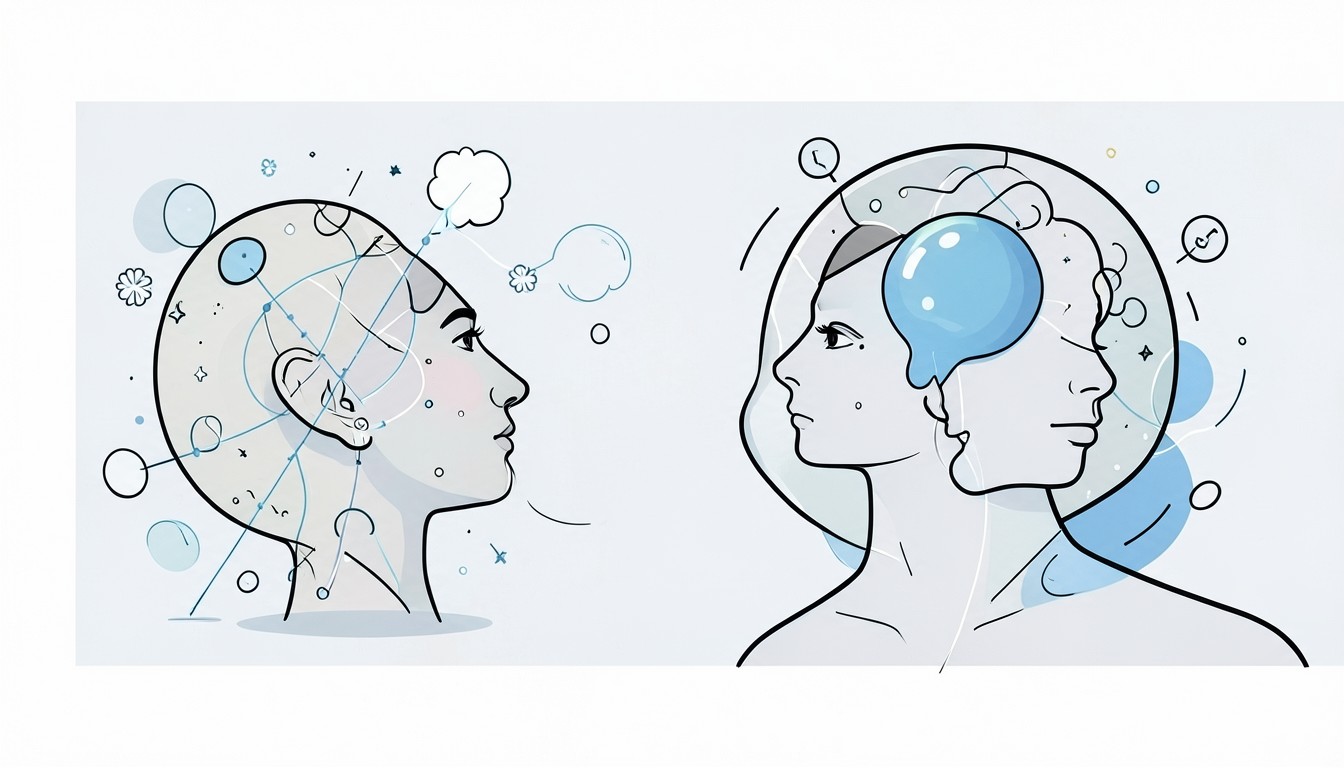
When a model predicts patterns of brain activity, it is tempting to call that mind-reading. TRIBE is more interesting—and more scientifically useful—when described precisely. Meta’s foundation model is designed to predict how fMRI activity responds to visual, auditory, and language-related input. It offers researchers a way to test models of sensory processing computationally, not a transcript of a person’s private thoughts.
That distinction matters for the AI impact on human psychology. Psychology concerns behavior, experience, cognition, and their contexts; a predicted fMRI response is one kind of evidence about the brain, not a complete account of a person. TRIBE may help researchers ask better questions about how sensory information is represented. It does not settle what someone feels, believes, or intends.
What is AI in psychology—and can AI understand human psychology?
AI in psychology is a broad label for computational systems used to analyze or model psychological data: language, behavior, task performance, or physiological signals. Some tools classify patterns or forecast outcomes; others simulate aspects of perception or cognition. Their usefulness depends on the quality of the data, the design of the task, and whether results generalize beyond the people and settings represented in training.
Can AI understand human psychology? Not in the expansive, human sense implied by “understand.” A model can learn regularities in data and produce predictions that help researchers test a hypothesis. It does not follow that the model has subjective experience, knows an individual’s inner life, or can diagnose a mental-health condition from a brain scan. TRIBE’s stated domain is narrower: predicting fMRI responses to sensory stimuli. Its output is a research estimate, not a psychological interpretation on its own.
This makes the “best AI for human psychology” the wrong question if it suggests one universal tool. A model should be judged against a specific research purpose, an appropriate comparison, and independent validation. TRIBE is relevant to brain-response modeling; that does not make it a general-purpose psychology assessor.
How TRIBE turns sensory input into predicted brain activity
TRIBE—short for TRansformer for In-silico Brain Experiments—is a foundation model developed by Meta’s Fundamental AI Research team. The reported work trains a transformer-based system using fMRI data associated with people viewing movies and listening to podcasts. Those naturalistic stimuli combine visual, auditory, and language content in ways that are less constrained than a single isolated image or sound.
The model’s task is to map properties of an input stimulus to patterns of brain response measured with fMRI. In that sense it is an encoding approach: given input, estimate the corresponding neural response. This differs from starting with a brain signal and trying to reconstruct a person’s thoughts or the precise stimulus they experienced. The difference between encoding and decoding is not just terminology; it defines what the system is being evaluated to do.
The source reports a 70-fold increase in resolution compared with previous state-of-the-art systems. That figure describes a technical comparison in the reported modeling context. It should not be translated into “70 times better understanding” of a person. Finer-grained predicted activity may let researchers examine more detailed distinctions in response patterns, but the meaningfulness of those distinctions still depends on measurement, validation, and the question being asked.
The report also describes zero-shot capability: predicting responses for new individuals or languages without task-specific retraining. This is a potentially useful generalization property, not a guarantee that every new person, language, or scanning setup will be modeled equally well. Generalization claims need to be read in the context of the tested data and evaluation protocol.
In-silico neuroscience: a virtual experiment, not a virtual person
In-silico neuroscience means using computational models to run or explore experiments in a computer. TRIBE could let a research team generate predictions for candidate sensory inputs and compare them with hypotheses before committing to a new scanning study. That may help prioritize experiments and explore how a model represents different kinds of stimuli.
The metaphor of a “digital twin” can obscure an important point. TRIBE is not a complete replica of a particular person’s brain. It is a model trained to capture relationships between stimuli and fMRI responses in the data it has seen. A virtual prediction can suggest where to look; it cannot replace the empirical check that a real participant’s measured response provides. Researchers still need carefully designed studies, suitable participants, and transparent reporting of uncertainty and limitations.
There is a practical payoff if the predictions are useful: computational exploration can be faster and less costly than collecting a new fMRI dataset for every preliminary idea. But virtual runs do not create new biological evidence by themselves. Their value lies in helping researchers choose which questions and experiments deserve real-world testing.
What is a brain-computer interface, and how does it work?
A brain-computer interface (BCI) is a system that links measured brain signals to an external device or computer. In a typical BCI pipeline, sensors record signals, software extracts patterns associated with a task or intention, and a decoder maps those patterns to commands—for example, selecting a cursor direction. The details vary substantially by signal type, hardware, training protocol, and intended use.
TRIBE is not itself a BCI and does not, on the evidence described here, turn thoughts into commands. Its relevance is indirect: better models of how sensory input relates to brain activity could contribute methods or hypotheses for future neurotechnology research. Moving from predicting fMRI responses to a usable interface would require additional steps, including a clearly defined signal and task, robust decoding, testing with intended users, and clinical or engineering validation appropriate to the application.
This distinction helps keep the promise of neurotechnology grounded. A model that predicts a response to a movie or podcast is not automatically capable of decoding communication or controlling a device. Those are different scientific and technical problems.
Implications for neuroscience and mental-health research
For neuroscience, a model like TRIBE may serve as a computational partner: researchers can compare predicted response patterns across sensory conditions, refine hypotheses about representation, and decide which experiments could discriminate between competing explanations. Its multi-modal training context is relevant because ordinary perception rarely arrives as a neatly separated stream of images, sounds, and words.
For neuroscience mental-health research, the most responsible near-term contribution is methodological rather than diagnostic. Researchers may use improved modeling to study sensory processing or to formulate new questions about brain function. The reported findings do not establish TRIBE as a clinical tool for diagnosing neurological or psychiatric disorders, nor do they show that a prediction can explain an individual’s symptoms. A path from basic model to clinical application would require evidence specific to that condition and use case.
The distinction also matters ethically. Brain data can be sensitive, and future systems that infer more from neural signals will demand careful governance, consent, privacy protections, and limits on secondary use. Those questions are not answered by a model’s technical performance. They should be part of the research conversation as neurotechnology advances. For a related look at how researchers investigate brain circuits and behavior, see advanced chemogenetic methods.
A useful advance with boundaries
TRIBE’s significance is not that it has solved human psychology. It is that a foundation model may make it easier to model how sensory inputs correspond to fMRI responses and to explore some research questions in silico. The reported resolution gain and zero-shot results are promising technical claims, while their broader meaning depends on validation and the boundaries of the data.
For readers asking about the AI impact on human psychology, the careful answer is that AI can help researchers model selected aspects of brain activity—not stand in for a person’s experience. TRIBE offers a tool for studying brain responses and potentially informing later neurotechnology work. Its predictions are a starting point for experiments, not the last word about what a human mind means.
Source