
The Idea That Won't Die
Siting datacenters on or under water has been a recurring fantasy in tech for over a decade, and yet here we are — multiple projects operational or under construction, with serious capital behind them. The Register's Dan Robinson captured the mood in June 2026: "Siting datacenters either on the water or underwater is an idea that just won't sink, and there is increasing interest in it, despite the obvious fact that water and IT equipment are a potentially disastrous combination."
The core attraction is brutally simple: water offers virtually limitless natural cooling for GPU-heavy AI workloads. As datacenters push into the multi-hundred-megawatt range, land-based thermal management is becoming a binding constraint. The ocean doesn't care how many exaflops you're running — it just absorbs the heat.

China's Underwater Breakthrough
The most concrete recent development is an underwater facility off the Chinese coast, operated by Beijing-based Highlander Digital Technology. First disclosed last October and now operational, it runs at 24 megawatts — roughly half the average US datacenter size — and draws more than 95% of its power from a nearby offshore wind farm.
Clients include China Telecom and a state-owned AI computing company. The project is part of Beijing's broader push to lower the carbon footprint of its rapidly expanding compute infrastructure. This isn't a prototype; it's live, serving production workloads.
Microsoft's Surprising Success — and Silence
Long before China moved, Microsoft ran Project Natick: a prototype submerged off California in 2015, followed by Phase II near Scotland in 2018. The Scottish trial housed 12 racks with 864 servers on the seabed.
When Microsoft hauled it up in 2020, the results were striking: failure rates one-eighth those of a comparable land-based cluster. The sealed, pressurized, corrosion-resistant enclosures actually outperformed traditional datacenters in reliability.
Yet Microsoft declared the experiment a success and walked away — never fully explaining why. The likely culprits: maintenance access is enormously harder underwater, power delivery to a submerged enclosure is non-trivial, and land-based facilities remain simply more convenient for most operators. The data said "it works"; the logistics said "not worth scaling."
The Floating Contenders
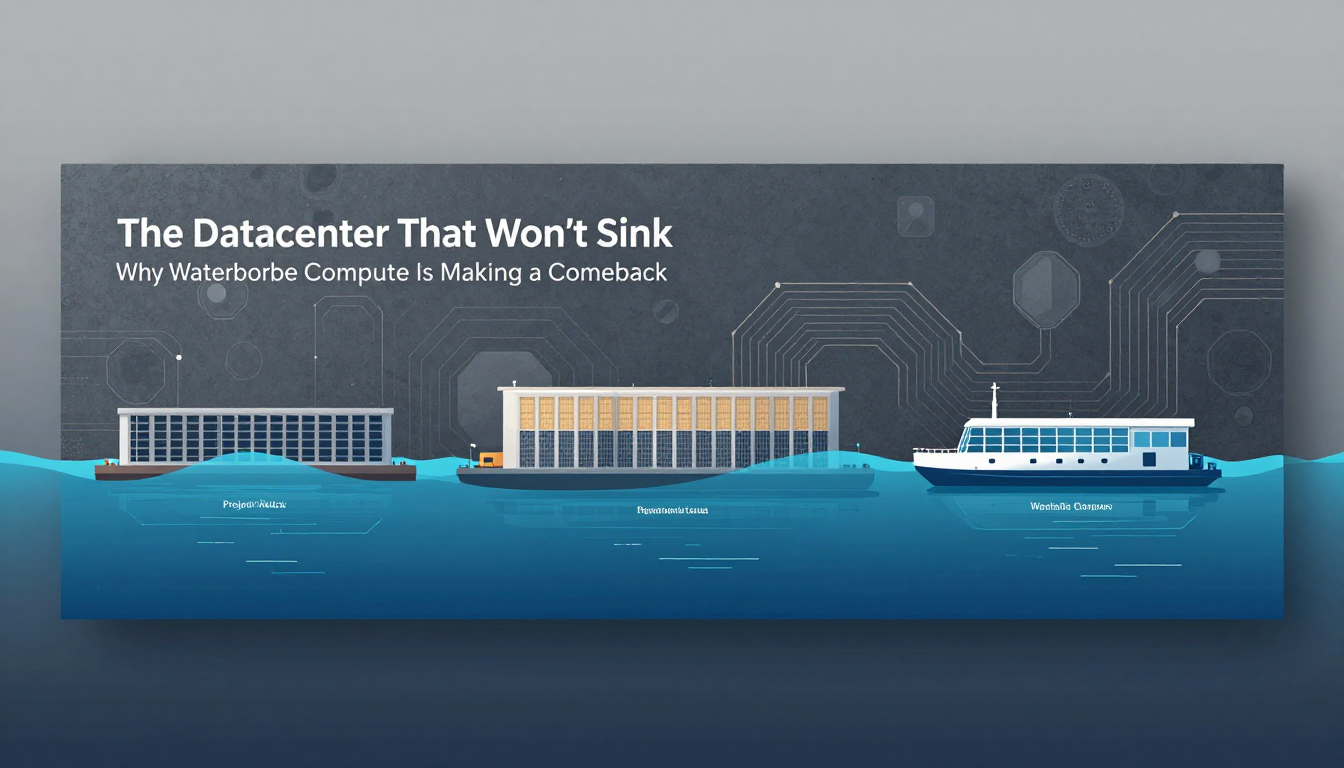
A different approach — floating datacenters on barges or retrofitted ships — is gaining more traction than the submerged model:
Nautilus Data Technologies made bit barges real with facilities in Marseille, France, and Stockton, California. The Stockton site is still operational at 6.5 MW of IT load capacity, though Nautilus has since pivoted to its EcoCore line of AI infrastructure.
Mitsui OSK Lines (MOL) and Hitachi signed an MoU to convert a second-hand vessel into a floating data hall, targeting operations in 2027. Initial plans called for a 120-meter ship supporting 20–73 MW; the Hitachi partnership may involve a larger vessel. Onboard systems — air conditioning, water intake, power generation — service the IT infrastructure directly.
Samsung Heavy Industries (covered separately) is building purpose-built floating datacenters from scratch, targeting 50 MW per unit with a 2028 launch.
Google toyed with the concept in 2013 after patenting a floating facility design in 2008, but abandoned it — reportedly finding federal maritime safety regulations too burdensome in time and cost.
The Wild Card: Panthalassa
Perhaps the most audacious concept comes from Panthalassa, a Portland, Oregon startup backed by Peter Thiel. They're developing wave-powered floating structures designed to operate autonomously in the deep ocean, connected to the outside world via SpaceX's Starlink satellite network.
New Scientist raised legitimate questions: saltwater and wave action are devastating to machinery, and Panthalassa didn't respond to inquiries about what happens when something breaks in the middle of the ocean, or how satellite latency affects production workloads. It's high-risk, high-reward — and currently more vision statement than engineering plan.
The Hard Limits
Despite the enthusiasm, waterborne datacenters face structural constraints that make them unlikely to compete with multi-gigawatt land-based facilities:
- Scale: Hyperscalers like Meta (planning the Hyperion facility) are building massive multi-gigawatt sites. Stuffing servers onto barges or ships can't match that scale or its economies of density.
- Power: Getting enough electricity to an offshore or underwater installation remains expensive and complex, even with adjacent wind farms.
- Maintenance: Underwater facilities require specialized subsea operations. Floating units face hull integrity, mooring, and maritime safety challenges.
- Regulation: Maritime safety compliance, environmental permits, and coastal zoning add time and cost that land-based builds simply don't face.
Where Waterborne Compute Actually Wins
The realistic niche for waterborne datacenters isn't replacing land-based hyperscale — it's serving markets where land itself is the constraint. Singapore, severely land-constrained, is already exploring barge-based solutions including floating hydrogen power plants to serve shore-side facilities. Coastal cities with limited expansion room, island nations, and regions with abundant offshore wind but scarce buildable land are the natural fit.
The verdict: waterborne datacenters won't dominate AI infrastructure. But they're no longer a novelty either — and in the right geography, they might be the only option.