
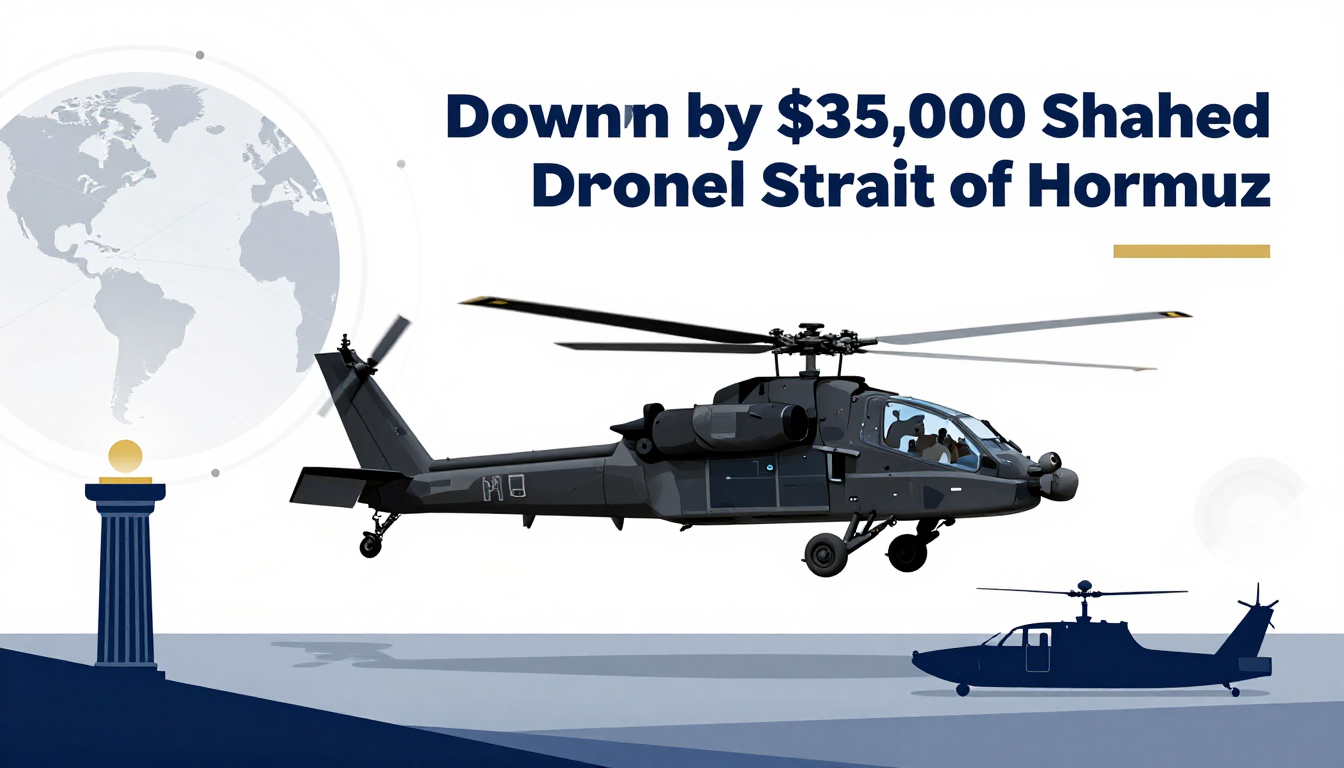
US Army Apache Helicopter Downed by Iranian Drone Near Strait of Hormuz
On June 8, 2026, a US Army AH-64 Apache helicopter was struck and downed by an Iranian Shahed drone near the Strait of Hormuz, marking a pivotal moment in the ongoing conflict between Iran and US-led forces. The incident represents the first US Army Apache helicopter to be lost during the conflict—and reportedly the first such helicopter ever taken down by a drone.
The Apache, a $25 million battlefield workhorse, was struck mid-air by what initial reports describe as an Iranian Shahed-type drone. The downing occurred during a patrol mission above the strategic waterway that connects the Persian Gulf to the Arabian Sea, a region that has become increasingly contested since February 28, 2026, when the United States and Israel launched joint military operations against Iran.
A New Phase in Asymmetric Warfare
The incident has reignited critical discussions about the asymmetric nature of modern warfare. A drone reportedly costing approximately $35,000 managed to destroy a helicopter valued at $25 million—a stunning cost disparity that underscores the strategic implications of unmanned aerial systems in contemporary conflict zones.
This outcome has led military analysts to reassess the vulnerability of traditional high-value platforms to relatively inexpensive, swarm-enabled drone tactics. The AH-64 Apache, renowned for its firepower and agility in close air support roles, faced a threat that does not require pilot survival systems or complex avionics—only a $35,000 airframe equipped with GPS guidance and basic targeting systems.
The concept of asymmetric warfare is not new; throughout history, weaker adversaries have sought to neutralize superior military forces through unconventional tactics. From guerrilla warfare to terror attacks, the principle of exploiting an opponent's strengths against them has defined military strategy for centuries. What is new is the scale and precision with which such asymmetry can be achieved through modern drone technology.
The cost ratio of over 700:1 in favor of the attacker represents a paradigm shift in military economics. Traditional defense planning has been based on maintaining qualitative advantages through expensive, high-end platforms like the Apache, F-35 fighter jets, and aircraft carriers. However, the drone battlefield challenges this model by enabling adversaries to create overwhelming numbers with relatively inexpensive platforms.
This shift has several critical implications:
- Force Protection: The threat to high-value platforms means that operations may need to be conducted at greater distances, potentially reducing effectiveness
- Sustainment: The economics of attrition warfare favor the side with lower-cost platforms
- Technological Response: New defense technologies like directed energy weapons (lasers) and electronic warfare systems become more attractive as they can engage multiple low-cost threats at lower cost per engagement
- Force Structure: Future military planning may need to balance high-end platforms with large numbers of less expensive, distributed systems
For more on how drones are reshaping modern combat, see our coverage of drone warfare tactics and the strategic implications for military procurement.

Shahed Drones: Capabilities and Evolution
Iran has fired thousands of Shahed drones against a wide range of military and civilian targets in the Gulf region since February 28, 2026. However, these drones have mainly struck stationary targets such as Amazon data centers and energy facilities. They have occasionally hit slow-moving commercial ships in the Strait of Hormuz, but engaging fast-moving, maneuvering aircraft like the Apache represents a significantly more difficult tactical challenge.
The basic models of Iranian Shahed drones rely on GPS satellite guidance and preprogrammed coordinates to strike stationary targets from long range. They are not usually designed to track and strike moving targets, a capability that requires sophisticated real-time remote operation or advanced autonomous navigation systems. The basic Shahed-130/136 series, for example, has an operational range of approximately 2,500 kilometers (1,550 miles) and can carry a payload of 30-40 kilograms (66-88 pounds) of explosives.
Mark Cancian, a senior adviser with the Center for Strategic and International Studies in Washington, DC, noted in an interview with The New York Times that while traditional Shahed drones are suited for stationary targets, there is growing concern that Iran may have received newer Russian-modified versions capable of remote operation to strike moving targets. This possibility, if confirmed, would represent a significant escalation in Iran's drone warfare capabilities.
The question of whether the drone that downed the Apache was a basic model operating on preprogrammed coordinates or an advanced variant with real-time human control remains central to understanding the incident. If it was a modified version, this would indicate that Iran has gained access to advanced Russian drone technology, which could have far-reaching implications for regional security.
For more on Iran's drone program and its evolution, see our detailed analysis of Iranian drone capabilities.
The Drone Technology Arms Race
The conflict in the Gulf region has become a testing ground for drone technology, with all sides rapidly developing and deploying new capabilities. Iran's drone program has evolved significantly since the 2019 attacks on Saudi oil facilities, with improvements in range, payload, and guidance systems.
Russia's involvement in the drone arms trade to Iran represents a significant escalation. Russian-modified Shahed drones with enhanced capabilities would provide Iran with more sophisticated strike options, potentially including features such as:
- Real-time remote piloting for dynamic target engagement
- Improved GPS jamming resistance
- Enhanced collision avoidance and terrain-following capabilities
- Swarm coordination features for coordinated multi-drone attacks
The United States and its allies have been developing counter-drone technologies including:
- Electronic warfare systems to jam drone control signals
- Directed energy weapons (lasers) for rapid engagement
- Radar systems specifically tuned to detect small, low-flying objects
- Defensive drone swarms for intercepting incoming threats
The downing of the Apache helicopter, whether accidental or intentional, underscores the urgency of these counter-drone efforts and the rapidly evolving nature of modern warfare.
For deeper insights into counter-drone technologies, see our coverage of military drone defense systems.
The Drone Boat Rescue: A Technical Marvel
The crew of the downed Apache helicopter survived the incident thanks to what military officials describe as an unprecedented use of a drone boat for rescue operations. This innovative approach to combat search-and-rescue operations demonstrates how asymmetric assets can also be used for defensive and humanitarian purposes.
The use of an unmanned surface vessel to reach the downed pilots in the waters near the Strait of Hormuz represents a novel application of drone technology that has been developed in recent years. The operation's success highlights the complementary nature of different drone systems—air, surface, and subsurface—in modern military operations.
The Growing Tally of US Military Aircraft Losses
This incident represents the first US Army Apache helicopter to go down during the conflict—and apparently the first such helicopter to be taken out by a drone. The United Arab Emirates and Israel had been using their own US-supplied Apache helicopters to hunt and shoot down Iranian Shahed drones with notable success in preceding months.
However, Iran had previously succeeded in shooting down an F-15E Strike Eagle fighter jet and an A-10 Thunderbolt ground-attack aircraft on April 5 and April 6, respectively, using ground-launched missiles. All crew members were rescued from those incidents, though the US military had to mount a risky combat search-and-rescue operation to retrieve the F-15 fighter jet's weapon systems officer from the Zagros Mountains in Iran.
Iran has also shot down dozens of US MQ-9 Reaper drones used for surveillance that can each cost more than $30 million. Other US military aircraft have sustained damage during combat operations over Iran or while sitting on the ground at air bases targeted by Iranian missile and drone attacks, according to a tally compiled by the Congressional Research Service.
F-15E Strike Eagle Losses
The F-15E Strike Eagle, a twin-engine all-weather tactical fighter jet, is one of the most capable combat aircraft in the US arsenal. Each F-15E costs approximately $120 million when fully equipped with mission-specific avionics and weapons.
The Strike Eagle that was shot down on April 5 was conducting a strike mission against Iranian air defense installations when it was hit by a surface-to-air missile. The aircraft managed to fly some distance before the pilot ejected, but the weapon systems officer remained in the cockpit and was seriously injured.
The combat search-and-rescue operation to retrieve the officer from the Zagros Mountains in Iran was described by military officials as extremely high-risk, involving multiple helicopters and fighter jets providing cover. The operation ultimately succeeded but highlighted the dangers of CSAR missions in contested environments.
MQ-9 Reaper Losses and Implications
The MQ-9 Reaper, often called the 'Hunter-Killer' drone, is a medium-altitude, long-endurance unmanned aerial vehicle used primarily for surveillance and precision strike missions. Each Reaper costs between $20 million and $35 million depending on the configuration.
Iran's success in shooting down dozens of MQ-9 Reapers is particularly concerning because:
- Intelligence Loss: Each lost Reaper represents the loss of valuable intelligence-gathering capability and potentially sensitive data
- Operational Tempo: Frequent losses can degrade the ability to maintain continuous surveillance over target areas
- Cost and Manpower: Replacing lost drones and training new operators represents a significant investment
- Force Protection: The loss of any US military asset increases pressure for political resolution of conflicts
The high attrition rate of MQ-9 Reapers has prompted the US military to accelerate development of more survivable reconnaissance platforms and to reconsider the deployment strategy for drones in contested environments.
For context on how drone losses are reshaping US military strategy, see our coverage of MQ-9 Reaper operational challenges.
Investigating Intent: Accident or Advanced Capability?
US military investigators are still evaluating whether the Iranian drone strike on the Apache helicopter was intentional or accidental. An unnamed US government official told Axios correspondent Barak Ravid that an Iranian drone had hit the US Army AH-64 Apache helicopter before it went down on June 8.
The New York Times later confirmed this reporting through more anonymous US officials, including one who said military investigators were still determining whether the strike was deliberate or a fortunate accident for the drone operators.
Determining intent is critical for several reasons:
- If the strike was accidental, it suggests that Shahed drones are becoming more numerous and persistent in contested airspace, increasing the likelihood of accidental hits on high-value targets
- If intentional, it would indicate that Iran has acquired or developed new drone capabilities specifically designed to counter moving targets
- The distinction affects threat assessments, defense planning, and potential responses
The investigation is ongoing, with analysts examining telemetry data, drone wreckage, and any surviving communication signals to reconstruct the event timeline.
Strategic Implications for Regional Security
The downing of the Apache near the Strait of Hormuz has significant strategic implications for regional security. The Strait is one of the world's most critical chokepoints, through which approximately 20% of the world's oil supply passes. The ability to threaten high-value military assets in this confined waterway demonstrates Iran's capacity to disrupt international trade and military operations alike.
The incident also highlights the vulnerability of US military forces in the region to asymmetric threats. While the United States maintains overwhelming conventional military superiority, the cost-exchange ratio favoring defenders has shifted dramatically in recent years. A $35,000 drone destroying a $25 million helicopter represents an exchange ratio of more than 700 to 1 in favor of the attacker—a statistic that has profound implications for military procurement and deployment strategies worldwide.
Impact on Gulf Regional Security
The Strait of Hormuz incident has significant implications for regional security dynamics:
- Freedom of Navigation: The ability to threaten military assets in the Strait challenges the principle of freedom of navigation, a cornerstone of international maritime law
- Alliance Dynamics: The incident may strengthen alliance ties between the US, Gulf states, and Israel as they face a shared threat
- Deterrence Calculus: The cost asymmetry changes the calculus for both deterrence and escalation
- Regional Arms Race: The incident may trigger a new round of arms procurement as Gulf states seek counter-drone capabilities
Gulf Cooperation Council (GCC) states are likely to reassess their own defense postures in light of this incident, potentially accelerating existing programs for drone defense and asymmetric capability development.
Global Military Implications
The cost-exchange ratio demonstrated in this incident has global implications for military planning:
- US Defense Posture: The US may need to reconsider the deployment of high-value assets in contested environments
- Allied Forces: NATO and other allied forces may need to adapt their doctrine for asymmetric threats
- Defense Budgets: Military budgets worldwide may shift toward counter-drone technologies and distributed force structures
- Technological Race: A new arms race in drone technology and counter-drone systems is likely to accelerate
The incident serves as a wake-up call for militaries worldwide that have relied on conventional superiority and high-cost platforms. As drone technology continues to evolve, the balance between offense and defense may need to be recalibrated.
Economic Implications for Global Energy Markets
The Strait of Hormuz incident also has implications for global energy markets:
- Oil Price Volatility: Any threat to the Strait can cause immediate spikes in oil prices
- Insurance Costs: Marine insurance premiums for shipping through the Strait may increase significantly
- Alternative Routes: The incident may accelerate development of alternative energy transport routes
- Strategic Reserves: Countries may increase reliance on strategic petroleum reserves as a buffer against disruption
For more on the economic dimensions of Middle Eastern conflicts, see our coverage of energy security and oil markets.