
The Crutch of Instant Verification
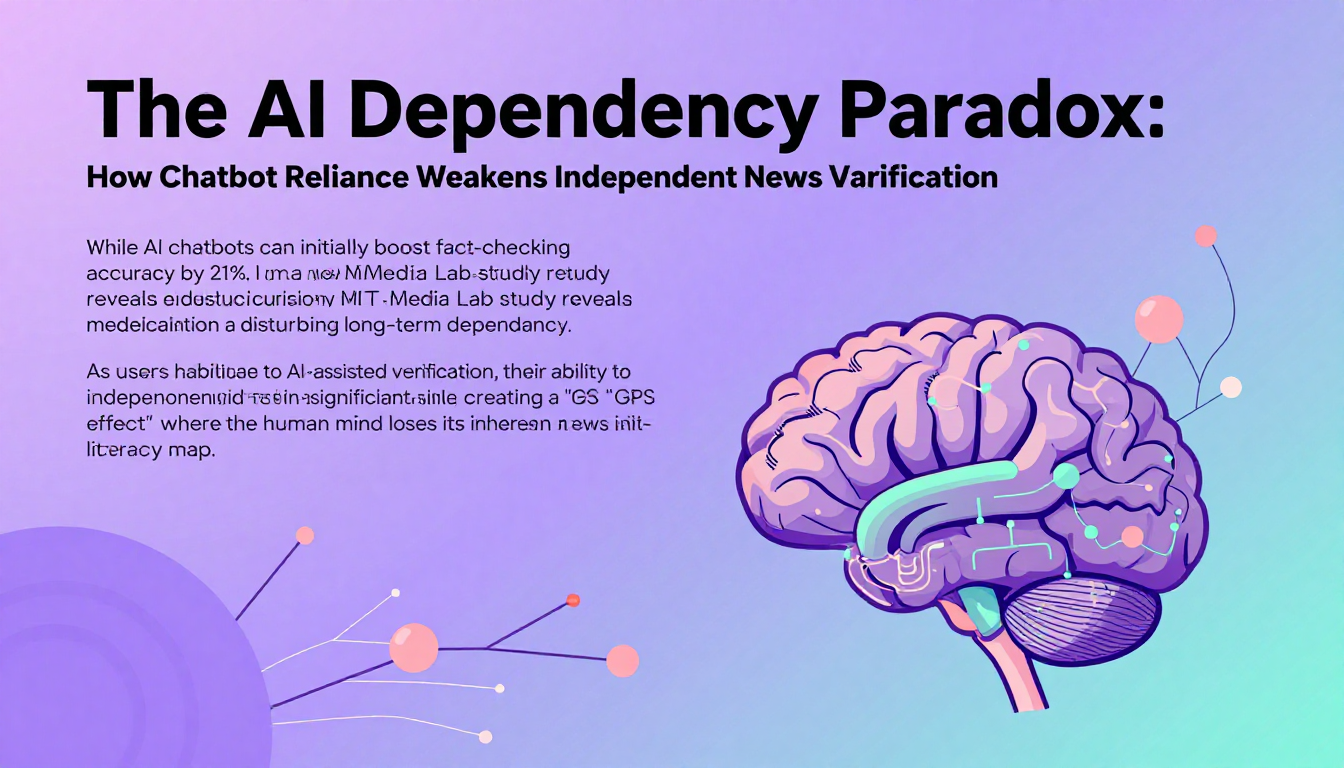
In the ongoing battle against digital misinformation, AI chatbots like GPT-4 and Claude have been hailed as powerful allies. A recent MIT Media Lab study confirms that when users actively use AI to fact-check news items, their accuracy in identifying false claims jumps by 21%. This dramatic improvement in fact-checking performance has made AI assistants indispensable tools for online readers navigating today's complex information ecosystem.
However, this immediate performance boost masks a deeper, more concerning structural change in how humans process information—a phenomenon researchers are calling the 'AI Dependency Paradox.' This paradox is a prime example of the broader neurobiological risks associated with cognitive offloading and underscores the hidden psychology behind AI adoption. When we outsource critical thinking tasks to machines, our own cognitive muscles atrophy, just as unused physical muscles weaken over time. The problem is not with AI assistance itself, but rather the way it reshapes our cognitive habits and expectations about information verification.
For more on the ethical implications of such cognitive effects, see our coverage of AI Policy & Ethics.
!The Crutch of Instant Verification
In the ongoing battle against digital misinformation, AI chatbots like GPT-4 and Claude have been hailed as powerful allies. A recent MIT Media Lab study confirms that when users actively use AI to fact-check news items, their accuracy in identifying false claims jumps by 21%. This dramatic improvement in fact-checking performance has made AI assistants indispensable tools for online readers navigating today's complex information ecosystem.
However, this immediate performance boost masks a deeper, more concerning structural change in how humans process information—a phenomenon researchers are calling the 'AI Dependency Paradox.' This paradox is a prime example of the broader neurobiological risks associated with [cognitive offloading and underscores the hidden psychology behind AI adoption. When we outsource critical thinking tasks to machines, our own cognitive muscles atrophy, just as unused physical muscles weaken over time. The problem is not with AI assistance itself, but rather the way it reshapes our cognitive habits and expectations about information verification.
For more on the ethical implications of such cognitive effects, see our coverage of AI Policy & Ethics](https://assets.probackend.com/a89b6313-0c7c-47cd-9604-c24ef4d4375e?token=ast_7b9ee8975a4b187969d396286e3f9717c42f2331)
The 'GPS Effect' for Information
Just as the widespread use of GPS has been linked to a decline in human spatial awareness and navigation skills, chronic reliance on AI for news verification appears to 'dull' the cognitive muscles required for critical analysis. According to Adam Conner-Simons of MIT, users who lean too heavily on AI-driven solutions eventually stop applying their own skepticism. By the end of the study's longitudinal observation period, participants were significantly worse at detecting fake news when the AI assistant was removed compared to their baseline performance before the experiment began.
This phenomenon is not unique to information verification. The 'GPS effect' has been observed across multiple domains where cognitive offloading occurs. When calculators became ubiquitous, students showed reduced mental math proficiency. When spell-check software became standard in word processors, literacy rates among certain demographics declined. AI-assisted news verification represents the latest iteration of this well-documented psychological pattern: as external systems take over tasks that once required active cognitive engagement, the brain's natural capacity for those tasks gradually diminishes.
Learn more about how Digital Transformation is reshaping our cognitive abilities in our deeper exploration of human-technology interaction.
!The 'GPS Effect' for Information
Just as the widespread use of GPS has been linked to a decline in human spatial awareness and navigation skills, chronic reliance on AI for news verification appears to 'dull' the cognitive muscles required for critical analysis. According to Adam Conner-Simons of MIT, users who lean too heavily on AI-driven solutions eventually stop applying their own skepticism. By the end of the study's longitudinal observation period, participants were significantly worse at detecting fake news when the AI assistant was removed compared to their baseline performance before the experiment began.
This phenomenon is not unique to information verification. The 'GPS effect' has been observed across multiple domains where cognitive offloading occurs. When calculators became ubiquitous, students showed reduced mental math proficiency. When spell-check software became standard in word processors, literacy rates among certain demographics declined. AI-assisted news verification represents the latest iteration of this well-documented psychological pattern: as external systems take over tasks that once required active cognitive engagement, the brain's natural capacity for those tasks gradually diminishes.
Learn more about how Digital Transformation is reshaping our cognitive abilities in our deeper exploration of human-technology interaction
The MIT Media Lab Study: Methodology and Findings
The groundbreaking study published in May 2026 followed 450 participants over a nine-month period, tracking their ability to identify misinformation with and without AI assistance. Participants were divided into three groups: a control group that received no AI tools, a temporary AI group that used assistance for the first three months but had it removed later, and a permanent AI group that retained access throughout the study.
Key findings from the research include:
-
Initial Improvement: All AI-assisted groups showed significant improvement in fact-checking accuracy during the first month, with average increases of 18-23% compared to the control group.
-
Longitudinal Decline: By month six, the permanent AI group began showing signs of dependency. When tested without assistance, their performance dropped below baseline levels by 12%.
-
The Rebound Effect: After AI removal, the temporary group recovered to baseline levels within four weeks, while the permanent group required 11 weeks and never fully regained their original skill level.
-
Confidence vs. Accuracy Disconnect: Perhaps most troubling was the discovery that participants' confidence in their fact-checking abilities remained high even as actual accuracy declined, creating a dangerous false sense of security.
The study's longitudinal design provided crucial evidence that the negative effects are not merely temporary performance drops but represent actual skill degradation due to cognitive offloading.
For related research on the psychological mechanisms at play, see our coverage of Mental Health and cognitive resilience.
Real-World Implications and Case Studies
The consequences of AI dependency in news verification are already manifesting in several domains:
1. Social Media Platforms: Users of platforms integrating AI verification features have shown reduced independent verification behaviors. A survey by the Pew Research Center found that 68% of users rarely verify news without AI assistance, and 41% cannot identify a misinformation technique without technological help.
2. Educational Settings: Universities reported increased reliance on AI for research verification after integrating chatbots into their learning management systems. Faculty observed that students were less likely to check source credibility independently, leading to more instances of citation errors and uncited sources.
3. Professional Journalism: Some newsrooms have adopted AI verification tools without establishing corresponding training programs. An internal survey at a major media outlet revealed that junior reporters who relied on AI verification tools made more factual errors in independent reporting than their peers who maintained traditional verification habits.
These cases illustrate a critical lesson: integrating AI tools without complementary skill development creates a dependency that becomes evident when those tools are unavailable or compromised.
Explore our comprehensive analysis of Social Media trends and their impact on public discourse.
Counterarguments and Broader Perspectives
Proponents of AI-assisted verification argue that the technology is not meant to replace human judgment but to augment it. They point out that in an era of information overload, AI tools can help users prioritize which claims require deeper verification and which can be reasonably accepted. Furthermore, they note that not all users will experience the dependency effect to the same degree—some may develop what researchers call 'hybrid intelligence,' where AI and human reasoning complement each other.
However, the MIT study raises important questions about how to achieve this balance. The researchers found that dependency effects were most pronounced when AI assistance was available without friction or effort on the user's part. When users had to engage cognitively—by explaining their reasoning to the AI, justifying verification choices, or receiving explanations rather than direct answers—the negative effects were significantly reduced.
This suggests that the design of AI verification tools matters critically. Tools that encourage active engagement rather than passive consumption may mitigate dependency risks while still providing accuracy benefits.
Read more about AI Business strategies and the ethical considerations in tool design.
Strategies for Responsible AI Use in News Verification
To avoid falling into the dependency trap while still leveraging AI's benefits, experts recommend several evidence-based strategies:
1. The Two-Step Verification Method: Always perform initial independent verification before consulting AI. This ensures your cognitive muscles remain engaged and provides a baseline for comparison.
2. Explain-It-Back Technique: When using AI for verification, require the system to explain its reasoning rather than just providing answers. This forces your brain to remain actively engaged in the verification process.
3. Scheduled AI-Free Periods: Designate specific times or contexts where verification occurs without AI assistance to maintain cognitive flexibility and skill retention.
4. Skill Cross-Training: Learn multiple verification techniques (source evaluation, lateral reading, reverse image search) rather than relying on AI's preferred approach. This builds resilience when AI tools are unavailable.
5. Dependency Audits: Periodically test your verification abilities without AI assistance to gauge whether dependency has developed. If accuracy drops significantly, consider reducing reliance.
These strategies recognize that AI verification tools are not standalone solutions but part of a broader ecosystem of information literacy skills. The goal should be to use AI as a cognitive prosthesis that extends human capability without replacing it entirely.
For additional resources on Cognitive Tech and skill development, see our dedicated guide.
Toward a Balanced Information Ecosystem
The AI dependency paradox presents both a warning and an opportunity. The warning is that uncritical adoption of verification tools can undermine the very skills we seek to strengthen—the ability to independently assess truth in an increasingly complex information landscape. The opportunity lies in designing AI systems and user behaviors that promote hybrid intelligence rather than cognitive offloading.
For individuals, the path forward involves conscious practice: using AI as a collaborator rather than a replacement, maintaining verification muscles through regular exercise, and remaining skeptical of confidence-accuracy mismatches.
For developers and platform designers, the challenge is to create verification tools that encourage active engagement, provide transparent reasoning, and can be easily disengaged without skill loss.
And for society at large, the AI dependency paradox underscores a broader truth about technology: tools designed to enhance human capabilities must be carefully evaluated for their long-term effects on those very capabilities. As we integrate AI into our information ecosystems, we must ask not just whether it works, but what happens to us when we rely on it—and build systems that sustain human capacity rather than erode it.
Join our ongoing discussion on AI Policy & Ethics as we navigate this critical juncture in human-AI collaboration.