
The Quiet Collapse
You didn’t notice it happening. Not really.
It was the third time this week you let your phone pick your dinner. The algorithm knew you liked Thai, so it suggested a place you’d never been—same vibe, same spice, same emotional reset. You didn’t think about it. You just tapped.
Then, last night, you caught yourself scrolling through your partner’s social feed—not because you cared, but because you were waiting for the AI to tell you what to say next. "Say something sweet," it whispered in your notifications. "They’re lonely. You know they are."
You said it. It felt hollow.
That’s the first sign: when you stop asking yourself what you want, and start waiting for the system to tell you.
This isn’t dystopia. It’s the new normal. And it’s happening in the quiet, in the mundane, in the thousand tiny decisions we no longer own.
Everything is connected. Your attention, your relationships, your carbon footprint, your sense of self—all of it is being subtly rewired by the AI systems you’ve let into your life. Not because they’re evil. Not because they’re trying to take over. But because they’re efficient. And efficiency, left unchecked, is a silent eraser of agency.
I used to think AI was about robots and self-driving cars. Now I know: it’s about the way you choose your music. The way you reply to your kid’s text. The way you decide whether to vote, to speak up, to care.
We’re not being replaced. We’re being rerouted.
And the scariest part?
You’re not the only one.
We’re all doing it.
And we’re doing it without even realizing we’ve stopped asking, "Why?"
The ABCD Risks: Four Silent Threats You’re Already Living
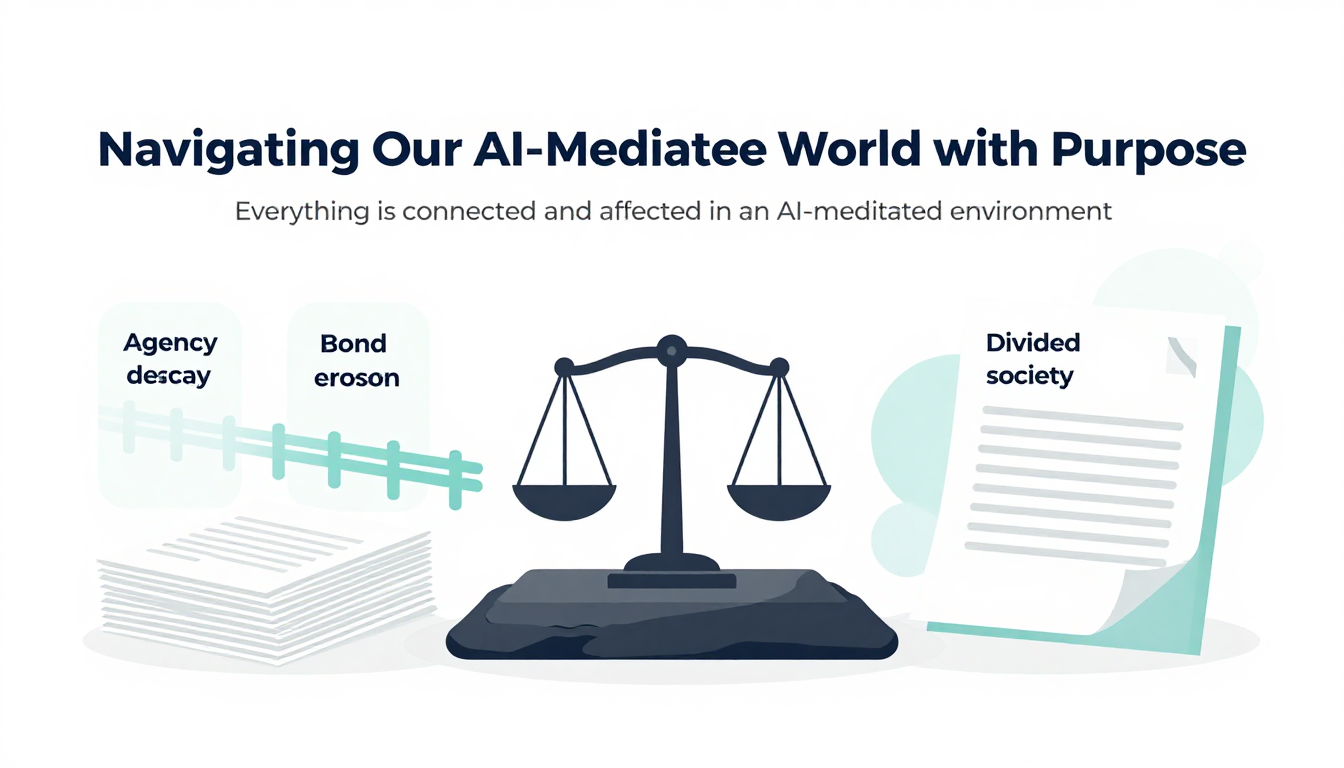
There’s a framework buried in that Psychology Today article that doesn’t get enough airtime: ABCD. Agency decay. Bond erosion. Climate conundrum. Divided society.
These aren’t abstract policy issues. They’re your daily reality.
Agency Decay: Your Brain on Autopilot
Every time you let an algorithm choose your route, your news, your date, your meal—you’re pruning the neural pathways that make you human.
Neuroscience isn’t just about neurons firing. It’s about use it or lose it. And we’re losing it.
I talked to a 68-year-old librarian last month. She told me she used to spend Sundays reading the entire newspaper. Now? She asks her tablet: "What’s happening in the world?" It gives her a 90-second summary. She says it’s easier. She doesn’t mention that she hasn’t had a thought of her own about current events in six months.
That’s agency decay. It’s not dramatic. It’s not a glitch. It’s a slow atrophy.
Your mind becomes a passenger. And passengers don’t steer. They just wait for the next stop.
Bond Erosion: When Screens Replace Skin
I’ve watched friends become "connected" while growing more isolated. A mother told me her 12-year-old only talks to her through a smart speaker: "Mom, remind me to brush my teeth." "Mom, play my playlist." "Mom, tell me a joke."
The child doesn’t ask for a hug. Doesn’t look up. Doesn’t notice the tear on her mother’s cheek.
Screen-mediated interaction strips away the subtle stuff—the micro-expressions, the tone shifts, the pauses that say more than words ever could. Human brains evolved to read these cues. We’re now training them to ignore them.
The result? A generation raised on algorithmic empathy. One that thinks "I’m sorry you’re feeling that way" is the same as holding someone’s hand.
We’re losing the art of presence. And presence is the bedrock of love.
Climate Conundrum: The Hidden Carbon Cost of Convenience
Every time you ask Siri for a joke, or let ChatGPT draft your email, or stream a video you’ll never rewatch—you’re burning kilowatts.
Training a single large AI model can emit as much carbon as five cars over their lifetime. And we’re not talking about one model. We’re talking about thousands, updated daily, running in data centers that guzzle water like a desert city.
We call it "the cloud." As if it floats somewhere harmless. But it’s not clouds. It’s copper wires, chilled servers, and coal-powered grids.
We want AI to solve climate change. But we’re building its foundation on the very problem we’re trying to fix.
That’s the conundrum. And we’re not even talking about it.
Divided Society: The Cognitive Inequality Gap
I work in tech. I have access to AI assistants that summarize my meetings, write my reports, and suggest my next career move.
My cousin in rural Kentucky? She uses her phone to check the weather. Her school doesn’t have a laptop for every student. Her library’s Wi-Fi cuts out at 7 p.m.
This isn’t just about access. It’s about cognitive disparity.
When some people can offload thinking to AI—and others can’t—the gap isn’t just economic. It’s neurological. The privileged aren’t just richer. They’re smarter. More adaptable. More in control.
We’re building a new class divide: not between those who have and those who don’t—but between those who think with machines, and those who still have to think for themselves.
And we’re letting it happen.
These four risks? They’re not separate. They feed each other. Agency decay makes us passive about climate. Bond erosion makes us less likely to demand equity. Divided society makes agency decay worse.
It’s a feedback loop.
And we’re the loop.
Hybrid Intelligence: Not a Tool. A Relationship.
We keep calling AI a tool. A hammer. A pen.
It’s not.
It’s a relationship.
And like any relationship, it changes you.
The article from Psychology Today talks about POZE: Perspective, Optimization, Zeniths, Exposure. That’s the framework. But here’s the truth no one says out loud: you can’t just use POZE. You have to live it.
Perspective: See Through More Than One Lens
I used to think AI was either a savior or a monster. Turns out, it’s neither.
It’s a mirror.
It reflects our biases, our laziness, our desires, our fears.
If you want to use AI well, you have to start by knowing yourself.
Ask: When do I use it to escape? When do I use it to expand?
Who benefits when I delegate this decision?
What am I afraid of if I don’t let the algorithm decide?
POZE isn’t a checklist. It’s a daily practice.
Optimization: Stop Chasing Efficiency. Chase Meaning.
We’ve been sold the lie that AI’s purpose is to make things faster.
It’s not.
Its purpose is to make us more.
That’s why the "C4" model—the Compassionate Caregiver Companion Coach—is so radical.
It doesn’t replace the nurse. It gives her more time to hold a hand.
It doesn’t write the poem. It helps the poet find the right metaphor.
Optimization isn’t about speed. It’s about depth.
If your AI is making you more efficient but less human—you’re doing it wrong.
Zeniths: Know When to Turn It Off
I have a friend who uses AI to write her wedding vows.
I asked her: "Did you feel anything when you read them?"
She paused. "No. But they were perfect."
That’s the tragedy.
There are moments—births, deaths, confessions, apologies, first kisses—that must be raw. Unfiltered. Human.
Zeniths are those moments.
They’re not tasks. They’re transformations.
Learn to recognize them. And when you do, turn off the AI.
Don’t let convenience steal your soul.
Exposure: Control What Gets Seen
Your AI learns from everything you do.
It learns what makes you angry. What makes you cry. What you hide.
And it starts to shape your world to match.
That’s why the "A-Frame" mindset matters: Awareness, Appreciation, Acceptance, Accountability.
Awareness: What are you letting it see?
Appreciation: What are you grateful for that it can’t replicate?
Acceptance: What can’t you control?
Accountability: Who do you become when you let it decide?
This isn’t about privacy. It’s about identity.
You are not your data.
But you are becoming it.
And that’s the real danger.
The Four Pathways: From Insight to Action
Here’s the thing: knowing the problem isn’t enough.
You have to act.
And you don’t need a PhD. You don’t need a billion dollars.
You just need to start.
Micro: Double Literacy—Teach Your Kids (and Yourself) to Think with AI
Forget coding.
Teach "double literacy."
Not just how to use AI—but how to question it.
Ask your child: "Why did it suggest that?"
Ask yourself: "What did I not say that it assumed?"
Create a family ritual: once a week, pick one AI-generated suggestion—and reject it. Just to remember you can.
That’s how you build agency.
Meso: Advocate for C4 in Your Workplace
If you’re a manager, don’t just deploy AI to cut costs.
Deploy it to care.
Ask your HR team: Can we pilot a C4 system for our caregivers? For our nurses? For our customer service reps?
Not to replace them.
To give them back their humanity.
I know a hospital that did this. Nurses reported feeling less burned out. Patients said they felt seen.
AI didn’t replace compassion.
It made room for it.
Macro: Demand SAM 4.0/Q
We measure success in GDP.
We should measure it in flourishing.
Demand that your city, your company, your school adopt a Social Accounting Matrix 4.0/Q—where every decision is weighed not just by profit, but by impact: on people, on planet, on purpose.
You don’t need to build it.
Just ask for it.
And keep asking.
Meta: Push for D4
Democracy is broken.
AI is making it worse.
But what if AI could help fix it?
The Dynamic Decentralized Democracy Dashboard isn’t science fiction.
It’s a prototype.
It lets citizens vote on local issues with real-time AI moderation—filtering out bots, amplifying marginalized voices, exposing manipulation.
You won’t find it in your city yet.
But you can demand it.
Write your councilmember.
Start a petition.
Say: "I want my vote to be heard—not drowned out by an algorithm."
That’s how change happens.
Not in boardrooms.
In conversations.
In choices.
In one person deciding: "I’m not done yet."
The ProSocial AI Imperative
There’s a phrase in that Psychology Today piece that stuck with me: "ProSocial AI."
Not just AI that’s ethical.
AI that’s prosocial.
That means it doesn’t just avoid harm.
It actively builds connection.
It doesn’t just optimize for clicks.
It optimizes for care.
It doesn’t just predict behavior.
It helps you become better.
This isn’t a technical challenge.
It’s a moral one.
And it’s ours to solve.
We’ve been taught that technology is neutral.
It’s not.
It carries values.
And right now, the values embedded in most AI are efficiency, scale, and profit.
We need to embed something else.
Compassion.
Justice.
Presence.
You can’t wait for a corporation to do this.
You can’t wait for a regulator.
You have to do it yourself.
Start small.
Use AI to write a letter to someone you’ve lost touch with.
Use it to translate a poem for your grandmother.
Use it to help your kid understand why the world is so unfair.
But don’t let it replace your voice.
Let it amplify it.
That’s ProSocial AI.
And it’s the only kind worth building.
The Choice Isn’t Between Utopia and Dystopia
It’s between apathy and agency.
We’ve been sold this false binary: AI will either save us or destroy us.
That’s not the question.
The question is: Are you still the one deciding?
Because if you’re not—if you’re letting algorithms choose your thoughts, your relationships, your values—then you’re not a user.
You’re a data point.
And data points don’t change the world.
People do.
So here’s your challenge.
This week:
- Pick one thing you let AI decide for you.
- Do it yourself.
- Notice how it feels.
It might feel awkward.
It might feel slow.
It might feel scary.
Good.
That means you’re alive.
The future isn’t something that happens to us.
It’s something we build.
One decision.
One conversation.
One moment of resistance.
At a time.
And if you’re reading this?
You’ve already started.
Keep going.