
The Memory Market's Bizarre Trip Into the Past
The memory landscape, once dominated by the relentless pursuit of faster, denser, and more efficient DRAM, has hit a wall that few imagined just a year ago. We've become accustomed to the march toward increasingly sophisticated technologies, from DDR4 to the power-efficient, performance-heavy DDR5. But the global semiconductor industry, now firmly in the grip of an AI-induced supply chain frenzy, has forced a strange, almost retro, pivot.
Major DRAM buyers, usually the ones fighting for allocations of the latest silicon, are now scrambling to secure supplies of DDR2 and DDR3. Yes, you read that right. In 2026, tech supply chain managers are scouring vendor lists for memory technology that many thought was destined for the museum.
This reverse-evolution isn't happening because of some sudden, widespread appreciation for retro-computing. It is a symptom of extreme desperation. When you can't get what you need to build your product, you look for whatever functional equivalent you can find. It is a clear sign that the supply shortage, which has already wreaked havoc on PC and smartphone pricing, is finally reaching into the oldest, most ignored corners of the memory market. It is a cautionary tale of what happens when a singular, high-margin demand—in this case, AI infrastructure—starves the rest of the tech ecosystem.
AI's Insatiable Hunger for HBM is Reshaping DRAM
To understand why DDR2 prices are climbing at rates that would make a stock market day trader sweat, we have to look at the root cause: the AI gold rush. The explosion of interest in large language models and other forms of generative AI has changed how memory chipmakers view their production lines.
High Bandwidth Memory (HBM) and server-grade DRAM silicon have become the golden tickets for manufacturers. These chips are essential for the massive graphics processing units (GPUs) and server clusters that underpin modern AI infrastructure. Naturally, memory chipmakers are reallocating their fabrication capacities to focus exclusively on this high-margin hardware.
When a manufacturer has a finite amount of wafer capacity, they’re going to prioritize the chips making them the most profit. For the giants of the memory world, that’s not the standard DDR4 DIMM for a home laptop. It’s the high-capacity, high-performance DRAM required for data centers. This decision ripples down, leaving mainstream memory types in woefully short supply. It’s not just a minor delay; it’s a systemic starvation of the traditional supply chain, leading manufacturers to prioritize their most profitable customers over high-volume, low-margin products.
Pricing Projections: The Cost of Supply Panics
The financial impact of this redirection is staggering, and according to TrendForce, it’s only going to get tighter. We aren’t talking about marginal inflationary adjustments; we’re looking at massive percentage hikes in contract prices for legacy DRAM generations.
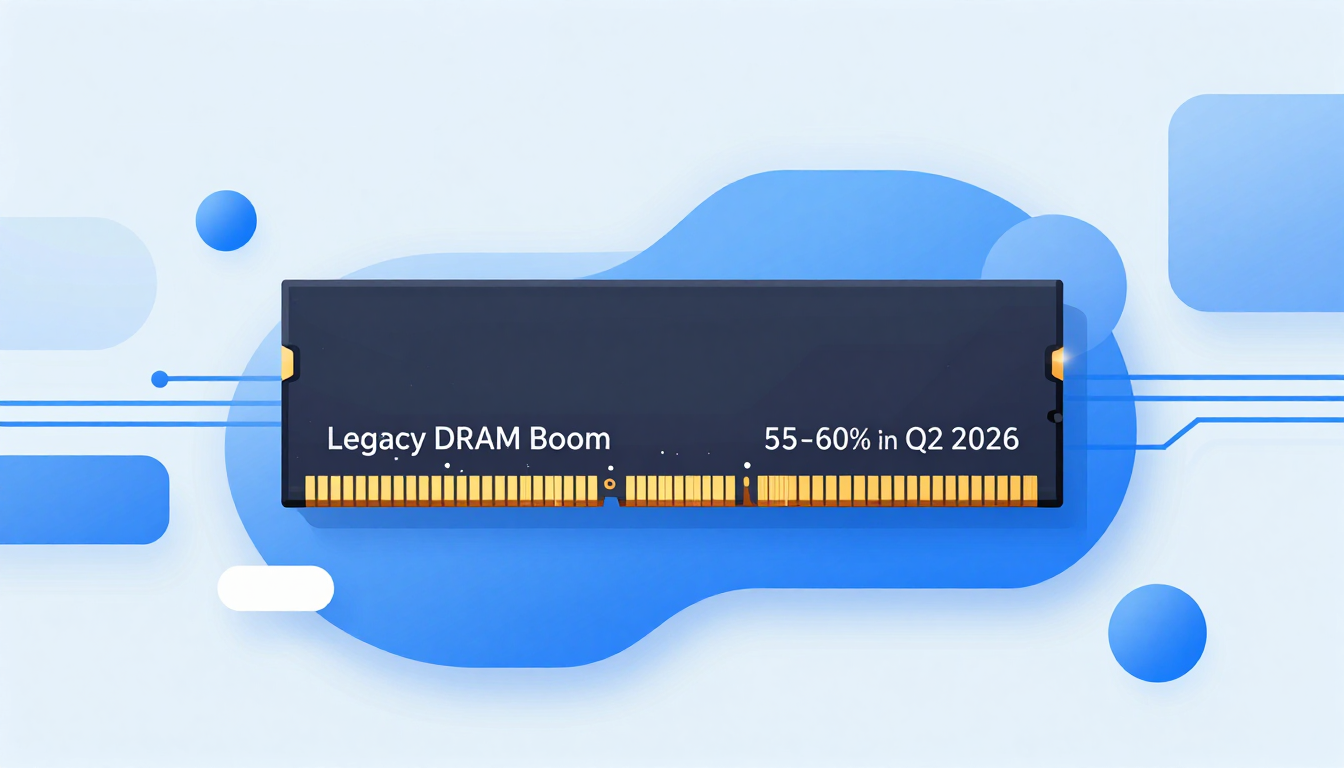
TrendForce estimates that DDR2 contract prices will climb by approximately 55 to 60 percent for the second quarter of 2026 alone. Things don't stabilize after that either; the same projections indicate another 35 to 40 percent increase in the third quarter.
When prices surge this quickly, they’re not just reflecting cost-of-production increases. They’re reflecting pure, unadulterated fear among buyers. When a company can’t secure enough DDR4 to meet its manufacturing demands, it starts scouring the market for older, compatible, or even adaptable alternatives. This panic buying pushes prices for the remaining stockpiles of DDR2 and DDR3 into, as some have put it, the stratosphere. It’s a classic squeeze, where manufacturers have less interest in producing these low-margin parts, and buyers are terrified of running out of any functioning memory.
The Industry Response: Redesign or Downgrade
How are hardware companies responding to this new reality? They’re getting creative, or at least, they’re getting desperate. Faced with the inability to procure mainstream memory components at reasonable costs, some manufacturers are actively redesigning their products.
In some cases, this means downgrading memory specifications entirely. If a device was designed for DDR4 but can function with DDR3, the manufacturer is making that switch. If the path leads to DDR2, they're taking it. This forces engineers into the uncomfortable position of making products perform more poorly to simply ensure they can be produced at all.
While it’s unlikely that modern, everyday PCs are switching to DDR2—given that modern processors aren’t built to support it—this implies a massive shift in other product categories. From industrial controllers to specialized embedded devices, manufacturers are finding that they have no choice but to build for older performance tiers. This is a profound, albeit inefficient, use of engineering resources, and it’s a direct response to the absolute lack of mainstream memory availability.
The Supplier Shuffle: Winbond vs. ESMT
The supply of legacy DRAM is turning into a game of musical chairs. Key suppliers of DDR2 components, such as Winbond and Elite Semiconductor Microelectronics Technology (ESMT), are each navigating a tricky path toward profitability in this environment.
Winbond, as part of its broader strategy, has been gradually winding down its DDR2 production to reallocate that precious wafer capacity for higher-margin products like DDR3, DDR4, and LPDDR4. It’s a logical move—why sell something for pennies when the market is begging for something else for dollars?
But this withdrawal leaves a gap that someone needs to fill. ESMT is taking a different tack. They’re moving to maximize their DDR2 production by leveraging their existing allocations at the PSMC wafer foundry. By concentrating resources, ESMT aims to capture the profitability of this legacy segment, stepping in to fill the hole left by Winbond’s shift. It’s a perfect example of how different firms are betting on different futures, with ESMT betting on the immediate, desperate demand for whatever memory is actually available.
The Long Road Toward Capacity Normalization
If we’re feeling the pain now, when does it get better? The big players in the memory market are planning to increase their capacity, but it’s a slow-moving, complicated process.
SK hynix has announced plans to double its silicon wafer output capacity over the next five years. It’s a massive commitment, but it’s a long-term goal. Similarly, American giant Micron is looking to bring "meaningful new capacity" online, but that’s not expected to happen until 2027 or 2028 at their new Virginia fabrication plant.
For the IT managers and procurement teams struggling right now, that is a long way off. Increased capacity takes years to bring online, requiring massive capital investment and complex logistics. The "meaningful" relief isn't on the immediate horizon, meaning the high-price, tight-supply environment we’re experiencing today is likely to stick around for a while. It’s a reminder that in the world of semiconductors, supply and demand are not just economic concepts—they are physical, slow, and staggeringly difficult to manipulate in the short term.
Conclusion: The Memory Market’s New Normal
This situation with legacy DRAM is a sharp, unexpected twist in the wider memory crisis. It shows us that in a world where AI infrastructure dictates the flow of silicon, the ripples of that demand don't just stay in the data center—they reach into the oldest products, forcing companies to move backwards just to stay in business.
We’re in an overheated market, one that’s being fundamentally reshaped by where the money is, not just where the need is. As manufacturers like SK hynix and Micron work to scale their future production, purchasers are going to have to navigate this "old-is-the-new-hot" landscape for some time. The irony isn’t lost on anyone: the industry is paying a premium for memory technology that most people thought was largely obsolete. That is the true measure of today's memory crunch. It isn't just a shortage; it's a profound, market-wide reconfiguration that should give anyone in the hardware supply chain reason to rethink their long-term planning. I've heard from more than one industry contact that they're scouring old inventory lists for anything that can be put in a box and shipped. It's a scramble, and there isn't much hope for a fast recovery. It is a fascinating, if frustrating, time to be in the business of managing a supply chain. When high-tech AI chips can cause a run on legacy memory, you know the market is well beyond the bounds of normalcy. We are, for now, stuck in this strange, backward-looking phase, and it will be interesting to see who can innovate their way out—or who will simply have to wait for the capacity to finally arrive.