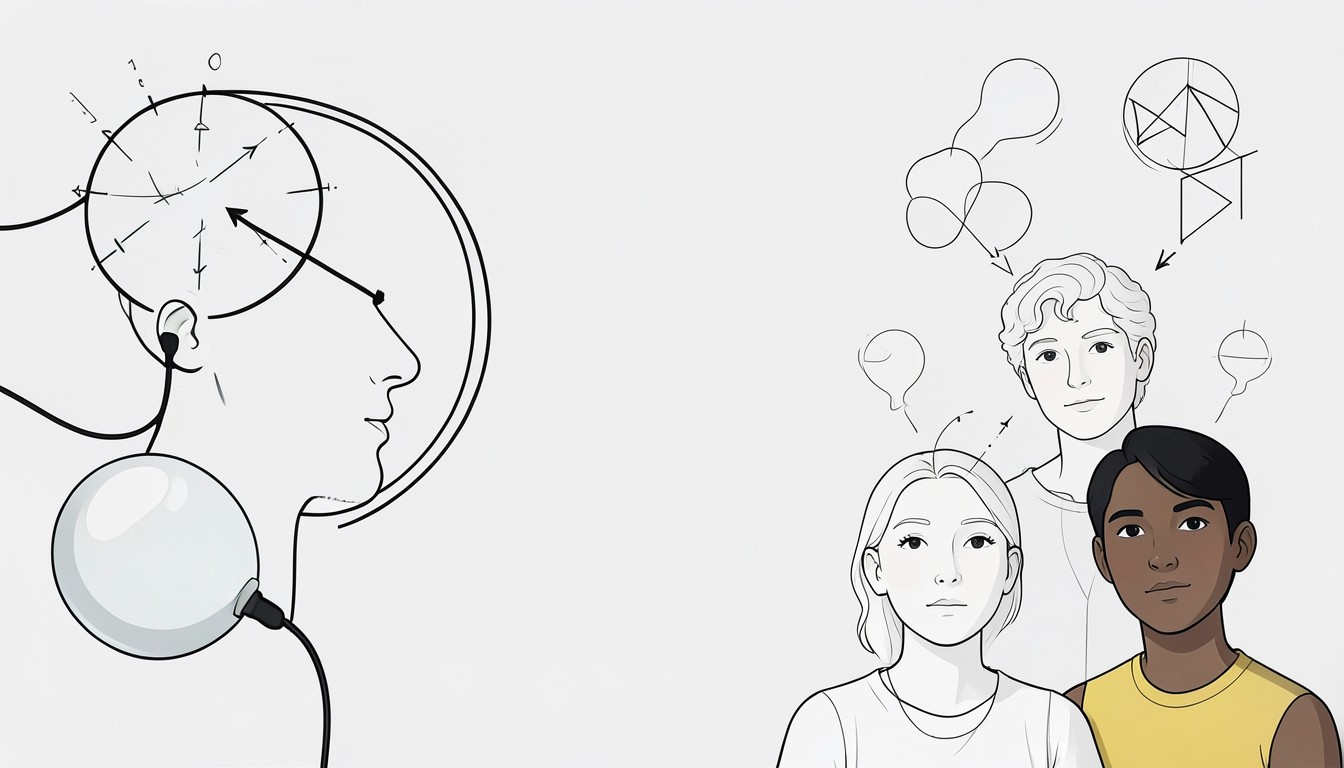
The Question AI Still Can't Answer
Here's what nobody asks about the AI impact on human psychology: can a machine tell when someone next to you just fled the room? Not in the obvious, pixel-level sense — computer vision already tracks bodies across frames. The harder problem is inferential. Did that person vanish because they left, or because they bolted? The answer changes your behavior entirely, and most AI systems treat those two events identically.
A team at UC San Diego just published work in Nature showing that a transparent fish called Danionella cerebrum solves this exact problem with a midbrain circuit roughly 500 million years old. The finding has direct implications for how researchers frame social action recognition — the computational backbone of any system trying to model human social cognition.
What the Transparent Fish Actually Does
The Lovett-Barron Lab at UC San Diego's Department of Neurobiology has been studying Danionella cerebrum as a model organism precisely because its entire brain is optically clear and its genome is amenable to genetic access. Researchers can record brain-wide neural activity while the fish interacts with computer-rendered "virtual fish" in a controlled environment.
In the study published September 23, 2026 in Nature, the lab used video-game-simulated virtual schools to test what triggers collective escape behavior in live fish. The results were precise and somewhat counterintuitive. Fish retreated from virtual schools that were fleeing or that abruptly disappeared from their expected positions. But only when those virtual fish moved with the species-specific "burst-and-glide" swimming pattern — the stuttering, biological motion that actual Danionella produce.
When the virtual fish glided with smooth, continuous motion, the real fish completely ignored them. No startle response. No flight. Nothing.
This matters because it reveals something fundamental about the detection algorithm: the midbrain circuit isn't looking for motion per se. It's looking for specific kinematic signatures that correlate with social threat in an ecological context.
The Disappearance Signal
The most striking finding from whole-brain calcium imaging — made possible only because the fish is transparent, is that escape-tuned neurons in the optic tectum fire under two conditions: when a neighboring fish actively flees, and when a fish simply vanishes from the location the brain expected it to occupy.
The fish doesn't need to see a predator. It infers danger from the absence of a social partner. In the turbid, low-visibility floodplain streams where Danionella live, rapid fleeing neighbors become invisible within fractions of a second. The disappearance itself, the violation of a spatial prediction, is the alarm signal.
Co-author Megan Fritz, a staff scientist in the lab, described it well: a disappearing fish, like a fleeing one, indicates an invisible threat. The circuit doesn't distinguish between seeing someone run and failing to find someone who should still be there. Both cases mean: something dangerous happened nearby.
An Ancient Circuit We Still Share
The optic tectum isn't unique to fish. This midbrain structure is conserved across birds and primates, including humans. Co-author James Liang, a graduate student in the Lovett-Barron lab, pointed directly at this evolutionary continuity when he noted that humans and birds also possess this midbrain region and react strongly to social actions like escaping conspecifics. He argued that Danionella may use the same mechanism, and that the circuit might help decode not only escape but other social actions in other organisms.
The same neurons that fire when a fish disappears from a Murky Burmese stream likely participate, in heavily elaborated form, in the startle cascade that makes you turn your head when someone at a café abruptly leaves the table. The prediction error is old. What's been layered on top of it is new.
Why This Changes How We Frame "What Is AI in Psychology"
When practitioners ask what is AI in psychology, the honest answer today is: mostly it's a pattern-matching layer bolted onto behavioral data. Sentiment classifiers. Engagement predictions. Diagnostic screeners trained on questionnaires.
The Danionella work exposes the gap. The fish brain doesn't classify. It maintains a predictive model of where social partners should be and treats prediction failure as a threat signal. That's a fundamentally different architecture, one that requires no training set, no labeled examples, and no dimensionality reduction.
Journals like Frontiers have published work exploring how the default mode network supports social understanding of others through brain connectivity patterns, suggesting that even in humans the "inference engine" runs on predictive scaffolding rather than reactive classification. The fish study gives computationalists a concrete target: if you can build a social action recognition system that triggers on disappearance, on violation of spatial expectation, you've captured something more primitive and more honest about social threat detection than any emotion classifier currently deployed.
Social Action Recognition at a Turning Point
Co-author Pradyumna Melkunda, a graduate student who led behavioral experiments, noted that fish are exquisitely sensitive to biological motion of nearby conspecifics and respond with evasive action in a fraction of a second. The neurons encoding those social offsets and escape actions were found not just in the optic tectum but also in downstream visual thalamus, suggesting the signal gets refined before it reaches decision-making circuits.
For the AI impact on human psychology research agenda, this creates a productive tension. The systems we build to model human social cognition, whether they're diagnostic tools, social-media sentiment engines, or interaction-monitoring chatbots, are trained on the end result of centuries of cultural elaboration layered over an ancient alarm system. They capture the elaboration and miss the substrate.
If we want AI that actually understands social dynamics, not just labels them after the fact, we need architectures that do what a 2.5-centimeter fish brain does: predict where others will be, and treat their absence as information.
That's not a metaphor. It's a computational blueprint published in Nature by a transparent fish, 500 million years before anyone thought to ask the question.
What This Doesn't Mean
None of this says AI can replace understanding of human psychology. The fish circuit is fast, coarse, and limited to a single species' behavioral vocabulary. Humans have language, cultural norms, and the capacity for deliberate mentalizing that no circuit, ancient or otherwise, provides. But the study does challenge a comfortable assumption in applied AI psychology: that building social cognition from scratch with enough data and parameters will eventually get you somewhere biologically meaningful. The fish got there first. The architecture is different.