
Artemis III Mission Overview
NASA has announced the crew for the Artemis III mission, scheduled for no earlier than summer 2027. As part of the announcement, space agency officials discussed plans for the crew to dock with both a Blue Origin lander and a SpaceX Starship lander during the spaceflight in low-Earth orbit.
The presentation, although informative, still left open key questions about the landers' readiness and what exactly they'll look like. Ars sat down with Jeremy Parsons, NASA's Artemis program manager, to answer some of these questions.
This mission represents a crucial stepping stone between Artemis II, NASA's first crewed mission of the Artemis program, and future lunar exploration efforts.
SLS Rocket and Launch Pad Status
Ars: How is the Space Launch System rocket and launch pad looking a couple of months after Artemis II?
Jeremy Parsons: The mobile launcher is honestly in great shape after the launch, so the modifications we did between (Artemis) I and II were highly, highly successful. We rolled back a couple of weeks after launch, and two things are kind of going on in parallel right now.
The boosters have arrived at what we call the rotation processing surge facility, so they're being prepped and ready for stacking—so rotation, all that kind of stuff. And then on the mobile launcher, there were a couple of areas of damage, and we've got like 90-something percent of it done right now. There are a couple of areas in the flame hole that they're re-welding, and we want to get that work done before we start stacking boosters. As a general rule, we don't want to weld with the propellant there. So all of that's looking to finish up in the early July time frame. I expect us to be stacking in July.
SLS Rocket Testing Plan
Ars: What is the plan for testing the SLS rocket? Will you perform a wet dress rehearsal on the rocket before putting Orion on top?
Parsons: As you saw in Artemis I and II, we had issues with the cryogenic seals—those go through what is called the tail service mast umbilicals. We're in the process of redesigning those and implementing new ones for this mission. Part of what we want to do is… what we call a short-stack tanking or wet dress rehearsal. Basically, you get the boosters and the core stage on, you complete all the thermal protection systems. We then would put a cover on top of the core stage, and we'd roll out in that configuration. Then we would tank it up and make sure the seals are tight.
ICPS Upper Stage Replacement
Ars: You're flying Artemis III without an ICPS upper stage because you don't need the performance to reach low-Earth orbit. But you do need a second stage simulator. What's the status of that?
Parsons: That, to me, is really cool. It's called a spacer, and we already have the design done. Metal is already being bump-formed at United Launch Alliance, and then we're going to weld it in-house at Marshall Space Flight Center. We expect it to show up at Kennedy Space Center no later than December, and then we'll stack Orion on top of that. We're in really good shape with that, and I'm pretty psyched with the progress.
Blue Origin Lunar Lander Details
Ars: You're flying Artemis III without an ICPS upper stage because you don't need the performance to reach low-Earth orbit. But you do need a second stage simulator. What's the status of that?
Parsons: That, to me, is really cool. It's called a spacer, and we already have the design done. Metal is already being bump-formed at United Launch Alliance, and then we're going to weld it in-house at Marshall Space Flight Center. We expect it to show up at Kennedy Space Center no later than December, and then we'll stack Orion on top of that. We're in really good shape with that, and I'm pretty psyched with the progress.
Ars: So it sounds like the rocket and Orion should be good to go by mid-2027. Let's talk about the other parts, the two lunar landers and their launch vehicles. Starting with Blue Origin, you called the prototype lander they're flying for Artemis III a 'lander test article' during your remarks today. What does that mean, exactly?
Parsons: It's in between Mk 1 and Mk 2. It's the same lunar crew module, which is really the most important aspect—same avionics, same flight software, so we're going to get all of that component testing done. This will be the first production article of the lunar crew module, so we're also going to have the ECLSS system (environmental control and life support).
The primary differences between this test article and the final lander will be the BE-7 engines, so you're not going to have cryogenics on this test. What we're going to use is storable propellants and a reaction control system because they don't need the big thrust that's needed to go to and from the Moon. That also gives us some time to really dial in what we call the dual-launch campaign. That's going to be something to really highly choreograph as we go into the Artemis IV missions and beyond.
Ars: What can you tell us about the visual appearance of the landers?
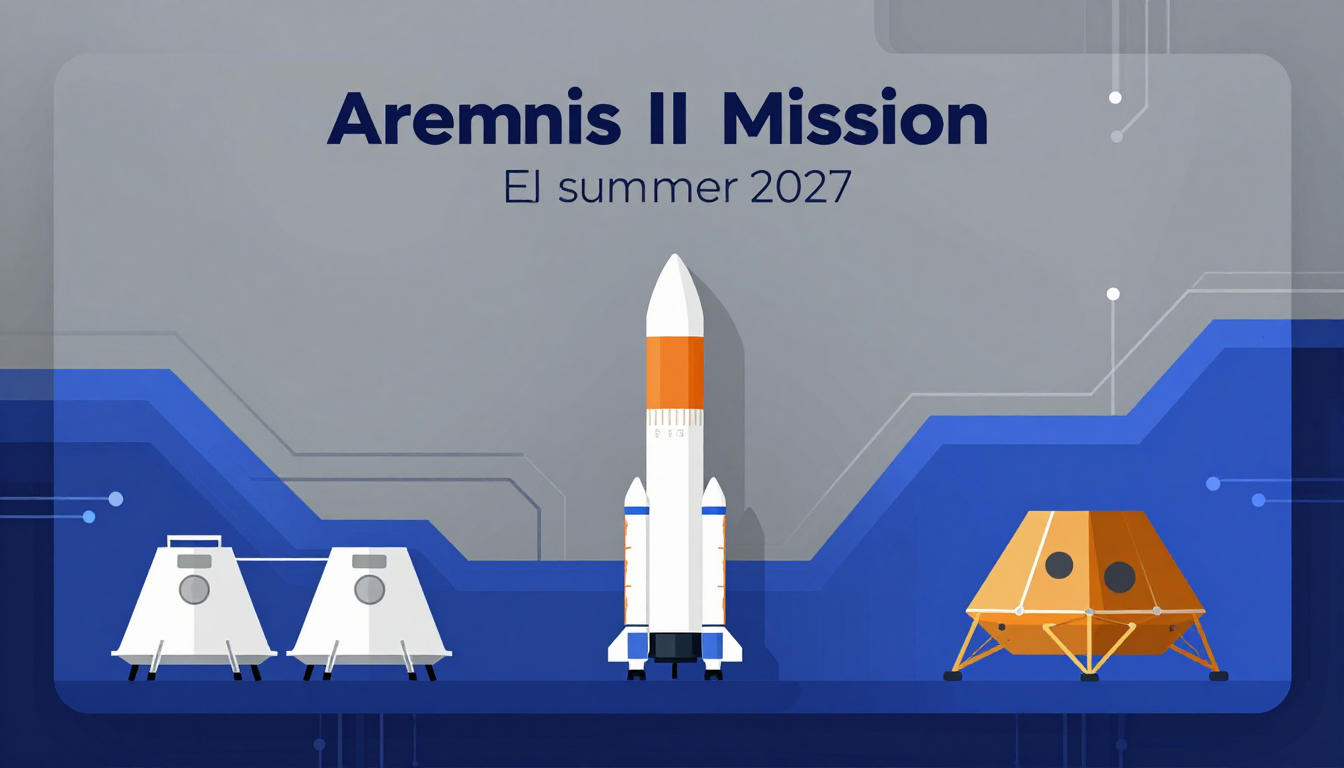
Parsons: Blue Origin's Blue Moon Mk1 lander, seen in the center, is taller than NASA's Apollo lunar lander, currently the largest spacecraft to have landed on the Moon. Blue Moon Mk2 is even larger, but all three landers are dwarfed in size by SpaceX's Starship. Learn more about SpaceX Starship development and its role in lunar missions.
Future Mission Planning
The dual-launch campaign mentioned by Parsons represents a significant shift in lunar mission architecture. As NASA prepares for Artemis IV and beyond, the agency must choreograph complex rendezvous and docking operations between multiple spacecraft elements including the Gateway space station, lunar landers, and Orion crew capsule.
This preparation begins with Artemis III, where the crew will dock with both landers in low-Earth orbit before the Blue Origin lander departs for the Moon. The experience gained from this operation will be critical for future missions that require more complex assembly in lunar orbit.
Conclusion
Artemis III represents NASA's next major step toward returning humans to the lunar surface. With the crew announced and detailed information about the SLS rocket, Orion spacecraft, and both lunar landers emerging, the agency appears to be on track for a summer 2027 launch—though significant challenges remain, particularly regarding the readiness of the commercial lunar landers.
The Artemis III mission will test new procedures for lunar landing operations, including the unprecedented dual-lander docking concept. Success would pave the way for sustainable lunar exploration and serve as a proving ground for technologies needed for future Mars missions.