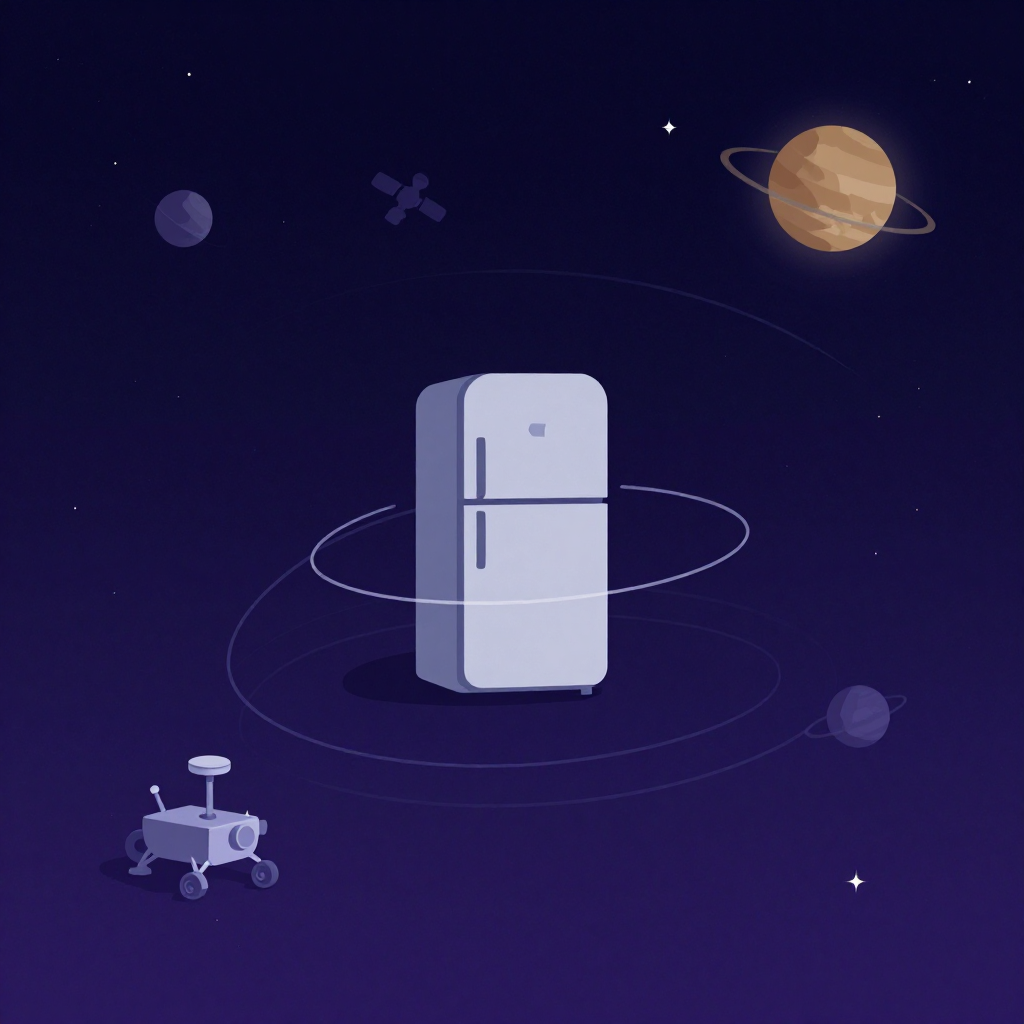
A Fridge-Sized Spacecraft Pulls Off a Mind-Bending Feat
Here's the thing about space missions that never quite sinks in until you read the numbers: JAXA's Hayabusa2 just flew within 800 meters of a 450-meter-wide asteroid spinning through deep space at roughly 30 kilometers per second, and it did so with a spacecraft the size of a household refrigerator. No flexible telescope lenses. No gimbaled camera mounts. Just a rigid, fixed-frame probe and an ion engine that's been whispering tiny corrections to its trajectory for years.
The flyby happened over the weekend of July 5–6, 2026. JAXA confirmed the spacecraft first spotted its target on June 24, and the final ion engine burn for the encounter wrapped up on June 11 — meaning months of patient, autonomous navigation led to a single, razor-thin window where the probe would pass close enough to see every crag and crevice on Torifune's surface.
This isn't a flyby you can do by accident. You have to get it right, or the asteroid becomes just another rock in a sea of rocks.
What Is Torifune, Anyway?
Torifune — formerly known as 2001 CC21 before JAXA ran a public naming campaign that landed on the Japanese word for "bird ship" — is what planetary scientists call a primitive near-Earth asteroid. Primitive here means it's largely unchanged since the solar system formed, which makes it a time capsule more than a threat. Though technically classified as a potentially hazardous near-Earth object because its orbit brings it into close proximity with Earth's path, the actual collision risk is negligible on any human timescale.
The asteroid measures roughly 450 meters across, which puts it in the "city-killer" category if something went wrong. But its real significance lies in what it looks like. Radar data and initial imaging show Torifune is elongated and asymmetrical — not the nice round sphere you'd see in a textbook. It tumbles through space with a rapid five-hour rotation period, which means its visual profile shifts constantly as it spins. For a spacecraft trying to track and approach it, that's both a challenge and an opportunity: you get to see every face of the thing.
Its orbit is what JAXA describes as a deep-space trajectory in close proximity to Earth's orbital path, which is why it was such an attractive target for a test of precision navigation.
The Spacecraft That Refused to Die
Hayabusa2 was built for one job and did it spectacularly: rendezvous with asteroid Ryugu, touch down on its surface multiple times, fire a penetrator into the rock, collect pristine soil samples, and bring them home. It arrived at Ryugu on June 27, 2018, and delivered those samples to Earth in 2020 — a triumph that gave scientists some of the most unaltered organic material ever brought back from space.
But the mission didn't end there. JAXA had spare fuel, a healthy spacecraft, and a clear mandate to keep going. The Extended Mission phase — informally called Hayabusa2# — was designed from the start to test whether a probe built for slow, careful orbital matching could also handle the extreme precision required to navigate toward fast-moving asteroids. Torifune is that test.
The engineering constraints are what make this impressive. Hayabusa2's imaging architecture is fixed — no movable camera mounts, no zoom lenses that can track a target independently of the spacecraft body. When you want to look at something, you have to turn the entire fridge-sized cube. And its navigation relies on autonomous optical software that locks onto the target and tracks it all the way to closest approach without waiting for manual commands from Earth. In a system where light-speed delay makes real-time control impossible, that autonomy isn't a luxury. It's the difference between success and missing your target entirely. While standard missions often rely on continuous ground telemetry via systems like NASA's Deep Space Network, Hayabusa2's autonomy was vital to mitigating transmission lag.
The ion thruster engine — JAXA's workhorse for years of continuous deep-space navigation — provides the tiny, precise trajectory corrections that add up to a successful encounter. Each burn is measured in fractions of a millimeter per second, but over months they steer the spacecraft along an exact path through the void.
Why This Matters for Planetary Defense
Let's be honest: asteroid deflection isn't exactly a comforting topic. But the work JAXA is doing with Hayabusa2's extended mission is among the most practically important space science being done right now, precisely because it's not theoretical.
The core question is simple: if a hazardous asteroid were headed toward Earth, could we stop it? The leading concept for doing so is the kinetic impactor — essentially crashing a spacecraft into the asteroid hard enough to nudge its orbit. DART proved that concept works in principle. But DART was a blunt instrument aimed at a relatively slow-moving target from a straightforward approach vector.
Torifune is different. It's spinning fast. It's elongated, which means its center of mass doesn't align with its geometric center — hitting it off-angle could send it tumbling in unpredictable ways. And the precision required to approach something that size at those relative velocities, without crashing into it, is orders of magnitude harder than what DART demonstrated.
By flying within 800 meters — less than twice the asteroid's own diameter — Hayabusa2 is proving that a spacecraft designed for gentle orbital rendezvous can also execute the kind of pinpoint navigation a kinetic impactor would need. The autonomous optical tracking, the ion thruster fine-tuning, the attitude control required to keep a fixed camera pointed at a tumbling rock — all of it is flight data that planetary defense planners can use.
The Bigger Picture
There's something quietly remarkable about a mission that was supposed to end in 2020 still pushing forward six years later. Hayabusa2's extended mission isn't just an afterthought — it's a deliberate statement that the spacecraft's capabilities far outstrip what was originally planned. Every flyby it completes adds to a dataset that no other probe has touched.
And Torifune itself, once this campaign wraps up, will join a small but growing list of asteroids that humanity has actually gotten close enough to study in detail. The samples from Ryugu have already rewritten textbooks on solar system formation—much like how the Mars Perseverance rover's discovery of unexpected carbon-rich rocks has challenged our understanding of Martian history. The data from Torifune will do the same for our understanding of near-Earth object populations and, critically, for the engineering of future deflection missions.
The flyby happened. The data is coming home. And somewhere in JAXA's control room, a team of engineers who spent years watching an ion engine fire in tiny pulses is probably just smiling.
Sources: Ars Technica — weekend encounter reporting; Insights IAS — Torifune and Hayabusa2 technical details; JAXA Hayabusa2 Project — campaign timeline, ion engine operations, and naming history.