
Agentic AI's Memory Problem
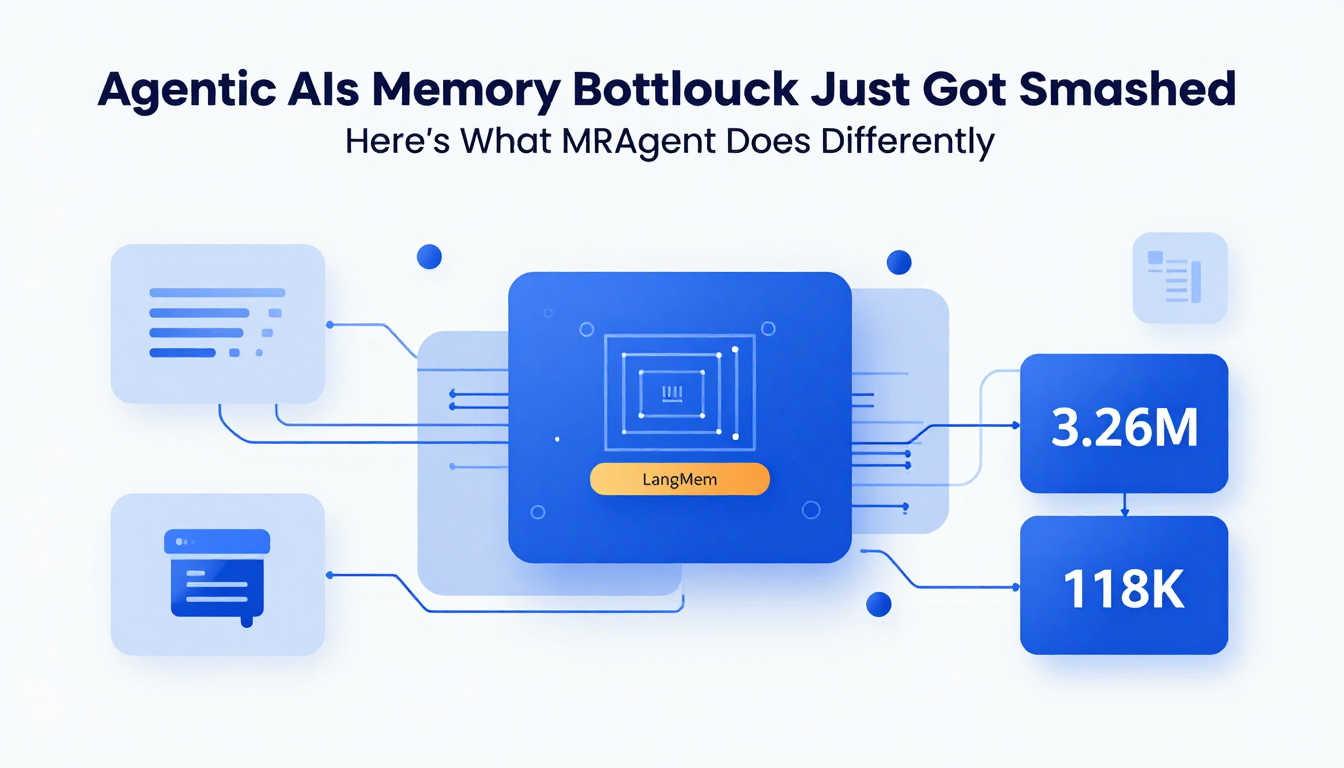
Here's a number that should make anyone building agentic AI systems uncomfortable: LangMem, one of the most widely adopted memory frameworks for LLM agents, burns through 3.26 million tokens per query on long-horizon tasks.
Three point two six million. That's not a typo. And it's not an edge case — it's what happens when you ask an agent to remember a multi-session conversation spanning weeks, then try to pull the right details back out.
IBM defines agentic AI as autonomous systems that can plan, act, and adapt without constant human oversight. Google Cloud puts it similarly: agentic AI systems operate with a degree of independence, making decisions and executing multi-step workflows on their own. The definition is clear enough. What's not clear — until now — is how these agents are supposed to remember anything useful without setting your inference budget on fire.
That's exactly the problem MRAgent tackles. Developed by researchers Shuo Ji, Yibo Li, and Bryan Hooi at the National University of Singapore, the framework (officially the Memory Reasoning Architecture for LLM Agents) reframes memory not as a database you query, but as something the agent actively reconstructs — step by step, like how human recall actually works.
The paper came out in June 2026, and the results are stark enough that they're worth looking at closely.

Why Static Retrieval Breaks Down
Traditional RAG systems — the retrieve-then-reason pattern that's become the default for giving LLMs long-term memory — hit three hard walls when tasks get complex.
First, you can't revise your retrieval mid-reasoning. The system fetches documents upfront based on the initial query, then the LLM works with whatever it got. If that retrieval was wrong or incomplete? Too bad. The context is locked in.
Second, fixed similarity scores flood your context window with noise. Vector search returns the "closest" matches by some mathematical distance metric, but closeness in embedding space doesn't always mean relevance to the actual question being asked. You end up stuffing your prompt with paragraphs that sound related but don't actually help.
Third, rigid pre-constructed structures limit scalability. Once you've indexed everything into a fixed graph or vector store, changing how the agent reasons about its own memory means rebuilding that structure from scratch.
Long-horizon tasks expose all three weaknesses at once. The context window fills up fast. Retrieval returns increasingly irrelevant results as the conversation grows. And you're paying for every token of that noise.
MRAgent's answer is to stop treating memory as a static thing you pull from, and start treating it as an interactive environment the agent explores.
The Cue-Tag-Content Graph
At the heart of MRAgent is a structured memory graph with three node types, and it's deceptively simple:
Cues are fine-grained keywords, entities, or attributes extracted from interactions — things like "Nate" or "video game tournament." They're the smallest units, the triggers that start recall.
Content holds the actual stored memories. These split into two layers: episodic memory (concrete events — "Nate won the tournament on March 12th") and semantic memory (stable facts and preferences — "Nate prefers competitive games"). There's also an abstraction layer with topic nodes for recurring patterns across multiple interactions.
Tags sit between the two. They're semantic bridges that summarize relationships — things like "Tournament Victory" or "Tournament Participation." Tags are the cheap-to-evaluate stepping stones that let the agent figure out which content is worth pulling in.
Here's how it works in practice. Say you ask: "How much prize money did Nate win after his third tournament victory?"
The system extracts cues from that query, maps them to candidate tags — "Tournament Victory" and "Tournament Participation" both light up. But the agent evaluates which tag is actually relevant, drops the one about mere participation, then retrieves only the episodic content tied to the winning tag. It prunes irrelevant branches as it goes, iterating until it has enough evidence to answer the question.
No flood of irrelevant context. No wasted tokens on content that doesn't matter.
Active Reconstruction, Not Passive Recall
What makes MRAgent different from RAG isn't just the graph structure — it's what the agent does with it.
In a standard retrieve-then-reason flow, you fetch everything upfront and hope for the best. MRAgent treats memory retrieval as a reasoning process itself. The agent uses its LLM capabilities to explore multiple candidate paths across the graph simultaneously, evaluating intermediate evidence at each step.
It infers new constraints as it goes. Pursues the most promising paths. Prunes branches that aren't delivering useful information. This is active reconstruction — building up the answer piece by piece from small, specific triggers rather than dumping a giant context window and hoping the right detail is in there somewhere.
The cognitive neuroscience inspiration is deliberate. Human memory recall doesn't work like a database query. You remember something because of a trigger — a name, a place, a feeling — and then your brain follows metadata stepping stones, gathering evidence sequentially until the full picture comes back into focus. MRAgent does the same thing, just with structured graphs instead of neurons.
The retrieval loop has four phases: action selection (which path to explore next), execution (following that path through the graph), routing and pruning (evaluating what came back and dropping dead ends), and termination (stopping when enough evidence is gathered). The agent decides when it has what it needs — not a fixed token budget or a pre-set retrieval count.
The Numbers Don't Lie
The benchmarks tell the story. MRAgent was tested on LoCoMo and LongMemEval — 500 questions spanning knowledge updates, multi-session recall, and temporal reasoning — using Gemini 2.5 Flash and Claude Sonnet 4.5 as backbones.
Token consumption on LongMemEval:
- MRAgent: 118K tokens per sample
- A-MEM: 632K
- LangMem: 3.26M
That's a 96% reduction versus LangMem. And runtime? MRAgent ran in 586 seconds compared to A-MEM's 1,122 — basically halved.
But the cost savings aren't the headline. Accuracy improved 23.3% relative on LoCoMo (scoring 84.21 with Gemini 1.5 Flash) and 32% on LongMemEval. The biggest gains showed up in multi-hop queries and temporal reasoning — exactly the task types where static retrieval struggles most.
Ablation studies confirmed that all three components matter: the active reasoning loop, the CTC graph structure, and the complementary memory layers. Remove any one of them and performance drops significantly. They're not optional features — they're the whole mechanism.
Building It
For developers, the implementation story is refreshingly practical. MRAgent includes an automated distillation pipeline — LLMs process raw interaction histories and populate the memory graph without manual tagging. You orchestrate the ingestion pipeline; you don't label data.
The code is released on GitHub, which means teams can start experimenting immediately rather than waiting for a vendor to ship an integration.
The implications for enterprise deployments are real. When your agentic AI system can reconstruct its memory in 118K tokens instead of millions, the economics of long-horizon agent conversations change dramatically. Multi-session customer support agents, research assistants that build up context over weeks, autonomous workflow systems — these all become viable at scale when memory isn't the thing that breaks your budget.
The shift from retrieval to reconstruction is more than an optimization. It's a different paradigm for how agents relate to their own history — and it turns out that's the bottleneck holding back practical agentic AI deployments right now.
What This Means for Agentic AI Infrastructure
The agentic AI space is moving fast, and memory has been the quiet bottleneck. Every framework — from LangMem to Mem0 to MemoryOS — has been trying to solve the same problem: how do you give an autonomous agent enough context to reason well without drowning it in irrelevant tokens?
MRAgent's approach suggests the answer isn't better retrieval. It's different reasoning about what to retrieve.
For AI cloud infrastructure companies building the platforms that host these agents, this matters. The token economics of memory directly impact deployment costs at scale. A 96% reduction isn't a marginal improvement — it's the difference between running an agent fleet profitably and burning through margin on inference costs.
The paper's full technical details are available via the alphaXiv summary of "Memory is Reconstructed, Not Retrieved: Graph Memory for LLM Agents" (arXiv: 2606.06036), and VentureBeat published the original reporting on the framework's capabilities.