OpenAI isn't waiting around for legacy power grids to solve their interconnect queues. The company just pushed its projected infrastructure bill through 2030 to a staggering $750 billion. That's a 25% jump over estimates published earlier this year, according to reporting from The Wall Street Journal.
This capital escalation arrives right as OpenAI's flagship Stargate project appears to have stalled. Building a single, monolithic super-site sounds great on paper until you hit regional power bottlenecks, environmental permits, and endless utility reviews. Instead of waiting for one mega-location to clear hurdles, OpenAI is executing a rapid geographical pivot. The flagship component of this shift is Project Camellia, a $20 billion data center campus landing in Georgia.
For engineering teams and infrastructure architects tracking the broader AI investment gap, Camellia offers a real-time case study in how hyperscalers handle hard physical limits when training requirements outstrip utility capacity.
Stargate Friction Drives OpenAI's $750 Billion Infrastructure Pivot
The jump to $750 billion reflects cold operational necessity. When initial plans for mega-gigawatt clusters ran into policy delays and transmission grid congestion, OpenAI restructured its infrastructure deployment strategy. Stargate was designed as a unified, single-site answer to frontier model training. When that vision ground down under administrative and electrical realities, modular site selection across multiple utility jurisdictions took over.
Georgia presented an attractive alternative: available land, eager local economic development authorities, and a utility willing to contract massive new generation capacity. But acquiring gigawatts on short notice isn't seamless. It forces utility commissions to rewrite their integrated resource plans on the fly and forces developers to negotiate unprecedented commercial terms.
Project Camellia: 1,400 Acres in Effingham County
The physical footprint of Project Camellia is massive. OpenAI secured 1,400 acres in Effingham County, located northwest of Savannah, Georgia. A footprint of this scale isn't just for show. High-density accelerator clusters demand sprawling liquid cooling infrastructure, massive step-down substations, and dedicated high-voltage switchyards built directly alongside the server halls.
To entice the developer, Effingham County granted OpenAI a 15-year, 50% property tax abatement, as reported by the Effingham Herald. Rural counties view a $20 billion capital injection as a generational win for local tax bases. Yet local tax concessions for energy-intensive campuses are facing heightened community scrutiny as residents weigh long-term resource usage against direct job creation.
Dissecting the 3.2 Gigawatt Georgia Power Agreement
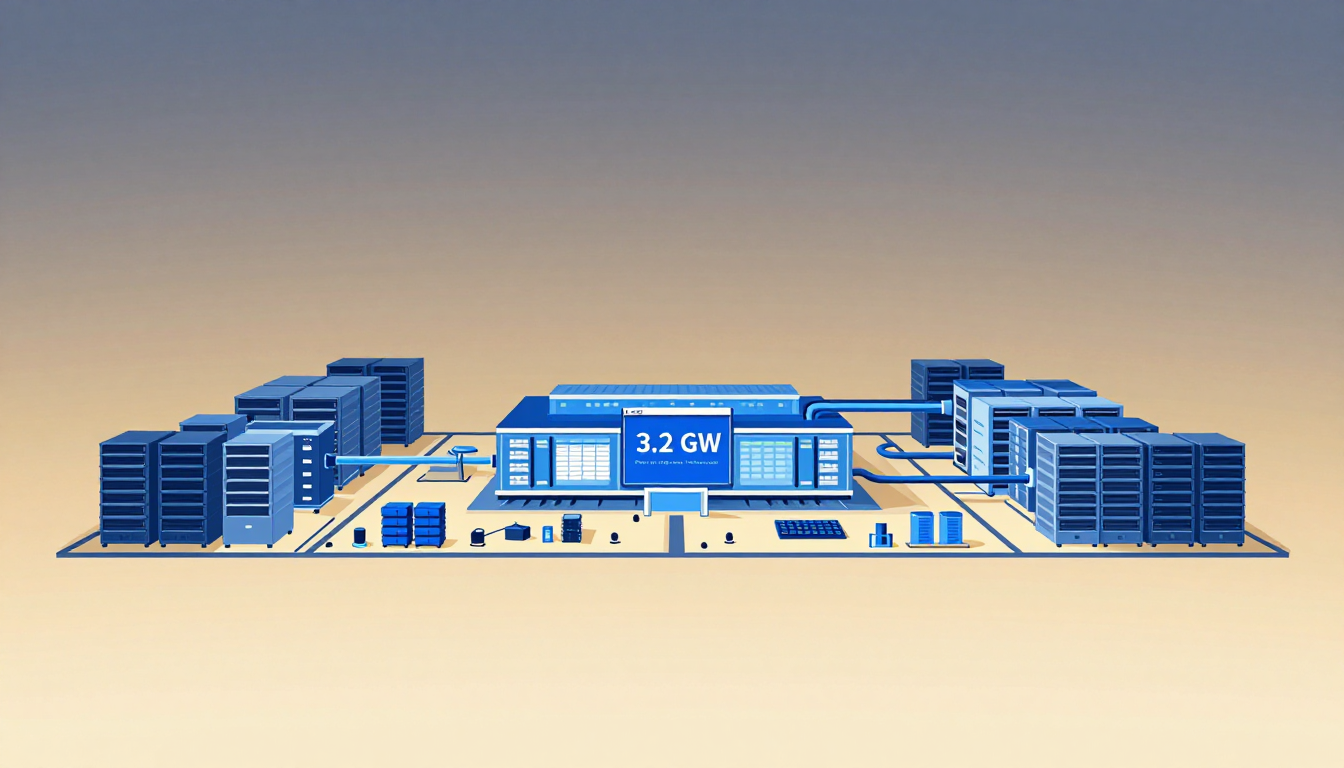
The core operational bottleneck for Project Camellia isn't land—it's electricity. OpenAI contracted for a minimum power commitment of 3.2 gigawatts from regional utility Georgia Power. To put 3.2 gigawatts into perspective, that electrical draw rivals the peak consumption of a major metropolitan area.
Georgia Power plans to deliver this capacity in phases between 2028 and 2032. However, while utility power is expected to begin flowing in 2028, OpenAI hasn't publicly disclosed a firm timeline for when the first GPUs inside the facility will actually turn on. Physical building completion, rack integration, and network fabric tuning often push operational dates beyond initial power availability.
Natural Gas Baseload Powers the 9.9 GW Utility Expansion
Where is all this power coming from? When asked by TechCrunch for specifics on the fuel mix for Project Camellia, neither OpenAI nor Georgia Power provided immediate answers. But state regulatory filings fill in the blanks.
In December, the Georgia Public Service Commission (PSC) approved Georgia Power to contract an additional 9,885 megawatts (~9.9 gigawatts) of capacity, which the utility expects to lock in by the end of 2026. OpenAI's 3.2 gigawatt commitment alone absorbs roughly one-third of that entire state-wide utility expansion.
According to filings with the PSC, the vast majority of that new power will come from fossil fuels:
- 5.8 GW Natural Gas Additions: Georgia Power plans to build or purchase approximately 5,800 megawatts of natural gas generation.
- Simple-Cycle Peakers: Roughly 25% of that natural gas portfolio will consist of simple-cycle gas turbines. These units can ramp up quickly to meet sudden load demands, but they burn dirtier and emit more carbon per megawatt-hour than combined-cycle facilities.
- Fleet Expansion: This single procurement more than doubles Georgia Power's existing natural gas fleet.
- Clean Components: The remaining share of the 9.9 GW authorization consists of utility-scale solar paired with grid-scale battery storage.
Despite public sustainability pledges, continuous cluster availability demands reliable baseload energy. Simple-cycle gas turbines provide the firm generation necessary to backstop training jobs that cannot afford power interruptions. Managing thermal density at this scale also requires aggressive cooling innovations, similar to developments in refrigerant-based two-phase cooling.
Ratepayer Safeguards and 1-Gigawatt Grid Curtailment
Multi-gigawatt data center contracts frequently spark political pushback over electric rates. Last year, the Georgia PSC adopted a key safeguard: a rule barring utilities from passing on the costs of infrastructure and electrical service upgrades required for users drawing more than 100 megawatts onto residential or commercial ratepayers.
Because of this rule, OpenAI must pay the full cost of its own site-specific grid upgrades, substations, and transmission connections, reflecting federal priorities outlined in the White House energy framework.
Additionally, Georgia Power confirmed that OpenAI agreed to operational grid shedding. During emergency grid events—such as summer heatwaves or severe winter freezes—Project Camellia will curtail its power draw by up to 1 gigawatt. Shedding 1,000 megawatts of active compute mid-training is a massive technical challenge. It requires fault-tolerant cluster architectures, instantaneous checkpointing, and dynamic workload migration to prevent lost model progress.
The Brett Mayo Playbook and Environmental Clean Air Lawsuits
To execute this build at maximum speed, OpenAI hired Brett Mayo to lead data center construction. Mayo previously ran infrastructure deployment for xAI, where he directed the construction of the Colossus data center campus in Memphis, Tennessee.
Mayo earned a reputation for ultra-fast physical execution at Colossus. But that speed came with intense legal and environmental friction:
- Air Quality Lawsuits: In Memphis, the NAACP and the Southern Environmental Law Center filed a lawsuit against xAI over local air pollution.
- Unpermitted Turbines: The lawsuit alleges xAI operated dozens of unpermitted natural gas turbines to power Colossus while claiming exemptions from federal clean air regulations.
As Mayo takes charge of Project Camellia in Effingham County, environmental groups and state regulators will be closely monitoring OpenAI's construction practices. The tension between meeting aggressive training timelines and complying with environmental standards will test OpenAI's operational strategy in Georgia.