The Idle Silicon Dilemma in Enterprise AI
Enterprise engineering teams are procuring high-end accelerator clusters far faster than they can measure what those racks actually cost. Data from a Q2 2026 VentureBeat Pulse Research survey of 107 enterprise organizations (concentrated in companies with over 100 employees) reveals a gaping disconnect between hardware acquisition and unit-economic visibility. Tech teams keep committing capital to fresh compute contracts while existing hardware sits idle most of the day.
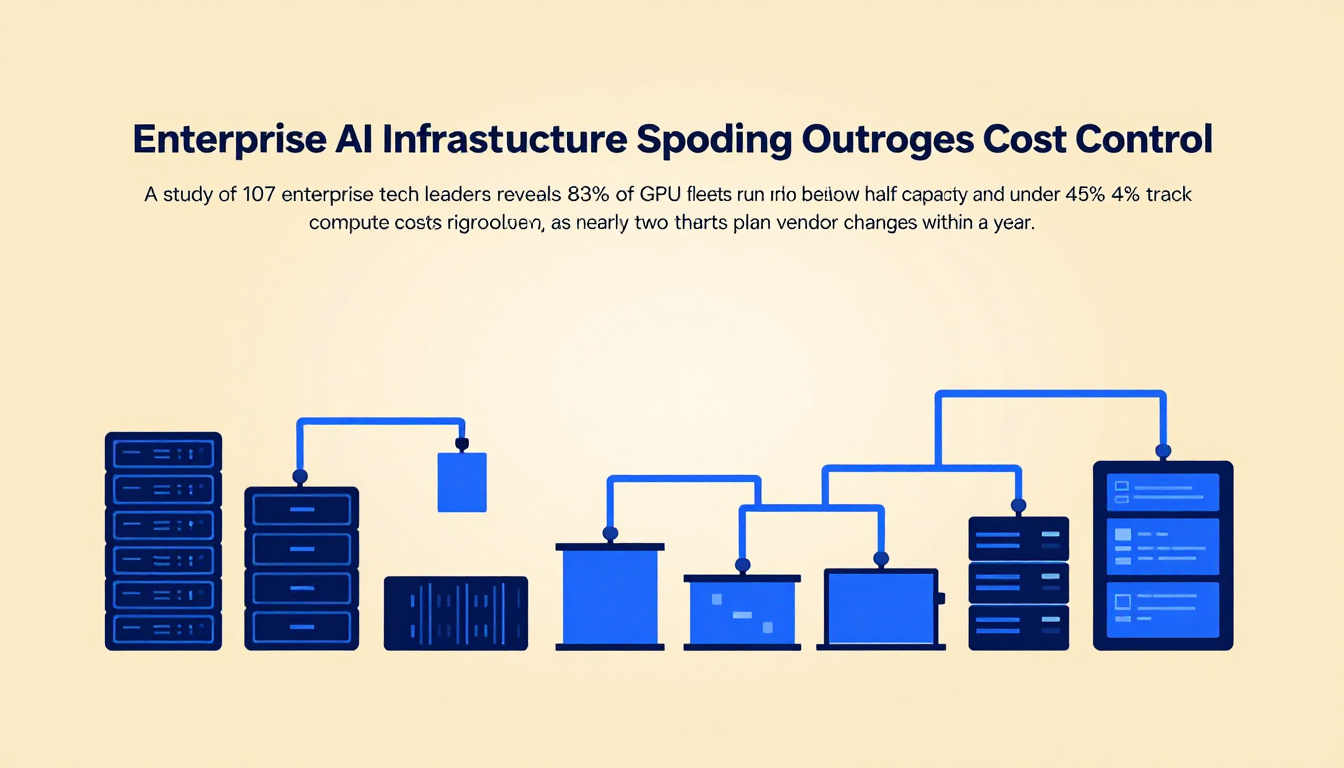
The raw numbers are stark. Among organizations running dedicated GPUs, 83% report average cluster utilization of 50% or less. Nearly half—49% of respondents—run their hardware at 25% capacity or below, with 15% lingering under 10% utilization. Only 12% of GPU operators clear the 50% utilization mark, while 8% do not measure utilization at all.
This waste isn't occurring in mature, battle-tested production environments. Only 21% of surveyed enterprises run AI workloads in production at scale. The remaining majority are still navigating the ramp: 38% remain stuck in proof-of-concept experimentation, 37% run limited workloads across isolated teams, and 4% have not deployed workloads yet. Organizations are locking in long-term compute commitments while still determining basic workflow requirements.
Current Stack Dominance Meets Emerging Neocloud Appetite
Today's enterprise AI stack remains anchored by established cloud hyperscalers and primary model vendors. Google Cloud leads platform presence at 48%, followed by Microsoft Azure at 29%, Amazon Web Services at 22%, and Oracle Cloud at 22%. On the model layer, Google's Gemini models lead at 41% usage, OpenAI sits at 40%, and Anthropic holds 12%. Self-managed physical hardware is rare: just 6% run co-located GPU clusters, and 4% operate a custom open-source stack.
Specialized AI cloud providers—including CoreWeave, Lambda, Crusoe, Nebius, Together, and Fireworks—account for less than 2% of active deployments each today. Yet that modest footprint masks an impending structural shift.
When asked where they plan to direct infrastructure evaluations over the next 12 months, 45% of enterprises pointed to specialized AI clouds. It represents the top planned evaluation target in the survey. Meanwhile, 32% plan to evaluate non-Nvidia accelerators such as AWS Trainium, Google TPUs, AMD Instinct, or Intel Gaudi chips. Another 28% are targeting next-generation Nvidia Blackwell GB300 silicon, while 16% plan to evaluate decentralized compute networks and 11% are exploring sovereign compute options.
Engineering leaders want performance options outside traditional cloud hyperscalers. But bringing new infrastructure vendors into an unmeasured operational environment often multiplies financial drag rather than reducing it. Without enforced control mechanisms, such as automated cloud waste policy gates, shifting workloads to specialized clouds creates unmonitored line items on the corporate balance sheet.
Near-Term Reshuffling and the Death of Token-Price Marketing
Vendor loyalty in enterprise compute has eroded. A full 64% of surveyed enterprises plan to switch or add infrastructure providers within the next 12 months. More than half of those switchers—38% of the total sample—intend to make a move within 0 to 3 months. Another 22% plan changes within 3 to 6 months, while only 36% intend to maintain their current provider lineup without modification.
Near-term churn isn't a sudden exodus to emerging startups. Over the next quarter, buyers are primarily shuffling spend among major incumbents: Microsoft Azure (33%) and Google Cloud (33%) lead switching consideration, followed by OpenAI (30%) and Gemini (22%). While specialized neoclouds represent a 12-month evaluation goal, immediate budget reallocation remains concentrated among major platforms.
What actually drives these enterprise procurement choices? Infrastructure providers frequently fight loud marketing campaigns over headline token rates, but enterprise buyers ignore those sticker prices. Cost per million tokens ranked dead last among selection criteria, selected by only 8% of respondents.
Instead, enterprise buyers prioritize stack integration and operational predictability:
- Integration with existing cloud and data stack: 41%
- Total cost of ownership (TCO): 35%
- Performance (latency and throughput): 24%
- Security, compliance, and autoscaling: 19% each
- GPU access and availability: 19%
Buyers care about how a vendor fits their current software architecture and what it costs over a multi-year horizon. But prioritizing TCO during vendor selection creates an obvious contradiction when teams cannot track their current operational costs. See Taming the GenAI Token Budget: Lessons from Cloud FinOps for how enterprises are applying FinOps disciplines to bring AI token spend under control.
The Financial Visibility Blindspot
The survey highlights a deep divide between stated procurement goals and operational measurement capabilities. Although TCO is a primary purchase criterion, fewer than half of enterprises—just 44%—rigorously track compute costs and return on investment. Another 39% track spend only partially, 20% cannot quantify ROI at all, and 6% state economic tracking isn't a priority.
Unsurprisingly, buyer satisfaction reflects this measurement gap. Overall satisfaction with current infrastructure averages a modest 4.0 out of 5, but scores drop when rating value for money (3.9) and implementation effort (3.8). When engineering teams cannot surface clear unit economics, finance teams face uncertainty during budget renewals. For CFOs, determining whether enterprise AI infrastructure spending yields net enterprise value remains a multi-trillion dollar question.
The Unwatched Bottleneck: Memory Bandwidth and KV-Cache Limits
A fundamental hardware bottleneck is approaching: the transition from raw GPU compute capacity to memory bandwidth and KV-cache constraints during large-scale inference. Enterprise readiness for this shift is fragmented.
When asked how they plan to address inference memory limits:
- 31% plan to rely on Dell storage platforms like PowerScale or Project Lightning.
- 16% look to Nvidia solutions such as Dynamo or ICMSP.
- 10% favor Hammerspace Tier Zero, and 9% lean toward DDN Infinia.
- 18% admit they either don't know about the memory bandwidth constraint (9%) or haven't started addressing it (8%).
Nearly one-fifth of enterprise tech leaders are stepping into the next major architectural shift without a strategy.
Strategic Directives for Infrastructure Instrumentation
Procuring additional raw compute capacity will not cure a telemetry deficiency. If 83% of your GPUs operate at 50% capacity or less, purchasing faster silicon merely speeds up capital burn.
Infrastructure leaders must institute operational discipline before expanding vendor contracts:
- Establish granular hardware telemetry: Track memory bandwidth utilization, tensor core activity, and idle container hours rather than relying on high-level node availability metrics. When workloads run below 25% utilization, auto-scale allocations or migrate them to shared burstable pools.
- Link compute costs directly to product services: Eliminate generic cloud tag buckets. Map token throughput and GPU hours straight to specific internal services, user features, or customer contracts to calculate true unit margins.
- Validate TCO before vendor migrations: Do not accept benchmark slides at face value. Factor in data egress costs, storage ingress fees, custom deployment overhead, and team retraining expenses before committing to alternative provider stacks.
Enterprise AI spending is accelerating, but building out compute without cost visibility is dangerous. Engineering teams that implement rigorous telemetry today will be the ones equipped to scale their infrastructure sustainably tomorrow. The broader pattern—trillions deployed into AI infrastructure with returns still elusive—is explored in The AI Investment Gap: Why Trillions Spent on Infrastructure Haven't Delivered Returns. Meanwhile, startups like PointFive are betting big on solving this exact problem, as covered in The $60 Million Bet That AI's Biggest Problem Isn't Intelligence—It's the Bill.