

The Stale Cache: Moving Beyond Habit Loops
For ages, the clinical consensus on obsessive-compulsive disorder (OCD) felt like an oversimplified diagnostics checklist. Clinicians watched patients wash their hands fifty times a day or check a door lock until their knuckles bled and labeled it a "habit." They assumed the brain was just stuck in a loops cycle, repeating physical routines because the motor paths were too deeply grooved. But from a systems engineering standpoint, that explanation is lazy. It ignores the input queries. If a system is running an expensive, resource-intensive write transaction over and over, you don't just blame the button. You check the state detection logic. Why is the client requesting a write if it knows the database has already been successfully updated?
It doesn't know. That is the core takeaway from a study published in Nature Mental Health. Led by Vasco A. Conceição and Frederike H. Petzschner at Brown University's Carney Institute for Brain Science, alongside international collaborators in Zurich and Lisbon, the research points to a state-inference failure. In my line of work (system migrations and distributed databases), we see this constantly. You migrate a database, but the app servers continue to read from a stale cache that had its invalidation triggers disabled. The user washes their hands, the physical telemetry reports "clean," but the state-inference engine fails to clear the old cache.
This is "belief stickiness." It isn't a mindless habit; it's a synchronization error. The brain's internal representations are lagging behind the live environment, refusing to invalidate outdated threat models even when the sensory reads are shouting that the coast is clear.
When you look at distributed environments, you expect a certain latency between a write and a read. But when that latency becomes infinite, the system breaks. That is what OCD patients live through every day. The sensory systems are sending clean packets, but the gateway rejects them because the local state is hardlocked on 'danger.' It's a structural software architecture problem, not just a physical muscle loop.
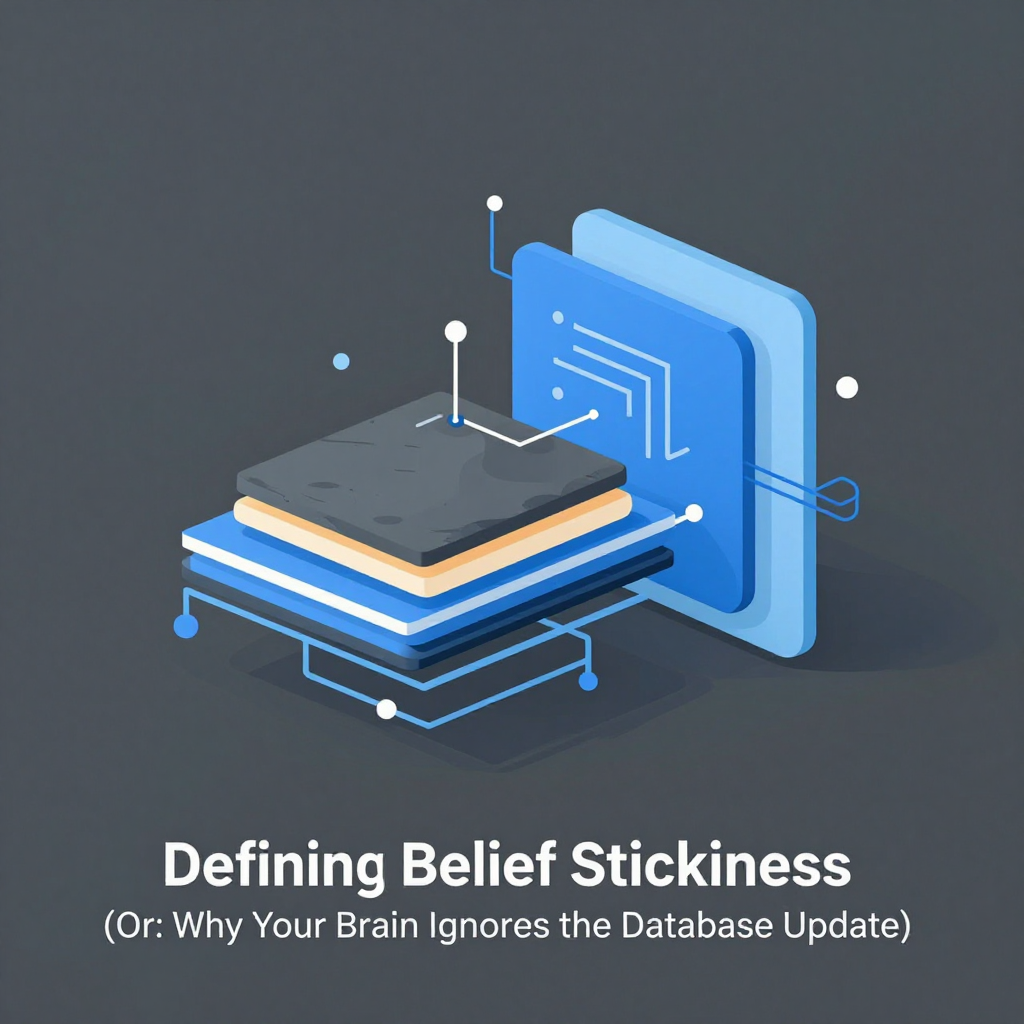
Defining Belief Stickiness (Or: Why Your Brain Ignores the Database Update)
Let's break down how this works under the hood. In a functional cognitive stack, the brain constantly balances two streams: prior expectations (its internal model of the world) and incoming sensory evidence (the real-time feed). If there's a delta between the two, the brain has to reconcile it. It can either dismiss the new data as noise, or it can update its model.
When the environment transitions from one state to another, a flexible mind invalidates the old model and pulls the new config. But if belief stickiness is high, the system behaves like a read-only replica that refuses to accept the master database's updates. The incoming data is labeled as noise, and the old, obsolete belief is kept active.
This matches what we see in other neurochemical systems. For instance, we've learned that adolescent risk-taking isn't just a simple failure of willpower or impulse control. Instead, low baseline dopamine drives compensatory actions as the brain tries to normalize its reward signaling. The system is trying to adjust its balance. In the case of OCD, the compulsive washing isn't a random behavioral glitch; it's a desperate, compensatory transaction designed to resolve an unyielding internal belief that the hands are still dirty.
According to the Brown University researchers, belief stickiness specifically refers to this difficulty in detecting that the world has shifted from one phase to another. The obsessive thoughts of contamination or hazard aren't irrational because the patient lacks intelligence. They are irrational because their state-inference compiler is stuck on a cached value. The visual feedback of clean hands or a locked door cannot override the persistent, outdated internal representation. If your local device is out of sync with the cloud, no amount of reloading will fix the page until you clear the cookies.
Even when you show the patient the raw logs of the lock click, their state engine refuses to record the transaction. They know the lock clicked—they heard it, they saw it. But the state variable remains unchanged. It is a deep, structural discrepancy that leaves the brain in a perpetuating loop of state validation. The client is trying to force a state mismatch resolution that the hardware cannot complete.
The Seasons Task: Benchmarking State-Inference in the Lab
You can't debug an out-of-sync system without reproducing the bug in a controlled sandbox. To test this state-inference model, Petzschner and cohort didn't rely on self-reports or vague clinical impressions. They designed a probabilistic shell-collecting task, which they called the "Seasons" game, to isolate how humans handle silent environmental transitions.
Fifty healthy volunteers participated in a randomized, double-blind, placebo-controlled trial. Half received a placebo, while the other half received a single dose of escitalopram, a common SSRI (Lexapro) that raises serotonin levels. They sat in front of a computer, collecting different shells.
The rules were simple. Some shells rewarded you with pearls (points), while others gave you dirt (point deductions). The trick was that the system had hidden seasons. The rules would silently flip. A shell that had been paying out pearls would suddenly start spitting out dirt.
To win, you couldn't rely on trial-and-error memory. That takes too long. Instead, you had to infer the current state—the "season"—of the environment. By comparing the volunteers' choices to mathematical models, the researchers could measure exactly how long a player clung to their old strategy before realizing the season had flipped.
The diagnostic was clear. The volunteers with higher levels of escitalopram in their blood systems were significantly faster at updating their models. They did not drag their feet. As soon as the shell outcomes changed, their brains registered the transition and adapted. Their belief stickiness was reduced, allowing them to shift strategies and minimize point losses.
Essentially, the serotonin boost acted like a network reset, wiping out the accumulated cognitive debt that usually keeps a user stuck trying the same failing strategy. The placebo group, on the other hand, kept picking the dirty shells long after the rules changed, demonstrating a persistent cognitive lag. They were still running the A season schema, even though the B season migration had already gone live.
Serotonin as the Cache Invalidation Engine
For decades, the pharmaceutical industry described SSRIs with vague hand-waving, saying they "boost mood" or "correct chemical imbalances." It is a fuzzy explanation that explains nothing about the actual mechanism. This is like saying a database update command "makes the system happier." We need to know what the query does.
This study gives us a precise computational role: serotonin is the cache invalidation signal.
When serotonin levels are pharmacologically elevated, the brain becomes more sensitive to unexpected outcomes (prediction errors) and reduces the weight it assigns to its prior, rigid beliefs. It forces the system to perform a live read from the sensors instead of trusting the local data cache.
This is similar to how we use automated tools to spot subtle, hidden system errors that humans miss. For example, when detecting neurological disorders, clinics used to wait for active symptoms, but now AI decodes background brainwaves to identify subtle epilepsy markers long before a patient experiences their first physical seizure. It's about finding the computational irregularities in the baseline background noise.
In the case of OCD, the irregularity is an over-weighted prior. The brain assigns so much weight to the "threat" belief that no amount of clean sensory data can overwrite it. But when you boost serotonin via escitalopram, you re-calibrate the system. You lower the priority of the prior belief and allow the new environment data to rewrite the cache. The belief stickiness dissolves, and the organism is free to adapt to the present reality.
It is a beautiful piece of bio-computation. Instead of trying to suppress the motor execution of the washing, the serotonin boost fixes the root logic that makes washing seem necessary. It upgrades the client's local configuration. If you don't fix the underlying state-inference engine, the client will just find another way to resolve the mismatch, leading to symptom substitution. By resetting the cache invalidation threshold, you fix the bug at the source.
Synchronous Care: Timing Therapy to the Pharmacological Window
If a single dose of an SSRI causes a rapid, acute boost in our ability to update beliefs, the way we structure psychiatric treatment is fundamentally broken. Right now, medications and therapy run on separate tracks. You take your pill with breakfast, go to work, and then see your psychotherapist for an hour on a Tuesday afternoon. The two treatments are placed in the same general timezone but they are never synchronized.
That is a massive waste of resources.
If the medication is opening a temporary, high-flexibility window where the brain is uniquely primed to update its internal rules, we should be scheduling therapy to hit that window exactly.
Think of it as a systems migration. You don't try to shift legacy infrastructure to a new cloud platform when the network interfaces are down or when the database is congested. You wait for the exact maintenance window when the tools are ready.
While we know that evidence-backed approaches to healing like Cognitive Behavioral Therapy (CBT) and Exposure and Response Prevention (ERP) are the standard options for recovery, their timing has always been random. The Brown study suggests we need to build a synchronous protocol. If we schedule intensive exposure sessions to match the peak plasma concentration of the drug, we can challenge the patient's rigid beliefs while their brain is neurochemically flexible. We force a database write when the cache invalidation triggers are wide open. That is how you get a migration to stick.
By coordinating the chemical and behavioral inputs, we can make the learning process highly efficient. CBT teaches the patient that checking or washing isn't required for safety. But if the brain is in a sticky state, that lesson is rejected like a bad packet. Schedule that same therapy session when escitalopram levels are peaked, and the brain actually logs the new safety config. It writes the update to disk.
Computational Psychiatry and Open Source Standards
Beyond the immediate clinical implications, this research is a perfect example of what modern computational psychiatry should look like. The authors didn't keep their code or raw telemetry data locked up in a proprietary black box. They made their entire computational model available on public repositories like GitHub, and they uploaded their datasets to Zenodo.
This level of transparency is essential. For years, psychiatry has been criticized for relying on subjective, vibes-based diagnostics defined in the mid-twentieth century. By putting their mathematical models in public view, Petzschner and her team allow any systems developer or researcher to run the scripts, audit the learning rates, and verify the state-inference calculations.
The numbers speak for themselves. The team noted that volunteers who reported high levels of sub-clinical obsessive thoughts also showed the highest levels of belief stickiness and the poorest state-inference on the shell task. The math aligns perfectly with the clinical reality.
We are moving toward an era where we can debug the human mind using the same structured rigor we apply to enterprise codebases. For anyone suffering from the exhausting, repetitive loops of OCD, this study does not just modify the current treatment manual—it offers a completely new, system-wide upgrade.
It is about time. We have spent too long trying to solve software bugs with simple reboot scripts. If you want to fix the system, you have to look at the database logic, the queue management, and the cache invalidation triggers. This study shows us exactly how to do that. It proves that with the right neurochemical invalidation signal, we can help people rewrite even their most stubborn, sticky beliefs.