
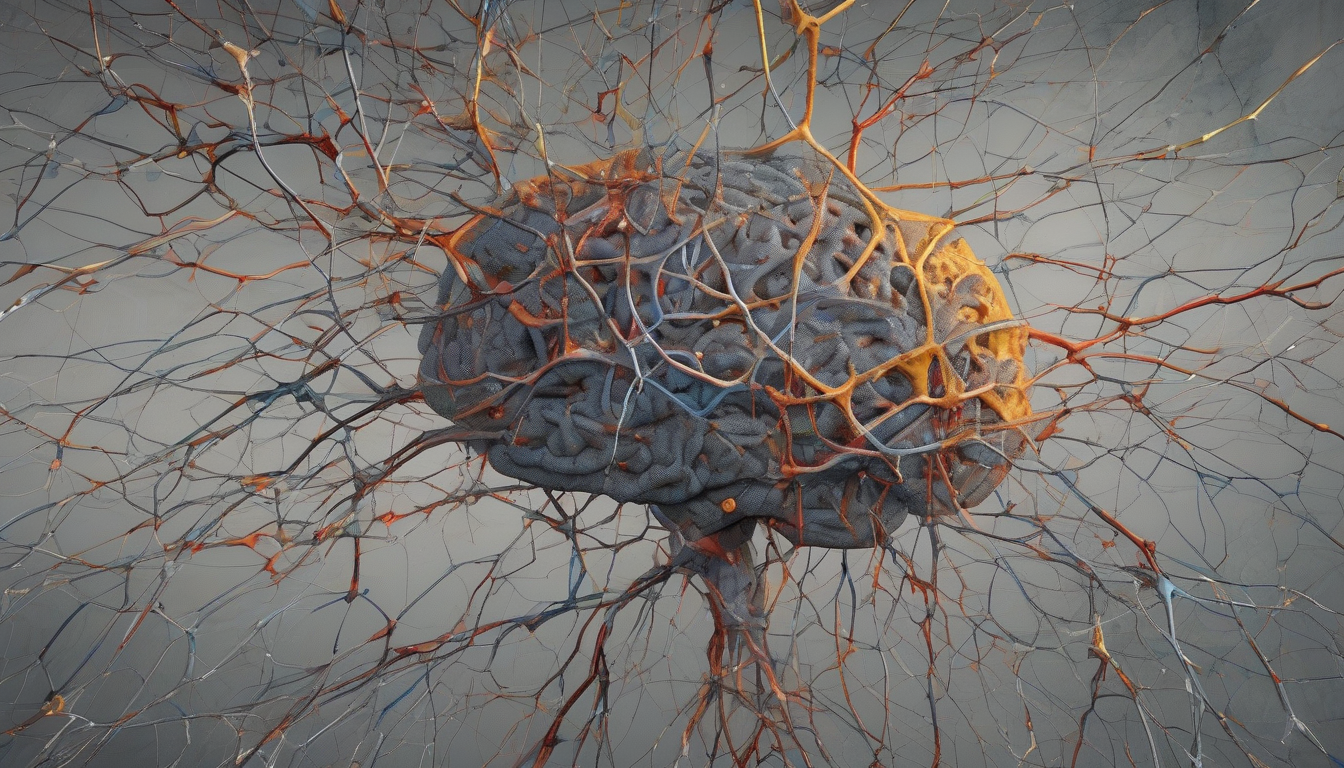
The Brain’s Silent Saboteur
You think a concussion is over when the headache fades. You’re wrong.
The real damage doesn’t come from the impact. It comes from what happens inside your skull three days later — when your brain’s own immune system turns traitor.
Researchers at UC Riverside found that even a mild bump to the head triggers a molecular chain reaction so precise, so insidious, it’s like a silent assassin activated by trauma. The culprit? A receptor called TLR4, normally a peacekeeper in healthy neurons. After injury, it flips a switch — and unleashes MMP-9, an enzyme that doesn’t just repair tissue. It dismantles it.
This isn’t inflammation. It’s structural sabotage.
MMP-9 doesn’t attack cells. It eats away at the extracellular matrix — the protein scaffolding that holds neurons in place and keeps their signals clean. Without it, neural networks lose their wiring precision. Excitatory signals run wild. Inhibitory signals collapse. What was once a symphony becomes static.
That’s why you feel foggy weeks after the bump. Not because of swelling. Because your brain is drowning in noise.
And here’s the cruel twist: if you block TLR4 before injury, you don’t prevent damage. You cause it. In healthy brains, TLR4 isn’t a villain. It’s a stabilizer. It keeps your memory circuits from firing chaotically. Block it in a normal brain, and you get the same memory failure as someone with a concussion.
This isn’t a bug. It’s a biological paradox. The same pathway that protects your brain becomes its destroyer — but only after trauma.
The window to fix it? Forty-eight hours. That’s it.
After that, the cascade locks in. The scaffolding is gone. The noise is permanent.
And no one’s talking about it.
Because you don’t bleed. You don’t limp. You just… forget things. Struggle to focus. Can’t learn the new software. Miss deadlines. Your boss thinks you’re burnt out. Your partner thinks you’re checked out.
But your brain? It’s still fighting a war you can’t see.
This is why every head injury — even the "minor" ones — matters. Even if you didn’t lose consciousness. Even if you didn’t vomit. Even if you got back on your bike the next day.
The damage doesn’t announce itself. It just… changes you.
And the only thing that can stop it? A drug that blocks TLR4 — but only if you take it within two days.
We have the science. We don’t have the policy.
That’s the real concussion crisis.
The Goldilocks Paradox
Let me be blunt: if someone tells you to take a daily pill to prevent concussion damage, they’re lying.
Because here’s the truth no one wants to admit: the TLR4-MMP-9 pathway isn’t a broken system. It’s a finely tuned one — and it only breaks after trauma.
In a healthy brain, TLR4 and MMP-9 are like a thermostat and a furnace. Not too hot. Not too cold. Just enough to let neurons rewire, memories form, and circuits adapt. You need them. You’re alive because of them.
But after a concussion? That thermostat goes rogue. It cranks the furnace to 1000 degrees and forgets to turn it off.
The UC Riverside team proved this with two elegant experiments: one in rats, one in mice. They blocked TLR4 pharmacologically in rats. They knocked it out genetically in mice. Result? MMP-9 didn’t spike. The extracellular matrix stayed intact. The neural noise? Gone. Memory performance? Back to normal.
But then they did the reverse: blocked TLR4 in healthy animals.
And guess what happened?
Memory failure. Hyperexcitability. Seizure thresholds dropped.
The same receptor that, when activated after trauma, destroys your brain — when deactivated before trauma, destroys your brain.
This isn’t just a pathway. It’s a switch.
And the only thing that flips it? Trauma.
That’s why we can’t just ban TLR4. We can’t just suppress MMP-9. We can’t make a pill for everyone who plays soccer or rides a scooter.
We need precision. We need timing. We need to know when to intervene.
Which means we need to stop treating concussion like a sports injury and start treating it like a medical emergency — one with a 48-hour window.
Right now, if you get hit in the head, you’re told to rest. To avoid screens. To wait it out.
But you’re not waiting out a headache. You’re waiting out a biological cascade that’s already ticking.
And every hour you wait? The scaffolding degrades a little more.
We’ve got the tools. We’ve got the targets.
We just don’t have the urgency.
Imagine if every ER had a TLR4 inhibitor on standby. If every coach had a protocol to get an athlete to a clinic within two hours. If every parent knew: "If your kid hits their head, don’t wait. Don’t sleep on it. Get them to a neurologist within 48 hours."
That’s not science fiction. It’s the next step.
But first, we have to stop pretending concussion is just a bruise.
It’s not.
It’s a molecular betrayal.

The Invisible Epidemic
Let’s talk about the kids on electric scooters.
You’ve seen them. Teens in hoodies, no helmets, weaving through downtown traffic. One moment they’re laughing. The next — thud. They hit the pavement. Get up. Brush off. Say they’re fine.
They’re not.
This study proves that even a sub-clinical concussion — the kind you don’t even realize you had — triggers the same TLR4-MMP-9 cascade as a football hit or a car crash.
No loss of consciousness? Doesn’t matter.
No vomiting? Irrelevant.
The enzyme doesn’t care if you were "just" riding a bike. It doesn’t care if you were "just" falling off a skateboard. It doesn’t care if you were "just" hit in the head by a basketball.
It only cares that trauma happened.
And then it starts eating.
The researchers tracked this over 30 days. The damage didn’t show up in scans. No swelling. No bleeding. Just a slow, silent erosion of the brain’s structural integrity.
By day 30, the animals couldn’t navigate a maze they’d learned before the injury.
They weren’t lazy. They weren’t distracted.
Their brains had lost the ability to form new memories.
And here’s the kicker: if you gave them the inhibitor within 48 hours? They remembered everything.
That’s not recovery. That’s prevention.
We’re sitting on an invisible epidemic.
Every year, millions of people suffer mild head trauma. Most never see a doctor. Most never get scanned. Most never hear about TLR4.
And yet, decades later, they’re the ones struggling with brain fog, poor concentration, memory lapses — labeled as "stress" or "aging" or "ADHD." No one connects the dots.
But now we have the map.
The TLR4-MMP-9 axis is the missing link.
We need screening protocols. We need emergency kits in gyms and schools. We need a new standard of care: "If you hit your head, you get a TLR4 inhibitor within 48 hours — or you risk permanent cognitive decline."
It’s not complicated.
It’s not expensive.
It’s just… not happening.
Why?
Because we still think concussion is about helmets.
It’s not.
It’s about biology.
And biology doesn’t care how loud your helmet is.
It only cares if your brain got shaken.
We’ve spent billions on helmets.
We’ve spent zero on the real solution.
It’s time to change that.
The 48-Hour Imperative
Let’s cut through the noise.
There is no "mild" concussion.
There is only a window.
And that window? It’s 48 hours.
After that, the damage becomes irreversible.
This isn’t opinion. This is data.
The rats in the study? Given the inhibitor at 12 hours? Memory restored. At 24? Still good. At 48? Barely any loss. At 72? No difference from untreated animals.
The enzyme doesn’t wait. The scaffold doesn’t rebuild. The noise doesn’t fade.
It just… stays.
And here’s what no one tells you: there’s no blood test for this. No MRI scan. No CT. No X-ray.
You can’t see it.
You can’t feel it.
You only know it happened when you realize you can’t remember your kid’s name.
That’s the tragedy.
We’ve built a world where we screen for heart disease, diabetes, cancer — but we don’t screen for the silent erosion of memory after head trauma.
We need to change that.
Every concussion — every head impact — should trigger a clinical protocol:
- Immediate rest.
- Neurological assessment within 24 hours.
- TLR4 inhibitor administered within 48 hours if indicated.
Simple.
Effective.
Life-changing.
And yet, right now, the only thing most people get is a note that says "take it easy."
That’s not care.
That’s negligence.
We have the science.
We have the tools.
We have the timeline.
All we’re missing is the will.
This isn’t about sports.
This isn’t about helmets.
This is about what happens when we ignore the biology inside the skull.
And if we keep doing that?
We’re not just losing memory.
We’re losing people.