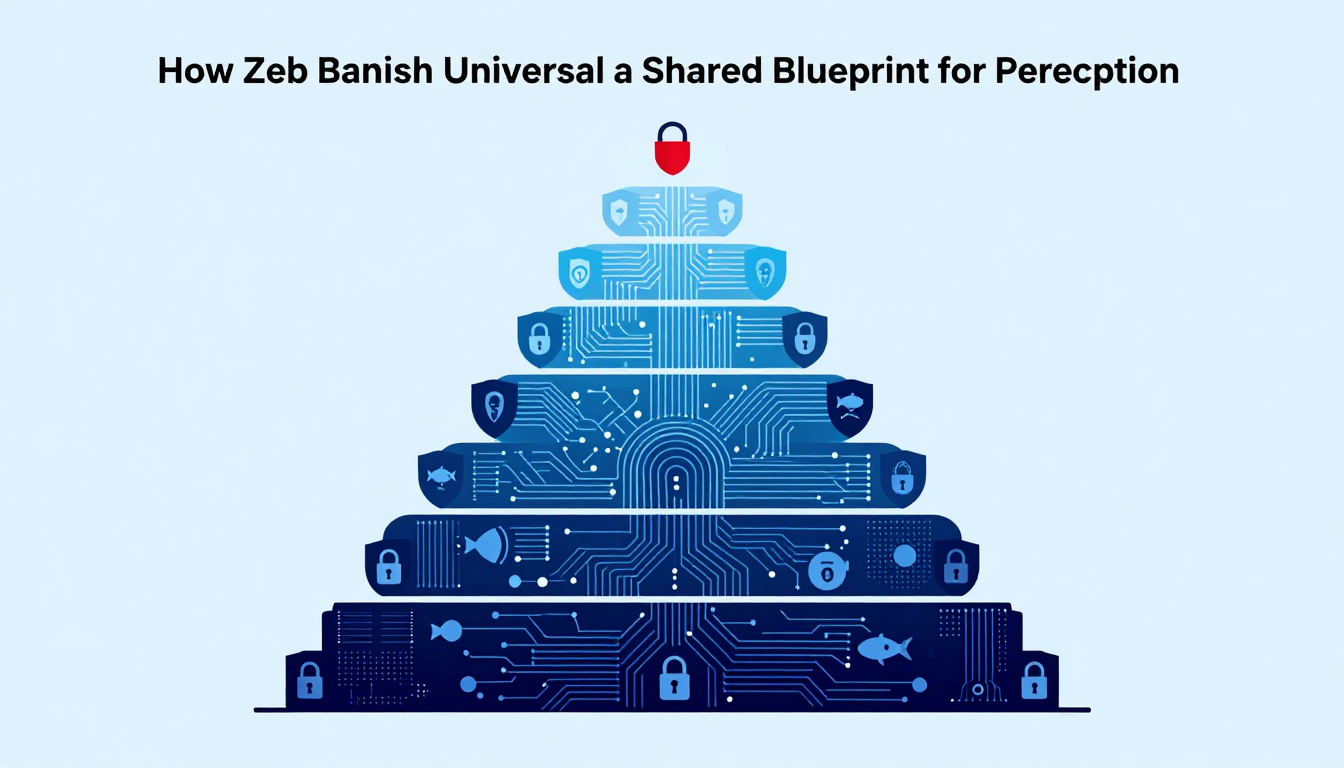
The Fish Brain’s Secret: How a Tiny Zebrafish Solves Perception Like You Do
You never experience the world as a mess of signals. Light, sound, vibration—each arrives separately, like letters in different envelopes. But your brain stitches them into one seamless scene: the thunderclap after the flash, the splash you see before you hear it. That’s not magic. It’s math. And zebrafish? They do it the same way.
I used to think perception was a mammalian luxury. Something evolved in primates, refined in humans, a crowning achievement of cortical complexity. I was wrong. It’s older than that. Older than mammals. Older than reptiles. It’s in the forebrain of a fish that’s barely longer than your thumb.
This isn’t about anatomy. It’s about function. And the fish doesn’t care if you call it a thalamus or a pallium. It just needs the problem solved.
The Problem No Brain Can Ignore
Let’s get real for a second. Your senses don’t deliver a movie. They deliver fragments.
Light hits your retina. Sound vibrates your eardrum. Water ripples against a fish’s lateral line. Each channel is isolated, noisy, delayed. A flash of light arrives before the thunder. A shadow passes before the splash. If your brain treated these as separate, you’d live in a fractured world—a strobe-lit nightmare of unconnected events.
So how do you know the lightning and the thunder belong together? How does a fish know the flicker above it and the vibration beneath it mean a predator’s tail just whipped by?
The answer isn’t in the eyes or the ears. It’s in the architecture.
The Thalamus Isn’t the Only Gatekeeper
In mammals, the thalamus is the bouncer. It sorts incoming signals: vision here, sound there, touch over there. Clean. Separated. Then it hands them off to the cortex for integration.
But zebrafish? They don’t have a thalamus. Not the one you know. Instead, they’ve got this weird, little structure called the preglomerular complex—or PG. It’s not homologous. Not evolutionarily related. It’s a different organ, built from different cells, shaped by different genes.
And yet? It does the exact same job.
Researchers showed larval zebrafish flashes of red light and gentle water vibrations. One at a time? The signals stayed cleanly separated in the PG. Light went left. Vibration went right. No crossover. No noise. Just like your thalamus.
This isn’t coincidence. It’s constraint. The problem demands it.
The Ladder: From Sensing to Perceiving
Here’s where it gets wild.
As signals climb deeper into the forebrain—past the PG, into the pallium—the neurons change. They don’t just pass signals along. They transform them.
At the back of the pallium? Simple cells. One stimulus. One response. Light? Fire. Vibration? Fire. Nothing more.
But as you move forward—toward the front of the brain—you start seeing cells that respond to both. Not just "light OR vibration," but "light AND vibration." Not just detection. Binding.
And then, at the very front? The coincidence neurons.
I’ll say that again.
They stay silent when you show them light alone.
Silent when you buzz the water alone.
But when both happen together? They explode.
It’s like a neuron that only screams, “Hey! That’s the same thing!”
The Coincidence Neuron: The Brain’s Glue
Dr. Anh-Tuan Trinh, the lead researcher, saw these cells for the first time on his computer screen and just… stopped. He spent ten minutes staring at the data. Not because he was excited. Because he thought he’d broken something.
"Is this real?" he kept asking himself.
He ran the analysis a dozen ways. Tried to break it. Tried to trick it. The pattern held.
These neurons aren’t just responding to stimuli. They’re performing a calculation. They’re measuring temporal alignment. They’re asking: Did these two events arrive at the same time?
If yes? They fire hard.
If no? They stay quiet.
This is how you know the thunder and the lightning are one storm. This is how a fish knows the flicker and the ripple mean a predator’s just passed.
It’s not perception. It’s inference.
And it’s not unique to us.
Why a Fish? Why Now?
You might wonder: Why does this matter? A fish doesn’t write poetry. Doesn’t build cars. Doesn’t care if you call it a cortex.
But here’s the thing: the fish doesn’t need to be smart to need this.
It just needs to survive.
Most of what keeps a fish alive—swimming, breathing, dodging—is reflex. Hardwired. Automatic.
But when the world stops behaving? When the usual predator doesn’t come from the usual direction? When the shadow doesn’t match the vibration?
That’s when the pallium wakes up.
That’s when the coincidence neurons start working.
They’re not for routine. They’re for adaptation. For learning that one thing causes another. For building a model of cause and effect.
And here’s the kicker: evolution didn’t invent this once.
It invented it twice.
Two Chefs, One Soup
Professor Emre Yaksi put it best: "It’s like two chefs trying to thicken soup. One uses potatoes. The other uses flour. Different ingredients. Same result."
Mammals use thalamus and cortex.
Fish use PG and pallium.
Different parts. Same logic.
The same ladder. Same step-by-step climb from segregated input to unified perception.
This isn’t convergent evolution in the weak sense—like wings in bats and birds. This is convergent architecture.
It’s the brain’s default recipe for solving a problem that has exactly one optimal solution: how to stitch a fractured world into a single, coherent reality.
The Rule Is Deeper Than Anatomy
We’ve spent a century thinking brains are defined by their parts.
They’re not.
They’re defined by their patterns.
The fish doesn’t have a cortex. But it has something. The pallium. And it does the same job.
The fish doesn’t have a thalamus. But the PG does the same sorting.
This isn’t about homology. It’s about functional inevitability.
The brain doesn’t have choices. When you’re faced with the problem of binding sensory streams into a single perceptual event, there’s only one way to do it well.
Sort. Then integrate. Then detect coincidence.
And that ladder? It’s been running for 400 million years.
So What Does This Mean?
It means your perception isn’t special.
It means your sense of reality isn’t a human invention.
It means the way you know the thunder belongs to the lightning? That’s not a gift of evolution. It’s a law.
A law written not in DNA, but in physics. In time. In the way signals travel through space.
And somewhere, in the forebrain of a tiny zebrafish, a neuron is firing—not because it’s smart, not because it’s evolved, but because it has to.
Because the world doesn’t come in pieces.
And neither can the brain.
This isn’t about fish.
It’s about us.
And the fact that we’re not as unique as we thought.

The Architecture of Reality: Why Your Brain Is a Fish’s Brain
I used to think consciousness was the thing that made us different.
I was wrong.
The real difference isn’t in what we feel.
It’s in how much we believe we’re special.
The zebrafish doesn’t know it’s a fish. It doesn’t know it’s being studied. It doesn’t care about evolution or neuroscience.
All it knows is: the water moved. The light flashed. And something felt wrong.
That’s all it needs.
And yet, the same neurons that let it survive are the same ones that let you know your coffee cup is hot before you touch it—because you saw it steam.
We’re not the center of perception.
We’re just one node in a network that’s been running since the first vertebrate swam.
The Silence of the Coincidence Neuron
I want you to think about the coincidence neuron again.
It’s silent when alone.
It screams when paired.
That’s not a bug.
That’s the entire design.
Because the world doesn’t care if you see the light or hear the sound.
It cares if you connect them.
And that’s the moment perception becomes prediction.
The moment you stop reacting—and start anticipating.
That’s not just sensing.
That’s understanding.
And if a fish can do it? So can you.
Because you’re not special.
You’re just the latest version of the same algorithm.
Final Thought: The Brain Doesn’t Care What You Call It
We name things to feel in control.
Thalamus. Cortex. Pallium.
We think naming makes it ours.
But the fish doesn’t care what you call its pallium.
It just uses it.
And if you look closely enough—at the neurons, at the timing, at the firing patterns—you’ll see the same logic.
The same ladder.
The same silence before the scream.
Perception isn’t a human invention.
It’s a universal rule.
And the zebrafish? It’s just reminding us.
That’s all.