

The Bedrock of Democracy
An educated citizenry isn't just a nice idea—it's the engine of a functioning democracy. As the U.S. celebrates 250 years, we must confront a sobering reality: our foundational literacy skills are faltering. Democracy demands more than just occasional participation; it requires voters who can engage critically with complex ideas, read founding materials, and understand civic responsibilities. When our schools neglect the essential mechanics of reading, writing, and spelling, they aren't just failing to teach a subject; they are eroding the capacity of future generations to self-govern.
We've leaned too hard on the false promise that technology will bridge the gap. It won't. True literacy, the kind that survives and thrives, demands active cognitive engagement. We are witnessing a drift in educational priorities that has left middle schoolers unable to read cursive—a direct connection to the very documents that frame our existence. This isn't nostalgia; it's a structural critique of what we value.
We must re-invest in the mechanics of our language, not just because it makes for better students, but because it is the prerequisite for a self-governing people. The challenge before us is to rebuild the architecture of literacy that sustains free discussion, informed consent, and robust civic participation. Anything less is a compromise we cannot afford as we turn the page toward our next 250 years. We have to wake up to the fact that literacy is not a static achievement, but a continuous process of civic maintenance.
The Growing Literacy Gap
The indicators are stark. Recent data from the National Center for Education Statistics and the National Assessment of Educational Progress (NAEP) tells us that nearly 70% of eighth graders are not demonstrating proficient literacy skills. This is not a slight dip; it’s a failure of significant proportions. When these foundational skills—like structured spelling—are sidelined, we lose the cognitive scaffolding that supports sophisticated thinking.
Imagine an eleven-year-old in Philadelphia, standing in the shadow of Independence Hall, unable to decode the script of the Declaration of Independence. That child represents a failure to connect with the past and an inability to fully grasp the present. When we fail to teach basic tools like cursive, we are effectively severing a link between the citizen and the constitutional record. This is not about the aesthetic of a handwritten note; it's about accessibility to the foundational democratic record. We are effectively illiterate to our own history if we cannot decode its primary sources. The implications for critical societal engagement are profound when the foundational texts become inaccessible to the average user of the language.
This gap isn't just about reading; it's about the ability to synthesize information, to weigh arguments, and to participate in the democratic exchange of ideas. Without a firm grasp of the mechanics, children are left to navigate an information environment where the ability to critically evaluate content is easily lost, leading to increased vulnerability to misinformation and shallow analysis. We are effectively creating a secondary class of citizens whose capacity for self-governance is compromised at the most basic level.
Decoding the Literacy Circuit
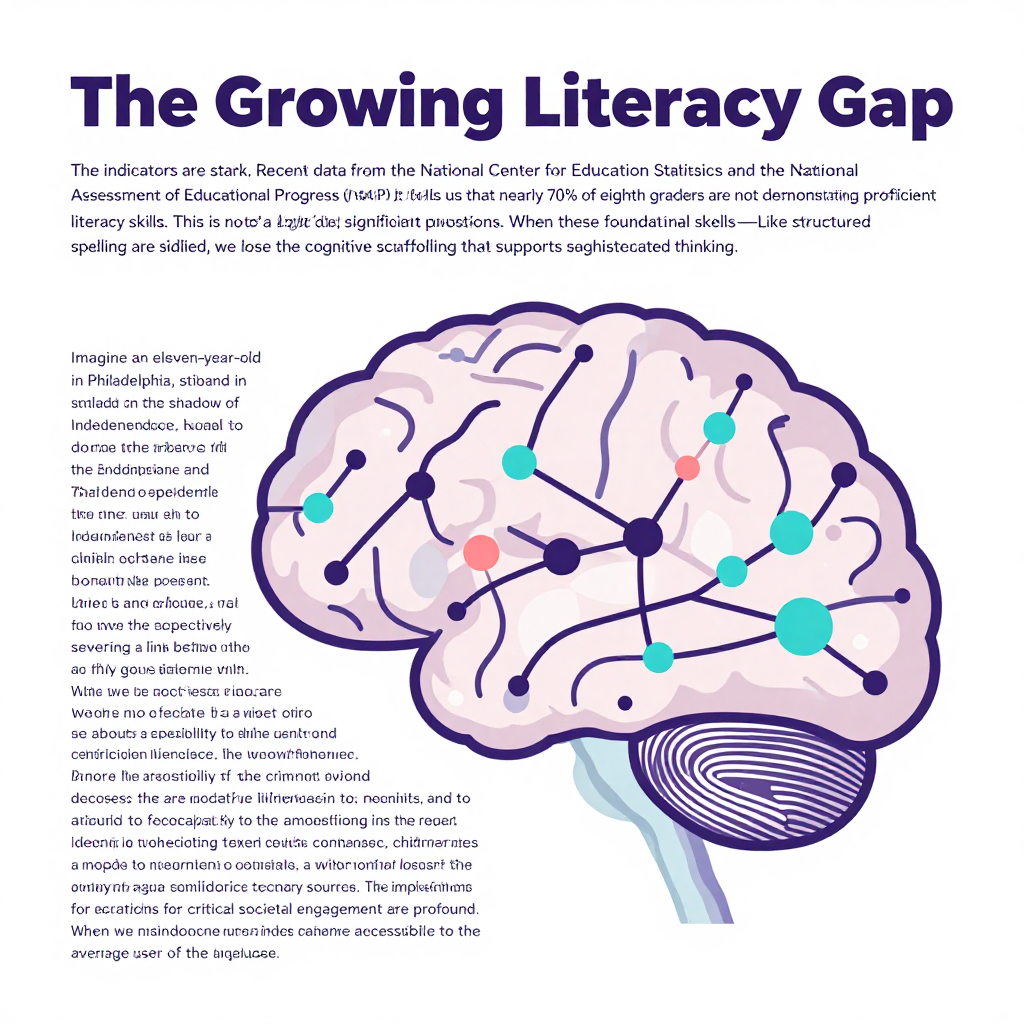
Why does spelling knowledge belong at the core of our curriculum? Because, as neuroscientist Stanislas Dehaene has argued, reading is fundamentally a visual coding system. You cannot expect the brain to create meaning if it hasn’t mapped those visual symbols onto already existing spoken language. Spelling isn't just about output; it's the input mechanism that builds the literacy circuit. By formalizing spelling instruction, we are literally activating the brain’s literacy circuits in a way that rote memorization simply cannot achieve.
When children learn to spell, they connect the visual representations to deeper morphological and phonological understanding. This is proactive, not reactive. We need to move past the era of the 'spelling test' where students briefly hold a word in their short-term memory before dumping it. We need to move toward embedding words into long-term memory. This, as researchers emphasize, is the glue that binds reading and writing together, ensuring they operate seamlessly. If we don’t commit words to long-term memory, we aren’t reading or writing; we are merely decoding. Real literacy, the kind that powers intellectual independence, happens when the spelling of a word is so internalized that it becomes automatic. This automaticity frees up cognitive resources for higher-level synthesis and critical analysis, the very skills required to navigate a modern, complex society. Without this foundational stability in the brain, the higher-level literacy skills suffer. We are leaving our students at a disadvantage because we are ignoring the basic neuroscientific principles that define how they learn best. Our educational policy needs to align with these findings.
A Case for Explicit Instruction
The recent Florida mandate, requiring formal instruction in cursive writing and spelling through fifth grade, is a welcome, common-sense push in the right direction. It signals a shift from letting 'innovation' dilute the curriculum to re-asserting the necessity of foundational skills. We must replicate this model with vigor elsewhere. If we want to guarantee a literate citizenry, we cannot leave the acquisition of these skills to chance or to a passive, exposure-based approach.
Systematic spelling instruction needs to occupy a protected space in the school day—twenty minutes daily, as recommended by researchers like Louisa Moats. This isn't a suggestion; it's a necessity. We need to stop pretending that this knowledge can be acquired passively through exposure. Morphology, root words, the six syllable types—these are specific tools that require explicit teaching. They are the keys to accessing advanced texts later on, and without them, students are left guessing. We are in effect asking our students to map a landscape without a map, a compass, or the skills to use them. The responsibility falls to the educational system to provide these tools explicitly, systematically, and consistently throughout the foundational years.
This is not a constraint on student creativity; it is a freeing mechanism that enables them to access the broader cultural, historical, and civic discourse. Teachers need a standalone curriculum because the nuance of English spelling is simply too complex to be taught off the cuff. A spiral curriculum, which reinforces and builds on previously learned concepts, is essential to ensure that foundational literacy skills are not just learned, but mastered and maintained through middle school and beyond. This is the structural correction our system urgently requires.
Democracy Needs Informed Practice
Civic education, too, needs a revamp. It shouldn't be a passive study of structures; it must be an active, practiced engagement with the responsibilities of constitutional democracy. Much like mastering literacy, citizenship requires deliberate practice. Without this, civic participation becomes a hollow exercise. We need a curriculum for the next 250 years that doesn’t treat these two pillars—foundational literacy and robust civic education—as optional, but as indispensable.
Parents, teachers, and school board members have to hold their districts to a higher standard. Demand more of the language arts block. Stop letting tech tools do the cognitive heavy lifting. It's time to invest in the research-based curricula that treat education as the primary tool for maintaining democracy. The future of our citizenship depends on it. We are not just educating individuals; we are cultivating the curators of a democratic tradition that spans generations. Each student who enters a classroom is a potential steward of our constitutional order. Giving them the tools of deep literacy and the practices of deliberate citizenship is the most responsible way we can ensure that order survives into the next quarter-millennium. The cost of failing to act is far higher than the cost of implementation. It is time to treat this with the structural priority it deserves.
In the final analysis, the health of our democracy and the strength of our literacy practices are one and the same. If we want the democracy we value to persist, we must rebuild the foundation ourselves, one word, one sentence, and one well-formed idea at a time. The work is clear, the evidence is sound, and the necessity is absolute. Let’s get to it.