
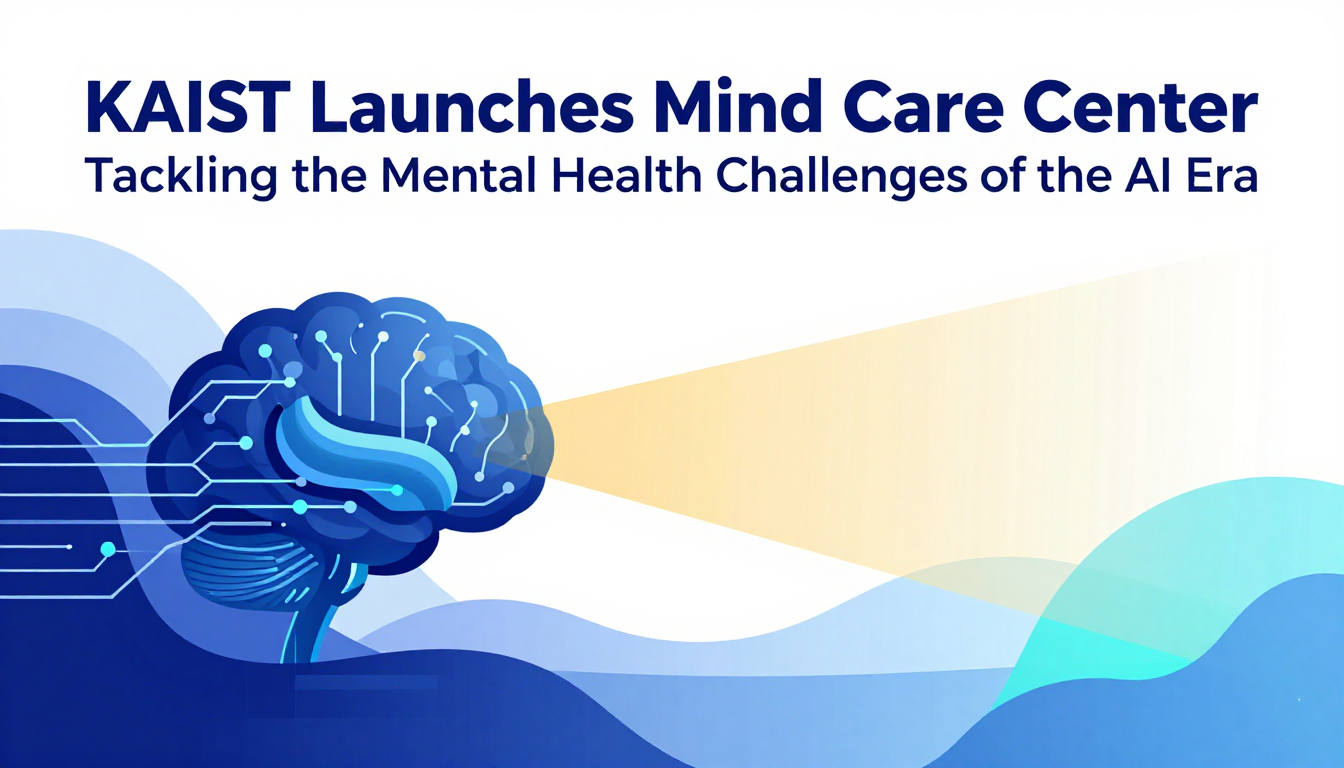
The Birth of a New Paradigm: KAIST Mind Care & Growth Center
On June 10, 2026, the Korea Advanced Institute of Science and Technology (KAIST) unveiled the KAIST Mind Care & Growth Center (KMCG), a pioneering, integrated platform designed to confront the emergent mental health crisis precipitated by the pervasive integration of artificial intelligence into daily life. Unlike traditional campus counseling centers, KMCG is not merely a service provider—it is a living laboratory at the convergence of clinical psychology, neuroscience, AI engineering, and digital humanities.
The launch was marked by an international symposium titled "Human Behavior and Mental Health," held at KAIST's Chang Young Shin Student Activity Center. Pre-registration filled to capacity within a week, and over 300 attendees—including faculty, students, global digital health experts, and clinicians—gathered to witness the formal inception of a model that could redefine mental health support in the AI era.
The center consolidates previously fragmented services—psychological counseling, psychiatric care, and crisis intervention—into a single, accessible hub. This eliminates the bureaucratic and emotional barriers students and staff once faced when navigating multiple departments for help. But KMCG’s true innovation lies in its dual mission: to deliver immediate, high-quality care while simultaneously generating rigorous, real-world research on the psychological impact of AI.
Algorithmic Anxiety: A New Clinical Phenomenon
At the heart of KMCG’s mission is the recognition and study of algorithmic anxiety—a term now formally adopted by its research team to describe the chronic stress, uncertainty, and helplessness individuals experience when confronted with opaque, automated decision-making systems. This is not mere tech frustration; it is a clinically significant condition.
As AI agents assume roles in hiring, loan approvals, academic grading, content moderation, and even interpersonal communication, users increasingly face decisions they cannot understand, challenge, or appeal. The lack of transparency in algorithmic logic—often referred to as the "black box" problem—creates a pervasive sense of powerlessness. Studies conducted by KMCG’s initial research cohort indicate that individuals exposed to high-frequency algorithmic interactions report elevated cortisol levels, disrupted sleep patterns, and diminished self-efficacy.
"We’re seeing students who refuse to submit applications because they believe an algorithm will reject them without cause," said Dr. Dooyoung Jung, Director of KMCG. "They don’t trust the system, and they don’t trust themselves to navigate it. That’s a profound erosion of agency."
AI Dependency Syndrome: When Algorithms Replace Human Connection
Beyond anxiety, KMCG researchers have identified a distinct clinical pattern they term AI Dependency Syndrome (ADS). Characterized by compulsive use of AI companions for emotional validation, avoidance of human interaction, and diminished capacity for self-reflection, ADS is emerging as a behavioral addiction with parallels to gambling and social media dependency.
A groundbreaking study co-authored by Dr. Jung and Professor Chul-Hyun Cho of Korea University College of Medicine, published in the Journal of Medical Internet Research (JMIR) on June 2, 2026, analyzed the clinical experiences of 311 Korean psychiatrists. The findings revealed that while generative AI can help users organize emotions and access therapeutic language, it also carries substantial risks:
- Reinforcement of distorted beliefs: AI systems trained on biased or incomplete datasets can validate unhealthy thought patterns, such as paranoia or low self-worth, without challenge.
- Overdependence: Patients begin to prefer AI responses over human therapists, citing "consistency" and "non-judgment" as primary benefits.
- Erosion of coping skills: Individuals disengage from traditional emotional regulation strategies, relying instead on AI to "fix" their mood.
The research team concluded that generative AI is a clinically ambivalent technology—capable of both profound benefit and serious harm. Its safe adoption, they argue, requires three pillars: technological reliability, clinical validation through peer-reviewed trials, and governance by licensed medical professionals—not engineers or product teams.
Interdisciplinary Innovation: The Neuroscape Model
KMCG’s structure is modeled after the Neuroscape lab at the University of California, San Francisco, led by Professor Adam Gazzaley, a pioneer in digital therapeutics. Gazzaley, who delivered the keynote at the launch symposium, is renowned for developing EndeavorRx, the first FDA-authorized video game treatment for ADHD.
Like Neuroscape, KMCG brings together researchers from disciplines traditionally siloed:
- AI & Computer Science: Developing adaptive AI companions trained on clinical feedback loops.
- Brain Engineering & Neuroscience: Using EEG and fMRI to measure neural responses to AI interaction.
- Industrial Design & Digital Humanities: Crafting user interfaces that promote mindfulness and reduce compulsive use.
- Mathematics & Data Science: Building predictive models to identify at-risk individuals before crisis.
- Clinical Psychology & Psychiatry: Validating interventions and ensuring ethical standards.
This convergence model allows for rapid prototyping and real-time iteration. For example, an AI chatbot designed to help students manage exam stress may be tested in real time with volunteers, its responses analyzed for emotional valence, then modified by psychologists before being redeployed.
Pilot Programs and Clinical Protocols
KMCG is already operationalizing its research into clinical protocols. Three pilot programs are currently underway:
- Digital Detox Interventions: Structured 14-day programs where students temporarily disconnect from non-essential AI tools (e.g., AI writing assistants, chatbot friends) and engage in mindfulness, journaling, and peer group therapy.
- AI-Assisted Cognitive Behavioral Therapy (CBT): A hybrid model where human therapists use AI to analyze patient journal entries for emotional patterns, then tailor CBT exercises accordingly. The AI does not diagnose or counsel—it augments.
- The "Human-in-the-Loop" AI Companion: An experimental AI agent trained exclusively on anonymized, consented data from KMCG therapy sessions. It can only respond with approved, clinically vetted phrases and is programmed to redirect users to human counselors when emotional intensity exceeds a threshold.
All interventions are subject to rigorous IRB oversight and longitudinal outcome tracking. Early results from the Digital Detox program show a 68% reduction in self-reported algorithmic anxiety after 14 days.
Leadership and Vision: Technology as a Tool, Not a Master
Dr. Dooyoung Jung’s vision is clear: "A healthy mind is the foundation for achieving outstanding research. We will develop the Mind Care & Growth Center into a platform that leads mental health solutions for universities across Korea—and eventually, the world."
KAIST President Kwang Hyung Lee emphasized the philosophical imperative behind the initiative: "In an era where artificial intelligence is replacing even high-level human intellectual labor, our greatest concern is not technological deficiency, but the potential erosion of human-centered values and culture. Technology must remain a tool guided by human wisdom and philosophy—not the other way around."
This ethos permeates every aspect of KMCG. The center’s AI systems are not designed to replace therapists but to empower them. The goal is not to make students more efficient AI users, but to make them more resilient human beings.
Global Implications and Future Trajectory
As AI becomes embedded in education, healthcare, employment, and social interaction, the challenges addressed by KMCG are not unique to Korea. Universities worldwide are witnessing rising rates of student anxiety, loneliness, and digital burnout.
KMCG is actively pursuing international partnerships with institutions like UCSF Neuroscape, the University of Oxford’s Centre for the Future of Intelligence, and the Max Planck Institute for Human Cognitive and Brain Sciences. The center plans to publish its clinical protocols and AI training datasets as open-access resources, enabling other institutions to replicate its model.
The Mind Care & Growth Center represents more than a new campus facility. It is a paradigm shift: the first institutional recognition that the mental health crisis of the 21st century is not caused by social media alone, but by the quiet, pervasive infiltration of opaque, autonomous systems into the fabric of daily human experience. By integrating care and research, compassion and code, KAIST is not just responding to the AI era—it is helping to define what it means to be human within it.
Sources and References
- Jung, D., Cho, C.-H., Kim, M., & An, Y. (2026). Mapping Practice-Based Signals of Generative AI in Psychiatric Care: Qualitative Study of Korean Psychiatrists’ Experiences, Interpretations, and Implementation Priorities. Journal of Medical Internet Research (JMIR). https://doi.org/10.2196/96556
- KAIST News Center. (2026, June 10). KAIST Launches Mind Care & Growth Center, an Integrated Mental Health Platform for the AI Era. https://news.kaist.ac.kr/newsen/html/news/?mode=V&mng_no=62830
- Mirage News. (2026, June 10). KAIST Unveils Mind Care Center for AI Era. https://www.miragenews.com/kaist-unveils-mind-care-center-for-ai-era-1689446/
- Neuroscape Lab, University of California, San Francisco. https://neuroscape.ucsf.edu/
- Akili Interactive. (2026). EndeavorRx: FDA-Authorized Digital Therapeutic. https://www.akiliinteractive.com/endeavorrx
- World Health Organization. (2025). Guidelines on Digital Mental Health Interventions. Geneva: WHO Press.