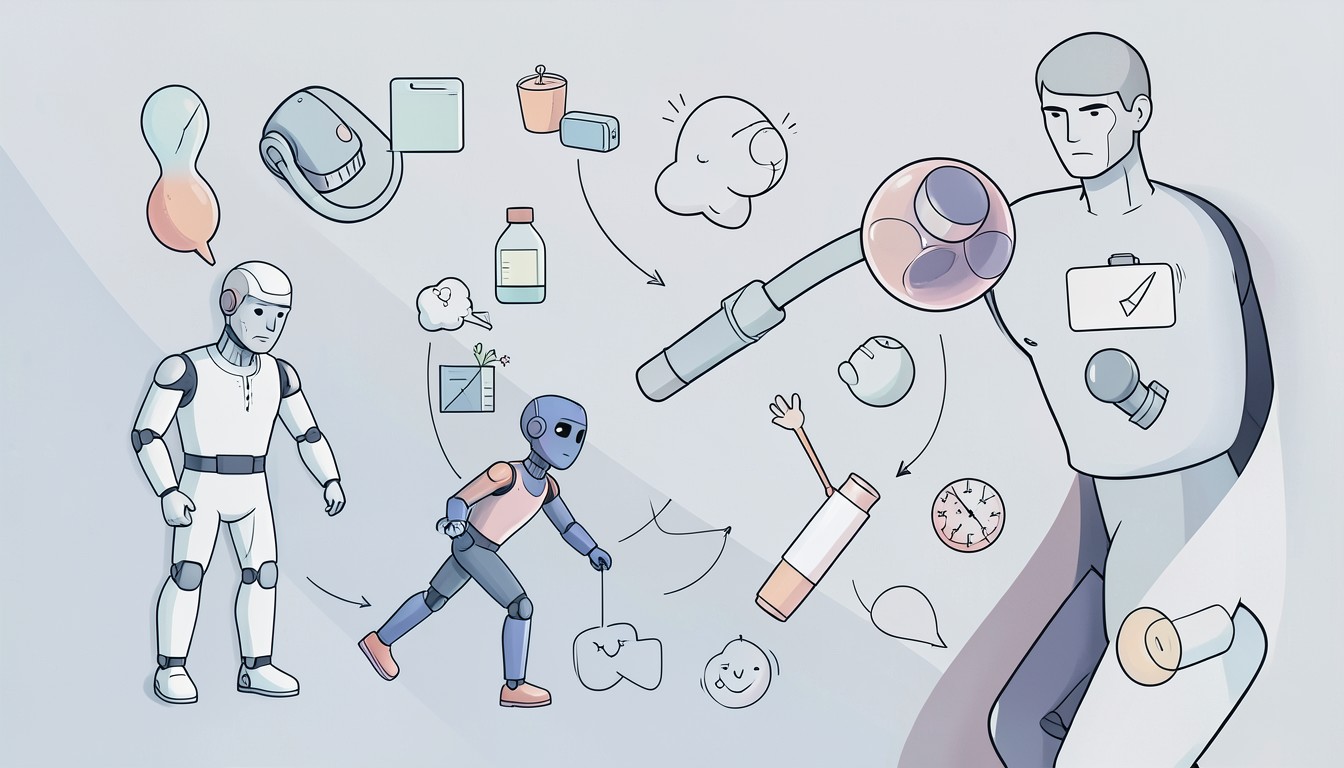
The Cognitive Bottleneck in Modern Robotics
We spend billions perfecting mechanical actuators, torque limits, sensor fusion, and path-planning algorithms, yet we routinely treat the human partner as an afterthought. Robots do not operate in a vacuum. When an industrial robotic arm, an autonomous mobile robot in a warehouse, or a service unit shares a workspace with a person, the real friction rarely stems from hardware failure or software bugs. It stems from the invisible, unmapped space between human cognition and machine behavior.
People naturally attribute intentions, beliefs, desires, and goals to moving objects—a pervasive evolutionary quirk known as the intentional stance. But when a robot moves with opaque, algorithmic logic, that natural intuition breaks down. The human operator hesitates, misinterprets state transitions, and accumulates severe mental fatigue. To understand this friction, cognitive psychologists look to dual-process theory: human interaction relies heavily on fast, intuitive System 1 processing for physical coordination, coupled with slow, deliberate System 2 processing for strategic oversight. When robotic systems violate intuitive expectations, they force humans out of effortless System 1 processing and into exhausting System 2 monitoring. If we want faster, safer integration, engineering alone will not get us there. We must look directly at cognitive science and human psychology to understand how people build trust, fluency, and cognitive synchronization with automated systems.
How Mental Models Shape Collaboration Speed
When humans work together in teams, we rely heavily on shared mental models—tacit, internalized representations of who is doing what, what the collective goal is, and how teammates will react under pressure. We predict what our colleague will do next because we share similar cognitive architectures, cultural norms, and social conditioning. Robots, however, lack human socialization and biological intuition, forcing the human partner to construct an entirely new mental model from scratch, often under high-stress operational conditions.
Cognitive science shows that human learning accelerates dramatically when machine interfaces align with existing cognitive heuristics rather than forcing unnatural abstractions. If a robotic system telegraphs its upcoming trajectory and intent through subtle physical cues—such as a slight pre-movement pause, directional gaze simulation, compliant movement arcs, or anticipatory LED status indicators—it slashes the cognitive burden on the human operator. Instead of computing complex spatial probabilities and kinematics matrices in real-time, the human brain taps into intuitive perception, cutting training time, lowering error rates, and establishing seamless workflow rhythms.
Bridging Theory of Mind and Machine Transparency
Psychologists frequently study Theory of Mind: the innate human capacity to impute mental states, intentions, and knowledge to others. In human-robot interaction, this mechanism operates in a frustratingly asymmetric fashion. Humans desperately try to model the robot's internal computational state, while the robot typically remains entirely opaque, executing code without contextual feedback or emotional signaling.
Recent research highlights that when scientists apply psychological frameworks to design robot feedback loops, human learning curves flatten drastically. Instead of forcing operators through rigid, text-heavy training manuals or abstract command-line interfaces, intuitive visual, auditory, and kinetic cues allow people to pick up collaborative workflows in minutes rather than hours. Transparency is not merely about dumping raw log files or error codes onto a monitoring screen; it is about translating machine state changes into a format that the human brain is evolved to decode instantly without conscious effort. By making the robot's goals and current operational limitations explicit, we bridge the Theory of Mind gap, enabling intuitive mutual adaptation.
Designing for Human Cognitive Limits
Working alongside automated systems places immense, often unmeasured demands on human working memory and sustained attention. Cognitive psychologists understand all too well the phenomenon of vigilance decrement: after just twenty minutes of monitoring a partially autonomous machine, human operators experience sharp drops in attention and routinely miss critical anomalies because monotony lulls cognitive vigilance. This is the same cognitive-load dynamic explored in research on AI as a cognitive amplifier: well-designed AI support can extend human thinking, but poorly designed automation drains it.
By integrating insights from cognitive psychology and human factors engineering, developers can design proactive task-allocation strategies and interface rhythms. Rather than treating humans as passive, sleepless monitors of automated routines, systems can engage them as active collaborators with well-paced turn-taking protocols. This keeps arousal levels optimal, prevents cognitive tunneling, and maintains robust situational awareness across complex shared tasks in dynamic environments. Understanding working memory bottlenecks ensures that interfaces do not overwhelm the operator with redundant alerts during high-stress operational windows.
Trust Calibration and the Cost of Ignoring Cognitive Architecture
When robotics developers ignore psychological science, the penalties show up immediately in deployment metrics: high turnover rates, operator resistance, frequent safety stops, and sluggish throughput are classic symptoms of cognitive mismatch. When a robot's movement feels jerky, erratic, or unreadable, the human brain interprets that unpredictability as a threat or unreliability, triggering anxiety and defensive avoidance behaviors.
Conversely, when machines exhibit predictable behavioral cadence and clear communicative signals, human stress hormones drop and operational trust surges. Trust calibration is critical in human-robot collaboration; operators must neither under-trust the system (leading to redundant manual overrides and wasted automation potential) nor over-trust it (leading to dangerous complacency). Psychology provides the exact diagnostic toolkit needed to understand where human-machine friction originates, how to calibrate trust accurately, and how to engineer intuitive coordination out of the system before deployment.
Psychological Frameworks for Adaptive Teaming
Moving beyond static interfaces, cutting-edge research in cognitive science emphasizes adaptive teaming—systems that dynamically adjust their behavior based on the cognitive state of the human partner. By monitoring physiological indicators, eye-tracking metrics, and interaction patterns, advanced collaborative robots can infer when a human operator is experiencing cognitive overload, fatigue, or confusion.
When overload is detected, the robot can autonomously alter its operational pace, simplify its communication modality, or take on a greater share of the physical workload until the human regains equilibrium. This reciprocal adaptability mirrors human interpersonal dynamics, where partners intuitively step in to help when they see someone struggling. Grounding robotics in these psychological principles transforms the human-machine relationship from a rigid master-slave hierarchy into a true cognitive partnership.
The Path Forward for Human-Robot Teaming
Integrating psychological principles into robotics development requires a fundamental cultural shift in engineering teams. It means bringing cognitive scientists, cognitive psychologists, and human factors researchers into the core design loop long before the first metal prototype hits the testing floor. It is the same shift now reshaping how we relate to conversational AI, where systems are evolving from simple tools into cognitive partners that must be designed around how people actually think.
As collaborative robots move out of tightly caged industrial zones and into bustling hospitals, dynamic warehouses, and complex domestic spaces, the success of the deployment will hinge less on raw compute and more on cognitive compatibility. When machines are designed to speak the language of human thought, collaboration transforms from a frustrating exercise in painful adaptation into a seamless, intuitive partnership that elevates both human productivity and technological utility. By respecting the architecture of the human mind, we unlock the true potential of intelligent machines.