
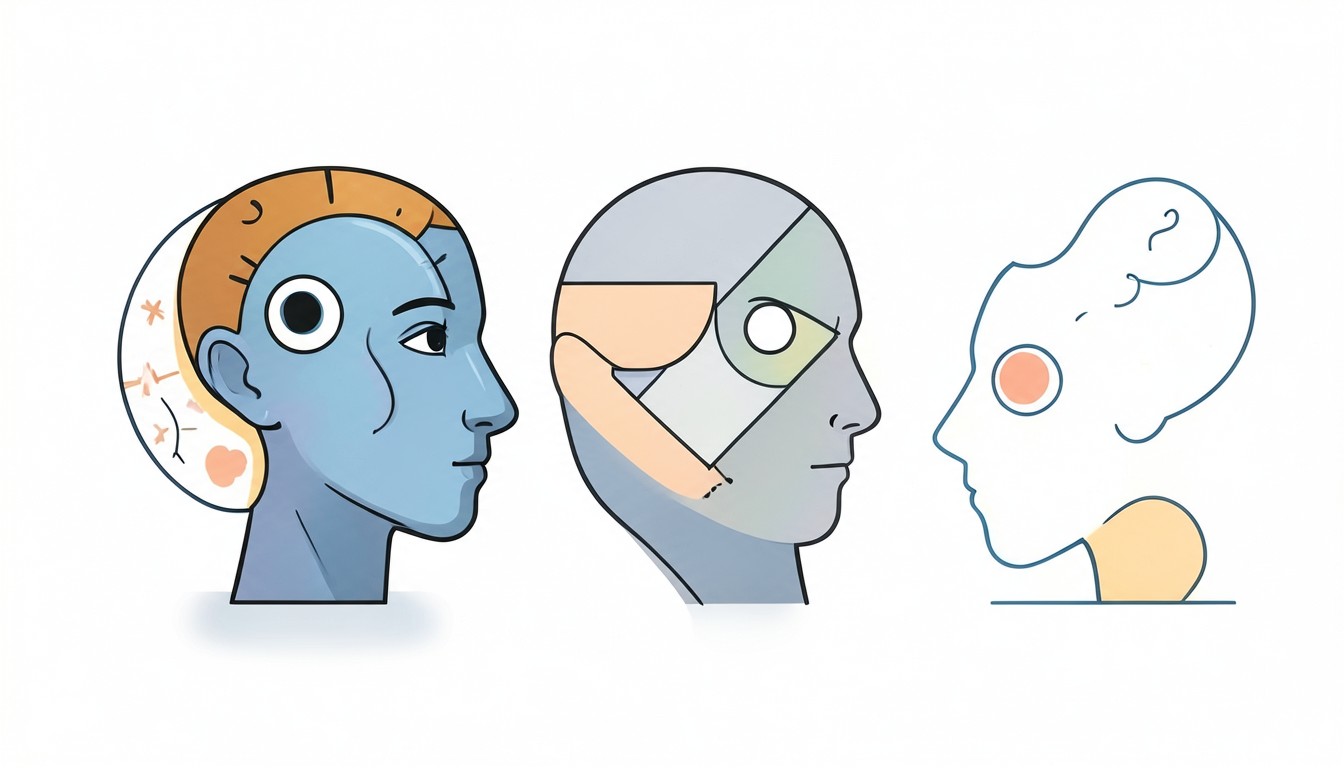
AI impact on human psychology: what a diagnosis can tell us
A label can organize information. It cannot tell the whole story of a person. That distinction matters in clinical care, and it matters just as much when artificial intelligence is used to sort, summarize, or classify psychological information.
A 2019 study led by University of Liverpool researchers examined the DSM-5’s diagnostic criteria across five areas: schizophrenia spectrum and other psychotic disorders, bipolar and related disorders, depressive disorders, anxiety disorders, and trauma- and stressor-related disorders. The authors analyzed how the criteria were constructed and compared across chapters. Their concern was not that distress is unreal, but that diagnostic categories may suggest cleaner boundaries and more explanatory power than the criteria support.
The study found substantial variation in the decision rules: criteria differed in symptom comparators, duration, severity indicators, and whose perspective was used to assess difficulties. It also identified symptom overlap across categories and noted that trauma’s role was inconsistently represented. The authors argued that this heterogeneity weakens the idea that the examined categories identify discrete disorders with uniform boundaries. They further warned that categories may obscure individual experiences and causal pathways. This was a thematic analysis of selected DSM-5 chapters, not a test of AI, a treatment trial, or an evaluation of every diagnosis or every person’s care.
What is AI in psychology?
AI in psychology can mean computational tools used to process psychological information: for example, software that classifies text or identifies patterns in data. That general description should not be confused with evidence from this study. The researchers analyzed diagnostic classification in the DSM-5; they did not evaluate an AI system, compare algorithms, or establish that automated assessment improves diagnosis.
The paper is still relevant to conversations about AI because classification is one of the tasks people may ask such systems to perform. When a model maps reported experiences to a diagnostic category, it is applying a pattern or rule. That output is not, by itself, an account of why a particular person is suffering, what events shaped their situation, or what support would help. A tidy category can conceal messy evidence. Automation doesn’t make that problem disappear.
Can AI understand human psychology?
This study cannot answer that question directly. It contains no experiment on machine understanding. But it gives us a useful distinction: recognizing a pattern is not the same as understanding an individual. A system may sort descriptions according to learned associations or specified criteria; that is different from establishing a person’s history, meanings, circumstances, and needs.
The same caution applies to people using diagnostic frameworks. The authors describe diagnostic manuals as an attempt to provide a common language and a list of symptoms. Shared language can help organize discussion, but the study’s analysis cautions against treating the category as a complete explanation. If an AI tool produces a plausible label, that label should be regarded as a classification output, not proof that the system has grasped the person behind the text.
Why the distinction matters in care
The practical implication is not to discard every diagnosis or to deny that clinicians use categories for pragmatic reasons. The research article notes that criteria recurring across categories can offer flexibility in clinical practice, even as they undermine a strict model of discrete disorders. Its authors favor an approach to assessment that recognizes individual experience rather than relying solely on categorical commitment.
That is a sensible standard for any technology used around mental health. Ask what information went into a result, what it leaves out, and whether the result is being treated as a starting point or a verdict. A classification may help structure a conversation. It should not close one.
The paper’s specific concern about trauma illustrates why context matters. Its analysis argues that the way categories are organized can imply that trauma is relevant only to a limited set of diagnoses, while individual experiences and causal pathways may be obscured. That observation belongs to the authors’ analysis of the selected chapters; it does not establish a single cause for any person’s difficulties. In practice, it is a reason to ask about context rather than infer it from a label.
Use labels as shorthand, not explanations
For clinicians, researchers, and developers, the lesson is modest but important: classification is useful only if its limits remain visible. An AI tool can support administrative or analytic tasks, but the study offers no basis for claiming that it can diagnose better, understand people, or recommend treatment. Those claims would require separate evidence.
For anyone encountering a label, it may help to ask what the label describes and what it cannot settle. The study’s analysis points toward heterogeneity in criteria, overlap among symptoms, and the risk of overlooking personal experience. That is not a reason to dismiss someone’s distress. It is a reason to take the person, not merely the category, seriously.
The AI impact on human psychology will depend partly on how people use these systems: whether they mistake a confident classification for understanding, or treat it as limited information that calls for human interpretation. This research supports caution about categorical claims. It does not settle what AI can eventually do; it reminds us that sorting is not the same as knowing.