
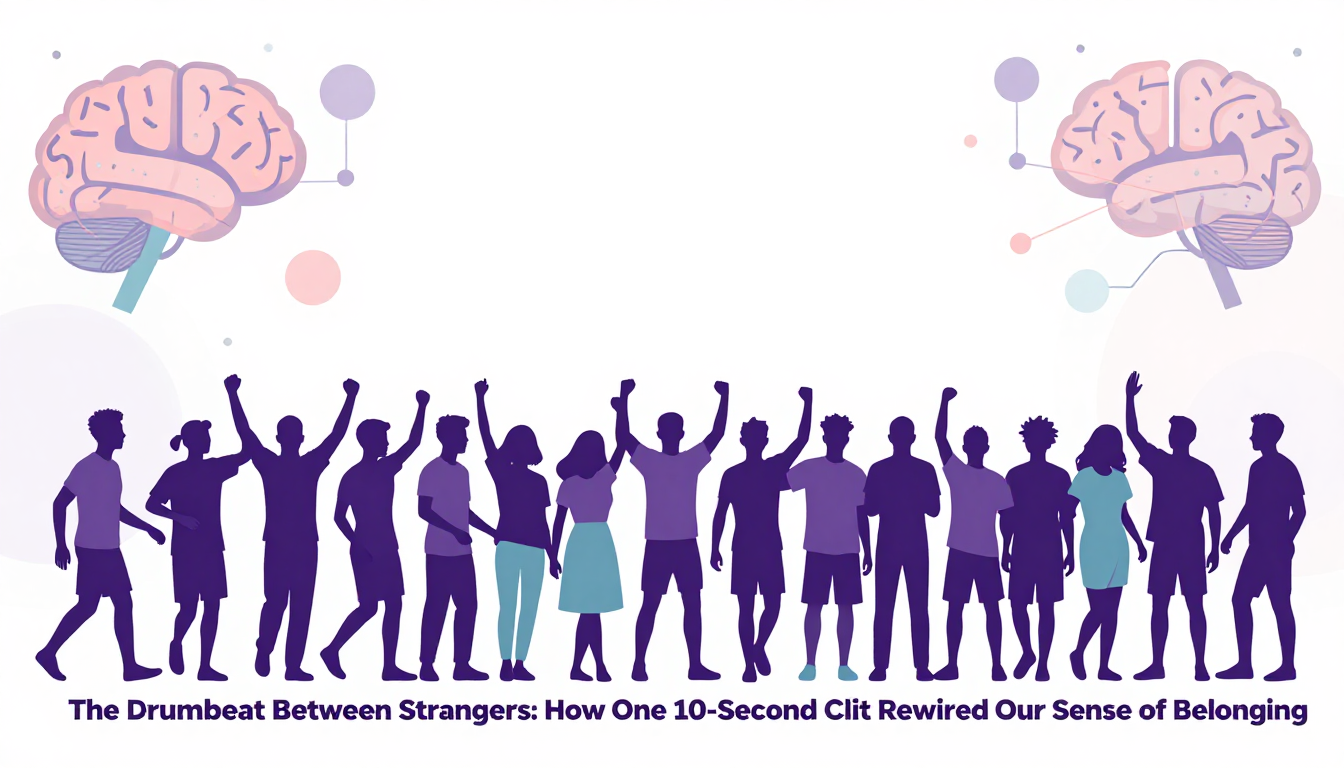
The Drumbeat Between Strangers
You don't need subtitles for joy. Just the thump of a drum, a smile flashing across a sea of unfamiliar faces—and suddenly, it's like someone flipped a switch in your nervous system. That's what happened in a Philadelphia stadium one June evening, captured on an iPhone and shared with the world as "International language of love." Within hours, nearly 200,000 people watched it. Not because it had high production value or a celebrity cameo. But because, for ten seconds, it showed what we've mostly forgotten: how to be human together.
It starts simple—a group of Croatian fans pounding a drum between chants. A woman in a Ghana jersey walks over, taps her foot, then steps into the rhythm. Within moments she's surrounded, lifted—not in mockery but in pure, unscripted celebration—and the whole stadium roars with her. No one introduced anyone. No one asked for a name or nationality. They just matched breath to breath, movement to movement. That's not teamwork. It's something older, deeper: the biological and social architecture of belonging.
This wasn't a staged photo-op or branded fan experience. It was raw, unpolished, and that's exactly why it hit like a wave. In an age where algorithms serve us content that confirms what we already believe, this clip proved something else is possible: spontaneous, unmediated connection across national and cultural lines. It happened not in some idealistic peace summit but inside a World Cup match—a place where rivalry usually rules. And still, joy overruled.
The video caption spoke the truth before anyone could overthink it: there's nothing like soccer that brings people together. The drum didn't care if her hands were scarred or smooth; the rhythm had already decided she belonged.
I've watched that clip dozens of times. Each time, something deeper settles in your chest—not nostalgia, not sentiment, but recognition. Like you're remembering a language you once spoke fluently before life taught you to stay quiet.
The science behind it? Not surprisingly, it's about more than just serotonin. We're talking about the mechanics of shared experience: the way positive emotions ripple through crowds, how movement synchronizes hearts, and why even introverted fans felt compelled to dance with strangers that night. Let's walk through what really happened—not just in Philadelphia, but inside every one of us.
The Sudden Unraveling of "Us" and "Them"
That moment didn't begin with the drum. It began earlier—much earlier—with thousands of fans arriving from different corners of the world, each carrying their own expectations and tribal loyalties. Croatian supporters in red-and-white, Ghana fans in green, gold, and black; locals mixed with tourists. You could feel the tension in the air before kickoff, layered with national pride and high stakes.
But something shifted somewhere between walk-in music and the opening whistle. Maybe it was the weather—mild, forgiving—or the way strangers began passing snacks and water bottles across rows. Maybe it was the collective hum of anticipation, a sound so low it borders on silence but vibrates in your molars.
After the final whistle, a different kind of energy took hold. This wasn't the usual post-match grumpiness or quiet walk to the subway, heads down. This was expansion: chests puffed, limbs loose, laughter just bubbling up unbidden.
The Psychology Today piece that captured the footage notes that even introverted fans joined in. That's key. Most of us learn early how to shrink ourselves in crowds—to avoid eye contact, to stay quiet, to keep our personal boundaries tightly sealed. But collective joy does something radical: it temporarily dissolves the boundary between self and other. You stop interpreting the person beside you as "not like me" and start feeling with them instead.
The study referenced in the article—published in Frontiers in Psychology in 2026—found that rhythmic movement is one of the strongest predictors of this shift. When people march, dance, or simply sway in unison, their stress biomarkers drop and their sense of social connectedness spikes. It's not about shared language, shared politics, or even shared nationality. Just shared motion—enough to reset your nervous system and say: You're here. I'm here. Let's be here together for a little while longer.
The woman in the Ghana jersey didn't calculate the odds. She just moved. And when she did, the whole stadium mirrored her instinct.
Co-Experienced Joy: Why Shared Positivity Amplifies Everything
Martin Seligman, the founder of positive psychology, frames well-being around five pillars: positive emotion, engagement, relationships, meaning, and achievement. But here's the part we too often skip over: some emotions simply can't be experienced alone.
Barbara Fredrickson's broaden-and-build theory explains how positive emotions don't just feel good—they literally widen our perceptual field, helping us see more possibilities and connections. And recent work has shown that co-experienced positive emotions do even better. They don't just broaden; they bind.
The Philadelphia moment is a textbook case. The joy wasn't isolated to Croatian or Ghanaian supporters; it was co-experienced. That means the neural pathways lit up not just in each individual but across the group as a whole. Studies like Brown et al. (2022) show that shared emotional moments—particularly joy—are more strongly linked to relationship quality than individual positive experiences.
That's why the clip resonated beyond the stadium. We're not just watching; we're mirroring. Mirror neurons fire when we see someone smile, laugh, or lift their arms in triumph—even if they're strangers thousands of miles away. The 10-second clip acted like a relay race, passing joy from one viewer to the next. Within hours, it had 200,000 views not because people needed to see the match replay, but because they needed to feel that wave of shared delight.
Positivity is contagious, and its spread follows a predictable pattern: it begins in small clusters—two people, then five, then twenty—and builds to a social wave. That night in Philadelphia, that wave broke across the entire crowd.
What's especially striking is how quickly it happened. There was no planning, no PR team. Just a woman, a drum, and the willingness to be present in the moment.
Collective Effervescence: When the Crowd Becomes a Single Organism
Émile Durkheim coined the term collective effervescence to describe what happens when people gather for a shared purpose—religious rituals, protests, concerts—and the usual boundaries between self and group blur. In those moments, individuals lose themselves in the rhythm of the crowd and emerge changed.
The Philadelphia stadium was exactly that kind of space. The study referenced in the article—published in Frontiers in Psychology in 2026—found that stadium experiences, especially during events like the World Cup, act as a kind of ritual choreography. The sights (flags waving), sounds (synchronized chants), and shared movement all contribute to attunement. Fans don't just watch the game—they synchronize with each other.
Psychologist Dacher Keltner suggests this isn't just a pleasant side effect—it may be a survival mechanism. Early humans who moved and celebrated together were more cooperative, more trusting, and more likely to band together in times of threat. Collective effervescence signals: We're safe here. We belong here. And that's exactly what happened when the drum was picked up and the woman in Ghana jersey joined.
The study found that these benefits aren't limited to who wins the game. Whether your team wins or loses, showing up and singing together still lowers inflammatory markers and boosts well-being. It's not about victory; it's about presence.
The crowd didn't need to win the match. They already won each other's company.
The Everyday Applications—Where Joy Hides in Plain Sight
You don't need a World Cup ticket or international travel to experience this kind of belonging. Collective effervescence is quietly available in everyday life—if we're willing to show up and participate.
Group exercise classes, public viewings of big games, community rituals like block parties or potlucks—all offer micro-versions of the stadium effect. The 2026 Frontiers in Psychology study notes that shared activities build attunement, even among strangers. That means walking the dog at the park and saying hello to another owner isn't just friendly—it's biology.
One of the most powerful applications? Combating loneliness. The study found that even brief moments of authentic connection improve mood and health outcomes more than long-term isolation. A 10-second shared laugh counts. A five-minute conversation with someone whose name you'll never know still reshapes your stress response.
The takeaway isn't that we need to fill our lives with grand gestures—only that we stop treating connection like a luxury and start treating it like oxygen. Because in many ways, it is.
The woman who got lifted didn't plan to change anyone's day. She just moved toward the drum. And in doing so, she gave strangers permission to feel joy without justification.
It's worth remembering: the most transformative moments of belonging rarely come with an agenda. They show up unannounced, often in the most ordinary places—and they only last a few seconds. But if you lean into them, they stick.
They become part of your nervous system's long-term memory. A reference point for what it feels like to be human, not alone.
Explore why true therapeutic healing demands human presence over automated solutions.