ProBackend
robotics
2 hours ago10 min read

TechCrunch Mobility: New Robotaxi Scorecard Reveals China's Competitive Edge
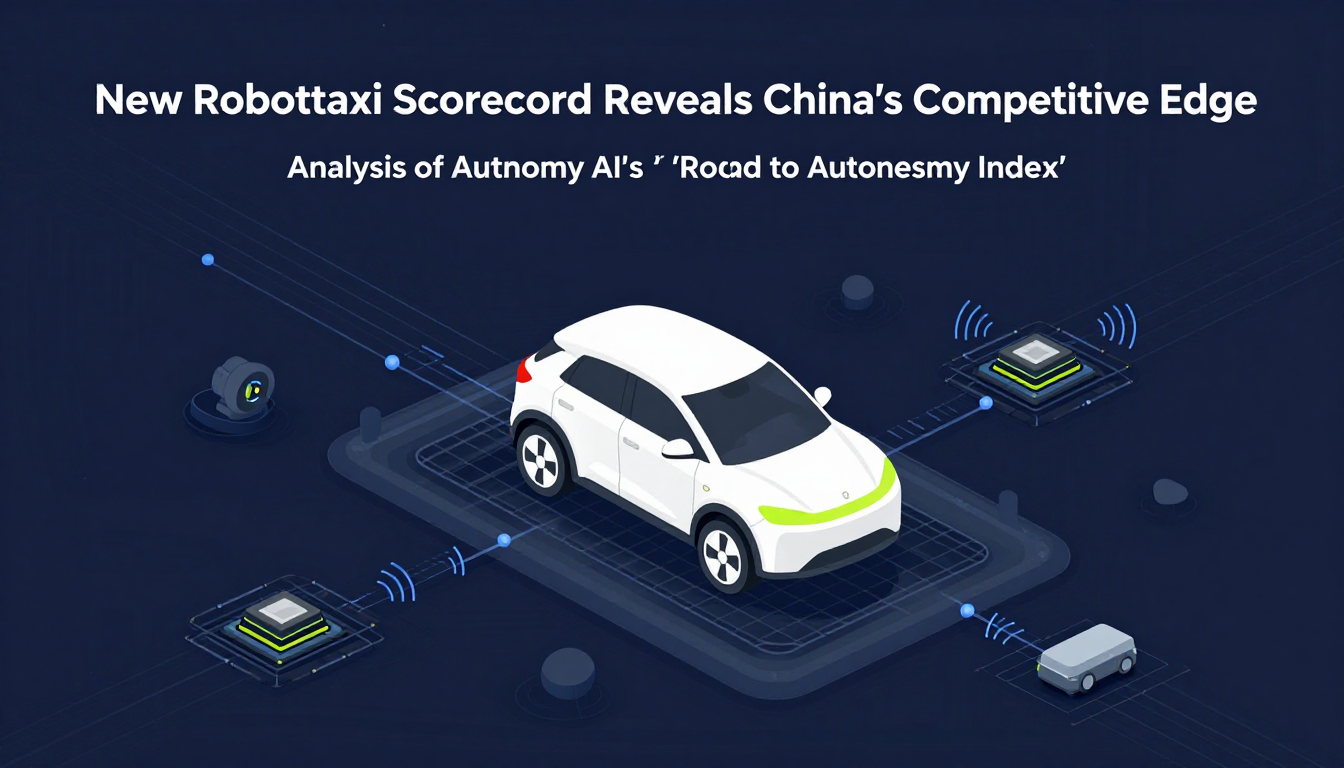
Analysis of Autnmy AI's 'Road to Autonomy Index' and its findings on global robotaxi leadership. Learn more about the [Robotics Category](/categories/fdfc3512-86b1-4deb-aea3-2c804ca75832) and the [General Domain](/domains/91036850-d784-47df-a4cb-1e92d108978f) for further insights on leading Chinese firms like Baidu Apollo Go, Pony.ai, and WeRide.
Percy Caldwell

Introduction\n\nThe landscape of the self-driving car race has shifted dramatically over the past decade. Where once we saw a proliferation of ambitious demonstrations and speculative capital, we have entered a new era characterized by actual deployment, regulatory maturity, and intense competition. A recurring question throughout this evolution has been: who is truly leading the charge? For years, this debate remained largely theoretical, plagued by a lack of reliable, standardized metrics.\n\nToday, that ambiguity is being replaced by data. The introduction of the 'Road to Autonomy Index' by advisory and research startup Autnmy AI offers a transformative approach to benchmarking autonomous vehicle companies. By integrating vast troves of public data—ranging from SEC filings to regional transportation reports—Autnmy AI provides the real-time visibility that the industry has long needed to track global leadership in the robotaxi sector, autonomous trucks, and delivery bots. \n\nAs this scorecard reveals, the race is far from a simple US battle, with Chinese firms showcasing a formidable competitive edge. This shift reflects not only technological investment but also the speed of operational deployment in high-density urban environments. For the global transportation sector, understanding these trends is no longer just about tracking milestones—it is about anticipating the future of mobility in an increasingly competitive global landscape, where the mastery of data, governance, and operational scale defines success

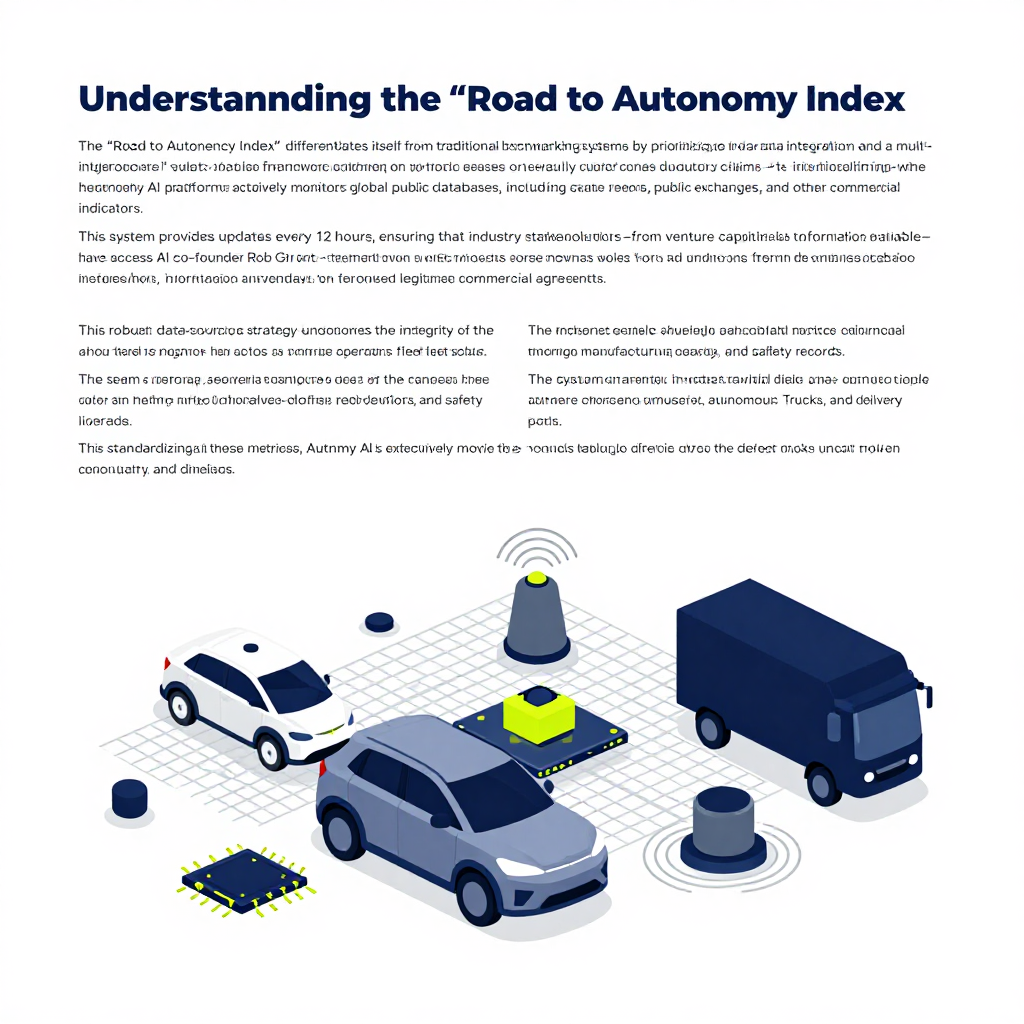
Understanding the 'Road to Autonomy Index': A New Standard of Benchmarking\n\nThe 'Road to Autonomy Index' differentiates itself from traditional benchmarking systems by prioritizing real-time data integration and a multi-faceted evaluation framework. Rather than relying on sporadic press releases or carefully curated manufacturer claims—which historically clouded the industry with hype—the Autnmy AI platform actively monitors global public databases, including federal and state reports, public exchanges, and other commercial indicators. \n\nThis system provides updates every 12 hours, ensuring that industry stakeholders—from venture capitalists to policy makers—have access to the most current information available. According to Autnmy AI co-founder Rob Grant, the platform’s transparency approach is crucial to its reliability. The team has made a point to ensure that the platform does not merely scrape information from the internet. Instead, it relies on publicly available information, data under Creative Commons licensing, or information secured through legitimate commercial agreements. \n\nThis robust data-sourcing strategy underscores the integrity of the rankings, which weigh factors such as vehicle operations, fleet scale, total commercial partnerships, manufacturing capacity, and safety records. The system currently maintains four distinct indices covering robotaxis, autonomous driving licensing, autonomous trucks, and delivery bots. This breakdown is vital for investors and policy makers trying to distinguish between different facets of the autonomous transportation market, which operate on drastically different technical and regulatory timelines. By standardizing these metrics, Autnmy AI is effectively moving the goalposts from speculative potential to measurable, real-world utility.

Understanding the 'Road to Autonomy Index': A New Standard of Benchmarking\n\nThe 'Road to Autonomy Index' differentiates itself from traditional benchmarking systems by prioritizing real-time data integration and a multi-faceted evaluation framework. Rather than relying on sporadic press releases or carefully curated manufacturer claims—which historically clouded the industry with hype—the Autnmy AI platform actively monitors global public databases, including federal and state reports, public exchanges, and other commercial indicators. \n\nThis system provides updates every 12 hours, ensuring that industry stakeholders—from venture capitalists to policy makers—have access to the most current information available. According to Autnmy AI co-founder Rob Grant, the platform’s transparency approach is crucial to its reliability. The team has made a point to ensure that the platform does not merely scrape information from the internet. Instead, it relies on publicly available information, data under Creative Commons licensing, or information secured through legitimate commercial agreements. \n\nThis robust data-sourcing strategy underscores the integrity of the rankings, which weigh factors such as vehicle operations, fleet scale, total commercial partnerships, manufacturing capacity, and safety records. The system currently maintains four distinct indices covering robotaxis, autonomous driving licensing, autonomous trucks, and delivery bots. This breakdown is vital for investors and policy makers trying to distinguish between different facets of the autonomous transportation market, which operate on drastically different technical and regulatory timelines. By standardizing these metrics, Autnmy AI is effectively moving the goalposts from speculative potential to measurable, real-world utility

Robotaxi Leadership: A Shifting Global Dynamic and Chinese Competitiveness\n\nThe findings from the latest scorecard highlight a particularly striking trend: the strong performance of Chinese players compared to their US counterparts. This global approach to benchmarking sheds light on competitive dynamics that often remain obscured by overly localized analyses. The concentration of infrastructure and fleet deployment in major urban centers appears to be a key driver for this newfound competitive edge.\n\nAs of the most recent data analysis, the ranking for robotaxi leadership paints a tight race. The top position is currently held by Baidu’s Apollo Go program, though it maintains its lead by a slim margin, reflecting the high-stakes battle for dominance. Waymo, a staple of the US autonomous market, currently holds the secondary position, maintaining its technological advantage but facing stiff pressure to match the scale of its Chinese rivals. Following closely are Chinese stalwarts Pony.ai and WeRide in the third and fourth spots, respectively, while Tesla occupies the fifth position. \n\nThis ranking illustrates that China’s heavy investment in domestic infrastructure and fleet deployment—often supported by cohesive industrial policy—is translating into tangible leadership in the global scorecard. For US-based companies, this underscores the intense, undeniable pressure to not only innovate on technical performance—advancing sensor fusion or neural network architectures—but to scale operational deployment in high-density markets efficiently. The global robotaxi arena is proving that local regulatory frameworks and state-supported infrastructure have as much impact on deployment speed as the underlying AI stack itself.

US Fleet Growth: Insights from the Texas Tracker\n\nWhile the global scorecard highlights Chinese dominance in robotaxi rankings, recent domestic data provides a contrasting view of US fleet development and the relentless push by major domestic players. The Texas-based automated vehicle tracker, which launched in May, has become an invaluable, high-transparency tool for monitoring fleet growth within a key US market, showcasing how firms are building out their testing and operational infrastructure in a competitive regulatory environment.\n\nRecent data from the tool confirms that major US players are accelerating their local footprint. As of mid-June 2026, Waymo had expanded its registered autonomous fleet in Texas to 620 vehicles, marking a 7.5% increase in less than a month. Similarly, Tesla has ramped up its presence, registering 69 autonomous vehicles—a noteworthy 64% increase compared to its fleet at the end of May. Zoox, likewise, is growing its test fleet, now with 43 registered vehicles. \n\nIt is imperative to maintain perspective when analyzing these numbers. Fleet registration does not automatically equate to commercial operations or revenue generation. Zoox, for example, continues to test its custom-built robotaxi without the ability to charge customers, pending a federal exemption. Nonetheless, the rapid scaling of these fleets signals a determined push by these companies to iterate in real-world urban environments, setting the stage for more robust commercial rollouts as regulatory pathways become clearer. This domestic fleet growth is, in many ways, the operational foundation needed to regain a higher position on the global scorecard, proving that competitive pressure is forcing US companies to move faster than ever.

The Governance Imperative: Managing Shadow AI and Access Controls\n\nAs these autonomous entities continue to scale globally and leverage increasingly complex AI architectures, the broader implications for enterprise governance—specifically cybersecurity—become undeniable. The integration of sophisticated AI systems into the backbone of transportation infrastructure necessitates a move toward rigorous, enterprise-grade governance, moving well beyond the initial deployment phase.\n\nTwo critical areas require immediate attention: the management of 'shadow AI' and the implementation of robust access controls. 'Shadow AI' in the enterprise context refers to the deployment of unauthorized or unmanaged AI tools by teams or employees. As robotaxi companies evolve into large-scale operators, the proliferation of unmonitored AI agents within their technical stack introduces significant security vulnerabilities, ranging from data leaks to model inversion attacks where proprietary data might be susceptible to extraction.\n\nFurthermore, the management of sensitive autonomous driving data requires strictly mandated access controls. Any entity handling such data must ensure that access to core AI systems is managed, audited, and granularly limited. Without a comprehensive framework governing who can train, update, or access core algorithmic performance data, these companies face increased risk of data exposure or the malicious manipulation of autonomous workflows. For companies to maintain their 'Road to Autonomy' and market position, securing the governance layer is just as vital as securing the technical capabilities of the vehicle fleet itself. This requires balancing rapid deployment for competitive advantage with the slow, deliberate work of robust data security and access governance. Firms that succeed in the next decade will be those that view cybersecurity not as a roadblock to innovation, but as a critical infrastructure requirement for safe, scalable AI.\n\nBuilding this governance layer requires a multi-layered approach: identifying all AI tools in use across the company, establishing a zero-trust model for access to training pipelines, and implementing real-time auditing for both training inputs and operational outputs. Failure to address these governance challenges risks not only catastrophic cybersecurity incidents but also regulatory scrutiny that could halt deployment in key markets. As the industry matures, stakeholders will increasingly factor these governance capabilities into the overall valuation and trustworthiness of these autonomous leaders.

Conclusion\n\nThe introduction of real-time, data-driven scorecards for autonomous systems marks a new phase in the industry. As the race to develop reliable, safe robotaxi services continues, having an objective, verifiable way to measure leadership is a vital step forward for investors, regulators, and the public. The findings regarding Baidu and the competitive presence of Chinese firms in the robotaxi space provide a necessary check on the industry's conventional narratives and a push to prioritize scale and regulatory success. \n\nHowever, the technical race is only half the battle. As fleet sizes grow in key markets like Texas and Chinese firms assert their leadership on the global stage, the success of these companies will ultimately depend on their ability to integrate not only better AI but also better security governance. Managing the risks of shadow AI and enforcing granular access controls will differentiate the leaders from the laggards in the next decade of transportation transformation. The 'Road to Autonomy' is paved with data, and it is imperative that it is also paved with security.\n\nThe real winner of the autonomous race will not just have the largest fleet, but the most resilient system—the one capable of navigating the complex, dual requirements of extreme operational technical performance and rigorous, enterprise-level cybersecurity. As we watch these leaders (Baidu, Waymo, Pony.ai, WeRide, and Tesla) iterate, we are witnessing the construction of a future where transportation is safer, more efficient, and fundamentally more reliant on secure, managed AI architectures. The scorecards of tomorrow will likely judge these companies as much on their governance as on their fleet size—and in the fast-paced, high-competitiveness world of global mobility, that shift is long overdue.

More blogs