
Beyond the Net: How Robotics is Bringing Precision to a Chaotic Seafood Supply Chain
It was a question rarely heard on the stages of high-octane Venture Capital & Startups conferences: "How do you know if a fish is stressed out?"
But for Saif Khawaja, founder of Shinkei Systems, it is the only question that matters. At the recent StrictlyVC event in Los Angeles, Khawaja and Founders Fund partner Delian Asparouhov delved into a topic that, while seemingly niche, strikes at the heart of one of the world's most inefficient supply chains: seafood. Shinkei is not merely selling a piece of hardware; it is proposing a fundamental re-engineering of how we catch, process, and consume our marine harvest.
The Invisible Supply Chain Crisis
To understand the magnitude of Shinkei's play, one must first confront the visceral reality of the current seafood supply chain. It is, by almost any metric, a logistical failure. Freshness is fleeting, and the industry standard for spoilage—the portion of the catch lost to decay between the dock and the grocery shelf—is a staggering 18%. This isn't just waste; it is a massive, systemic erosion of value.
The consequences ripple outward. When 18% of your product vanishes before reaching the consumer, you have three choices: raise prices on consumers, shrink margins for fishermen, or accept lower quality. The industry has long chosen the third option, creating a cycle where consumers expect cheap fish but receive inconsistent quality. The frustration is mutual: chefs complain about unpredictable texture, retailers deal with last-minute inventory crises, and fishermen see their hard work turned into losses before they receive payment.
Traditionally, the industry has accepted this spoilage as a cost of doing business. But the degradation of fish flesh is not merely a function of time; it is a function of biology. When a fish is hauled from the water and allowed to die slowly in the net or on deck, the trauma triggers a massive release of stress hormones like cortisol and adrenaline. Simultaneously, there is a rapid buildup of lactic acid as the fish's muscles work furiously to survive. These compounds act as chemical accelerators of decay.
They break down muscle structure from within, compromise texture until it becomes mushy or stringy depending on the species, and destroy delicate flavors before the fish ever lands on a processor's table. The physical evidence is unmistakable: eyes that cloud over quickly, gills that turn from bright red to dull brown, flesh that loses its elastic bounce. All of these are symptoms of stress-induced decay.
This is where the ancient Japanese technique of ike jime comes in. It is a precise method of dispatching a fish, severing the brain stem and spinal cord instantly with a specialized spike. This halts the biological machinery of stress before it can release its destructive hormones and acids, leaving the meat pristinely stabilized. The fish doesn't experience panic; it simply ceases to be.
Historically, this has been an artisanal craft performed by elite, highly skilled professionals at the dock—a logistical bottleneck that has kept high-quality ike jime fish as a luxury product for the ultra-fine dining market, available only at premium prices and in limited supply. The skill required to perform ike jime correctly has been passed down through generations in Japan, with apprentices spending years mastering the technique. This exclusivity was part of what made it valuable, but it also limited its reach.
Automation Takes the Helm
Shinkei Systems has identified the pivot point: what if you could scale the artisanal precision of ike jime and bring it directly to the source—at sea, the moment the net leaves the water?
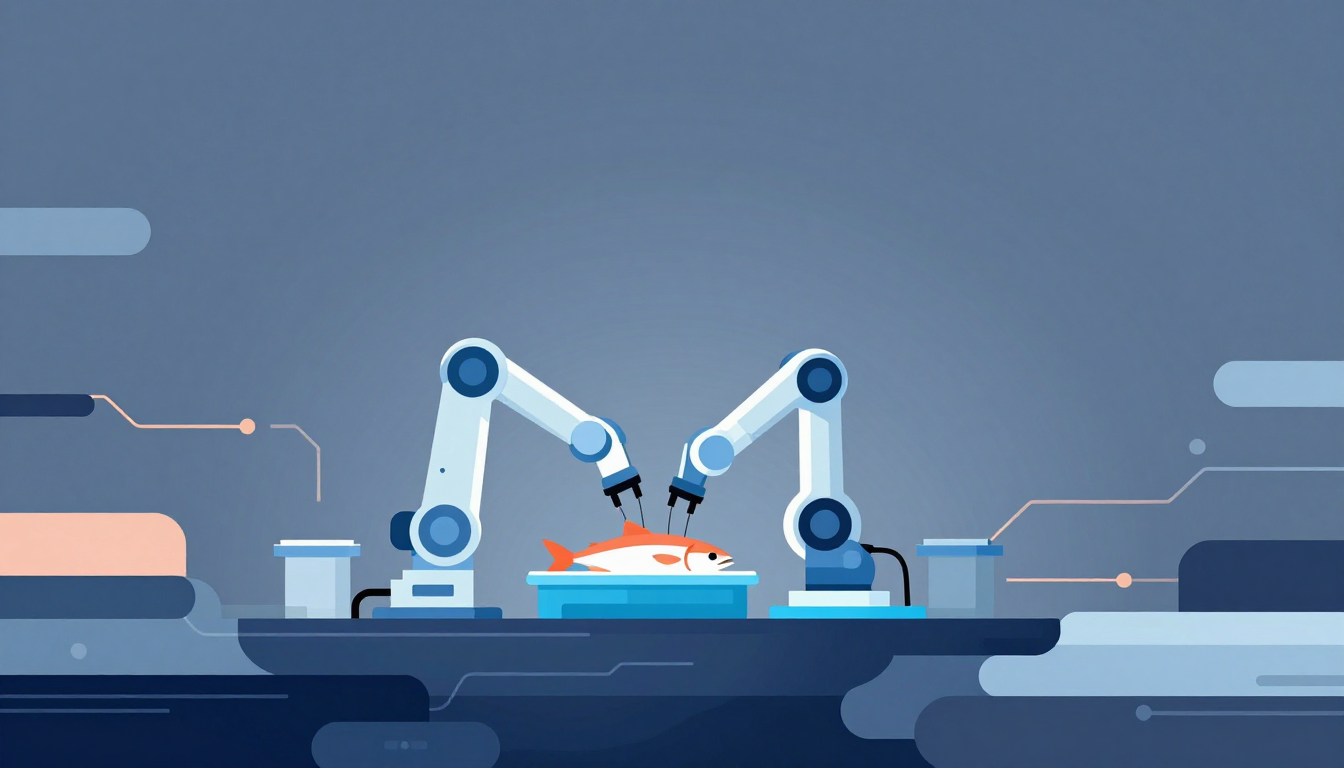
The physical manifestation of this ambition is a refrigerator-sized robot the company calls Poseidon. It is designed to be installed on commercial fishing vessels, operating with a level of consistency that human muscle and memory simply cannot match in the chaotic environment of a working boat. The sea doesn't care about your deadlines; it doesn't accommodate fatigue, morale, or even basic human safety margins. Poseidon was built for exactly this environment.
Poseidon is not just a robotic knife; it is a data-driven system that combines computer vision with mechanical precision. As fish are hauled onto the boat in real-time, the robot scans each one—identifying species, calculating physical proportions, and mapping the exact location of its brain with remarkable accuracy. The computational power needed to do this in milliseconds is staggering: neural networks trained on thousands of fish images, calibrated for different lighting conditions at sea, accounting for the movement of the vessel and the variability in fish size and shape.
With remarkable, sub-second speed, Poseidon performs the ike jime procedure perfectly every single time, without the variability of fatigue, morale, or human error. It is industrial-scale, machine-precision applied to an ancient biological mandate. The robot moves with deliberate speed: a scanning phase, a calculation phase, and then the precise insertion of the spike that severs both brain stem and spinal cord in one fluid motion. The entire process takes less time than it takes for most people to blink.
But the automation doesn't stop there. After the ike jime procedure, the fish is typically bled—another critical step in the process that has historically been performed manually. Shinkei's system completes this phase as well, ensuring that all blood is removed from the circulatory system. This double action—immediate neural termination followed by complete bleeding—is what makes the extended shelf life possible.
The engineering challenges were immense. Designing a machine that could operate in saltwater spray, withstand constant vibration from the vessel's engines, and function reliably for weeks at a time required rethinking every component. The original prototypes would fail within days; the current version is designed for continuous operation across multiple fishing trips. The refrigerator-sized housing you see isn't just for show; it protects the sensitive electronics from the marine environment while providing a climate-controlled space for operation.
Vertical Integration: A Bold Market Play
Shinkei's mission, however, has expanded significantly since its initial hardware focus. The company now positions itself not as a hardware vendor but as a vertically integrated harvester and processor. This is perhaps the most radical aspect of their business model: they don't just want to sell robots; they want to control the entire chain from net to table.
The business model is an astute display of leverage. Shinkei provides its Poseidon machines to fishermen for free—bearing the entire capital cost of installation. In return, the company takes total control over the supply of the fish processed by those machines. Because the fish is stabilized at the moment of catch, it is demonstrably higher quality than anything coming through conventional channels.
This creates a unique dynamic where fishermen are economically incentivized to work with Shinkei: they receive significantly more per pound than they would in a conventional, opaque dockside auction. The price premium reflects not just the quality improvement but also the elimination of waste in the system. Where a conventional fisherman might sell their catch for $5 per pound only to have 18% of that weight ultimately unsellable, Shinkei might pay $7 per pound for fish where nearly 100% becomes sellable product.
This bypasses the traditional, highly fragmented marketplace that typically eats away at the profits and the freshness of the producer. The normal seafood supply chain involves multiple intermediaries: fishermen sell to brokers, who sell to distributors, who sell to retailers or restaurants. Each layer adds cost, delays the product reaching its final destination, and increases the chance of quality degradation.
The catch is then transported to the company's own sophisticated processing facility in Tacoma, Washington—a 16,000-square-foot building designed for maximum efficiency and quality control. There, it is broken down, packaged, and sold under their consumer-facing brand, Seremoni—a play on the refined quality of the product that hints at both ceremony and serenity, evoking the original ike jime tradition while signaling something new.
The vertical integration doesn't just affect pricing. It creates a feedback loop where quality data from downstream processing informs improvements to the Poseidon system. When a particular species behaves unexpectedly during processing, engineers can adjust the scanning parameters and improve detection algorithms. The entire system becomes smarter as it processes more fish, creating a competitive advantage that is difficult to replicate.
Extending the Window of Freshness
By ensuring an instantaneous end, Shinkei is implementing an industrial-scale, automated version of ike jime that fundamentally changes the physics of storage. The time between catch and processing—the window where most spoilage occurs—is effectively eliminated.
Conventionally handled catch often possesses a shelf life of just 5-to-7 days. This is why you see so much seafood arriving at restaurants via overnight air freight—the only way to meet the tight timeline between harvest and consumption. The economics of this model are strained: high transportation costs baked into the price, environmental concerns about air freight emissions, and constant anxiety about whether the product will hold up during transit.
Shinkei's methodology significantly expands this temporal window. According to the company, their product can be pushed to 12 or 14 days, with some product remaining viable as long as three weeks post-harvest. This extension is achieved because the enzymatic degradation that usually accelerates rot in stressed muscle is effectively kept in check from the moment of dispatch. The flesh remains in pristine condition, as if it had been caught and processed immediately.
This has profound implications for the entire seafood industry. Longer shelf life means fewer lost sales due to spoilage, reduced waste at retail locations, and greater flexibility in logistics. A restaurant owner no longer needs to order daily or even every other day; they can plan their orders with more certainty. A retailer can maintain inventory without constant fear of expiration dates looming over perishable product.
The company is now moving to capitalize on this data, developing an in-plant sensor system to quantify this quality for each individual fish. This moves seafood inventory management from the realm of guesswork into the precision of modern perishable commodity management. Each fish would have its own projected shelf life, based on its species, size, and exact handling conditions—information that could be shared throughout the supply chain.
This level of traceability is revolutionary in an industry that has traditionally operated on honor systems and rough estimates. The notion of individual unit traceability for seafood—something that has long existed for beef, chicken, and produce—is only becoming possible through this kind of technology investment.
The Ultimate Test: Market Reception
The proof of this concept is, quite literally, on the table. The Seremoni-labeled Black Cod has already secured placement on the menu at Erewhon, the Los Angeles grocery chain that has become an indelible fixture of modern food culture. This isn't just shelf space; it's the seal of approval from a retailer known for its rigorous standards and discerning customers.
The response has been strong. Early adopters among consumers have embraced the product, drawn by both the quality and the story behind it. People who didn't think much about how their seafood was caught are now asking questions about the handling process. The "humanely killed" angle resonates in a way that industry insiders might not have expected—consumers who have already accepted higher prices for humanely raised cattle and poultry are finding it natural to apply the same standards to seafood.
Whether the broader consumer market is prepared to pay a premium for "humanely killed" fish remains the ultimate unknown. There are legitimate questions about whether this is a genuine ethical consideration or simply another marketing angle in an increasingly crowded space. The taste tests, however, tell a different story—these aren't consumers paying for feelings; they're people who can taste the difference and are willing to pay for it.
Khawaja reports that his company already supplies restaurants holding a collective 50 Michelin stars. This is significant not just for the prestige but because these chefs are among the most discerning buyers of seafood in the world. They don't settle for "pretty good"; they demand the absolute best, and their willingness to work with Shinkei suggests that the quality stands on its own merits.
Most audacious of all, the company claims to be achieving the historically improbable: Japan, a nation with a sophisticated seafood market that has long viewed American product as inferior, is now importing this US-caught, robotically processed fish. This represents a fundamental shift in global trade dynamics.
It is an inversion of the status hierarchy that speaks to the power of Shinkei's technology. For decades, American seafood has been seen as either commodity-grade product for export or high-value but inconsistent catch that might make it to domestic markets. The idea that Japanese buyers—known for their extreme standards and traditional preferences—would seek out American-caught product over domestic supply is truly remarkable.
The industry response has been mixed. Some view Shinkei as a threat to established practices, a disruption that could destabilize the carefully balanced supply chains that have operated for generations. Others see an opportunity—a new pathway to premium pricing and reduced waste that could be adapted across species and geographies.
The technology itself is neutral, of course. But its application raises questions about how we think about seafood, about quality, and about the relationship between human labor and automation in food production. When a machine can consistently perform a task that once required years of training, what happens to those skilled workers? Shinkei's answer is an interesting one: by expanding the market and creating premium product, they may be creating new opportunities rather than eliminating old ones.
A New Standard for Freshness
The bet that Shinkei and Founders Fund are making is that re-shoring the entire chain—catch, kill, process—is not just possible but preferable. By keeping more of the value creation within the United States, they're challenging the assumption that seafood must always be exported raw and imported finished.
This re-shoring has broader implications beyond just economic value. It means more consistent quality control, better traceability, and potentially reduced environmental impact from shorter transportation distances. It also means that the expertise and technology stay in domestic hands, creating high-skilled jobs in both engineering and seafood processing.
The skepticism from traditional players is understandable. Changing an industry that has operated the same way for generations requires more than better technology; it requires changing behavior, expectations, and economics across the entire value chain. But Shinkei isn't just offering technology; they're offering a new economic model that aligns incentives across the chain.
Fishermen get better prices, processors get consistent quality, distributors get reliable supply, and consumers get superior product. Everyone wins—if they're willing to adopt the new model.
The company's trajectory suggests they believe the answer is yes. As more players begin to see the economic and quality advantages of this approach, the likelihood grows that what starts as an outlier bet will become the new standard for how we think about seafood quality.
The ultimate proof will come not just from Michelin-starred restaurants or high-end grocery chains, but from the broader market. Will consumers at regular supermarkets—people who currently choose frozen or imported fish for price reasons—be willing to pay more for US-caught, robot-processed seafood?
The answer will shape not just Shinkei's future but the entire seafood industry. If the model scales successfully, we may look back on this moment as the beginning of a revolution in how we harvest and value our ocean's bounty—one where technology doesn't just improve efficiency but actually enhances quality, sustainability, and human dignity in the process.
The question is no longer whether this can work, but how quickly it will spread. And if the initial traction is any indication, the answer may come sooner than anyone expects.