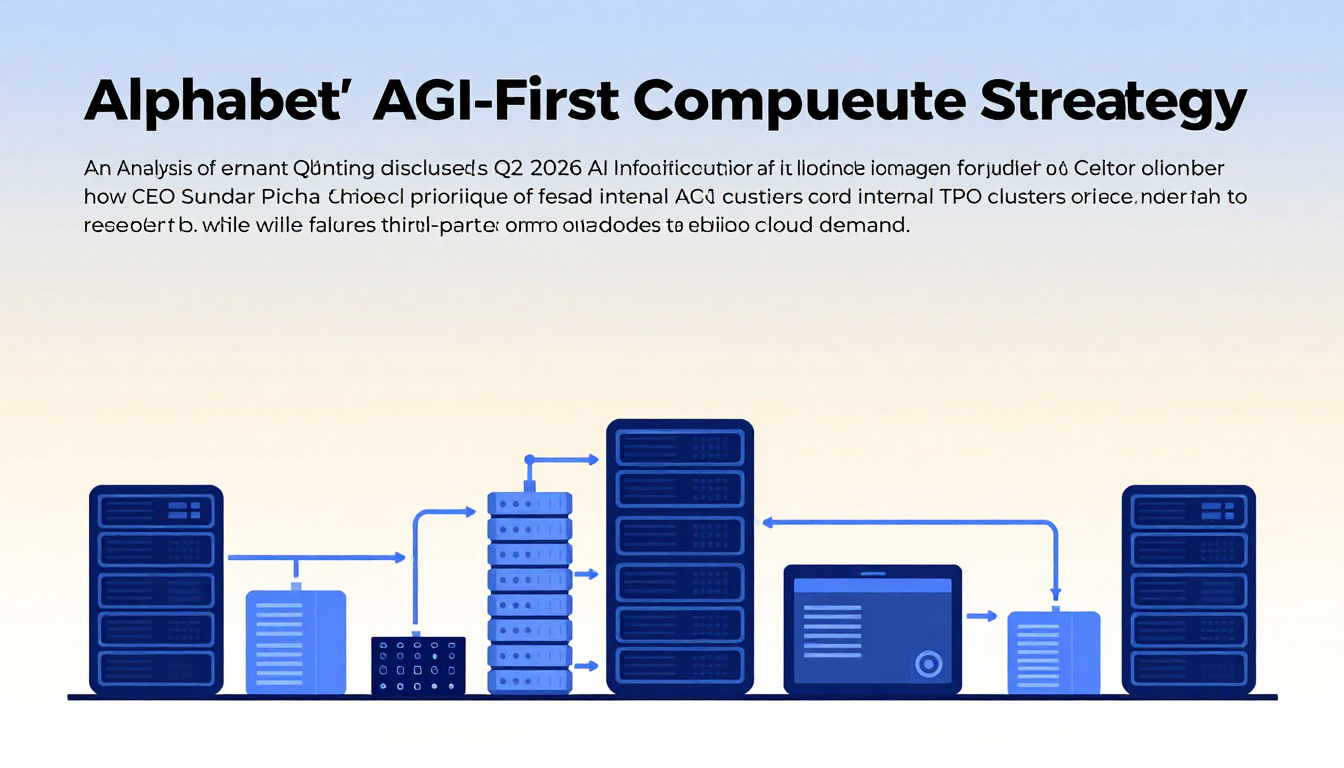
Alphabet made its hardware priorities explicit during its Q2 2026 earnings call: when accelerator capacity runs tight, internal artificial general intelligence (AGI) research takes precedence over external cloud demands. CEO Sundar Pichai outlined a strict rationing framework for the company's proprietary Tensor Processing Units (TPUs). Rather than throwing every available accelerator into commercial cloud clusters, Alphabet reserves its top-tier hardware to train frontier models.
Responding to Goldman Sachs analyst Eric Sheridan about balancing internal chip needs against customer demand, Pichai stated that allocating hardware for AGI development at the frontier is the foundation for everything the company does. That statement clarifies how Alphabet views its custom silicon footprint. TPUs aren't just commercial cloud rental products; they're the strategic engine for Alphabet's long-term survival.
Priorities inside the TPU allocation queue
Managing a massive accelerator fleet during an AI boom requires tough operational trade-offs. Pichai elaborated on the exact hierarchy Alphabet uses to distribute TPU capacity across the organization when responding to Bernstein analyst Mark Shmulik.
At the top of the pyramid sits frontier model training. Securing enough compute to train next-generation foundation models is the non-negotiable baseline. Once research teams receive their allocation, the remaining compute goes to core internal products. Google Search—specifically its generative AI features—and YouTube take priority here, ensuring consumer-facing platforms maintain low latency and continuous uptime.
Enterprise cloud customers come after internal research and core products. Within Google Cloud, capacity goes toward serving foundation models in Vertex AI, powering Gemini Enterprise, and running foundational data analytics and cybersecurity services. For cloud architects, this operational hierarchy offers a clear takeaway. If silicon supply tightens, Google's internal AGI efforts will consume capacity before external customer workloads get expanded reservations.
Cloud revenue surges while free cash flow turns negative
Alphabet's financial results for Q2 2026 show rapid top-line growth alongside massive capital investments. Consolidated revenue for the quarter reached $119.8 billion, representing a 24 percent increase year-over-year. Operating income grew 34 percent to $40.8 billion.
Google Cloud led this growth. Cloud revenue surged 82 percent year-over-year to hit $24.75 billion, generating $8.8 billion in operating profit. That represents a 214 percent jump in operating profit year-over-year. Demand for AI infrastructure and cloud solutions drove these numbers, pushing Google Cloud's total committed backlog to $514 billion. Meanwhile, core advertising streams remained strong: Search revenue grew 17 percent and YouTube ad revenue climbed 13 percent.
Yet these record revenues came at a steep cash cost. Alphabet recorded -$5.9 billion in free cash flow for the quarter—its first negative quarterly free cash flow performance since 2004. Investors reacted quickly, pushing Alphabet shares down 4 percent in after-hours trading. The cash drop highlights the extreme financial burden of funding physical data center builds, power generation access, and specialized chips ahead of realized revenue.
Third-party compute as a temporary bridge
To address capacity bottlenecks, CFO Anat Ashkenazi announced that Alphabet is raising its full-year 2026 infrastructure spending guidance. The company now plans to spend between $195 billion and $205 billion on capital expenditures this financial year, up from its previous guidance range of $180 billion to $190 billion.
Building data centers and procuring custom silicon takes time, even with a multi-hundred-billion-dollar budget. Ashkenazi acknowledged that Alphabet operates in a supply-constrained environment. To bridge the gap between customer demand and internal hardware availability, Alphabet will expand its use of third-party compute capacity during Q3 2026.
Renting external compute is an expensive short-term operational strategy, but Pichai defended the financial logic behind it. Landing major enterprise cloud contracts often requires delivering compute capacity immediately. Pichai argued that incurring high compute costs over a few months is acceptable if it locks in multi-year customer commitments. Over the lifetime of a long-term enterprise deal, bringing internal capacity online later restores high operating margins and delivers positive return on investment.
Lowering unit costs for search while expanding capex
While capital expenditure rises, engineering teams are working to lower inference costs on existing infrastructure. When generative search features first launched, analysts worried that expensive inference compute would destroy search profitability.
Pichai addressed those concerns by noting that AI Mode in Search actually increased overall search queries rather than cannibalizing existing behavior. More importantly, ongoing hardware and software optimizations allowed Alphabet to reduce the unit cost of serving AI Mode queries to its lowest level since launch.
Reducing unit inference costs is essential when scaling AI features to billions of daily users. By optimizing kernel routines, model distillation, and hardware scheduling, Google keeps its daily operational expenses manageable even as total query volume expands. These efficiency gains help offset the massive capital outlay required to build out next-generation physical data centers.
What Alphabet's infrastructure bottleneck means for cloud buyers
Alphabet's Q2 2026 disclosures highlight the complex realities of building frontier AI infrastructure. While Google Cloud revenue has surged, internal allocation priorities mean enterprise buyers are competing directly with internal AGI research teams for TPU capacity.
According to reporting from The Register, Alphabet's decision to use third-party compute as a bridging mechanism demonstrates how tight accelerator supply remains across the entire industry. Enterprise procurement teams negotiating cloud contracts should note this dynamic:
- Priority sits with internal research: Alphabet will always safeguard TPU supply for frontier model development before expanding external cloud quotas.
- Multi-year deals take precedence: Cloud sales teams use third-party compute to fulfill initial capacity commitments for large enterprise agreements, transitioning workloads to TPUs as internal capacity comes online.
- Unit economics matter: Software and hardware optimization efforts are critical for keeping inference costs sustainable across massive consumer products like Search.
Alphabet's strategy makes its long-term vision clear. The company is willing to absorb temporary free cash flow drops and rent third-party compute to secure its position in the AGI race while expanding its long-term cloud market share.