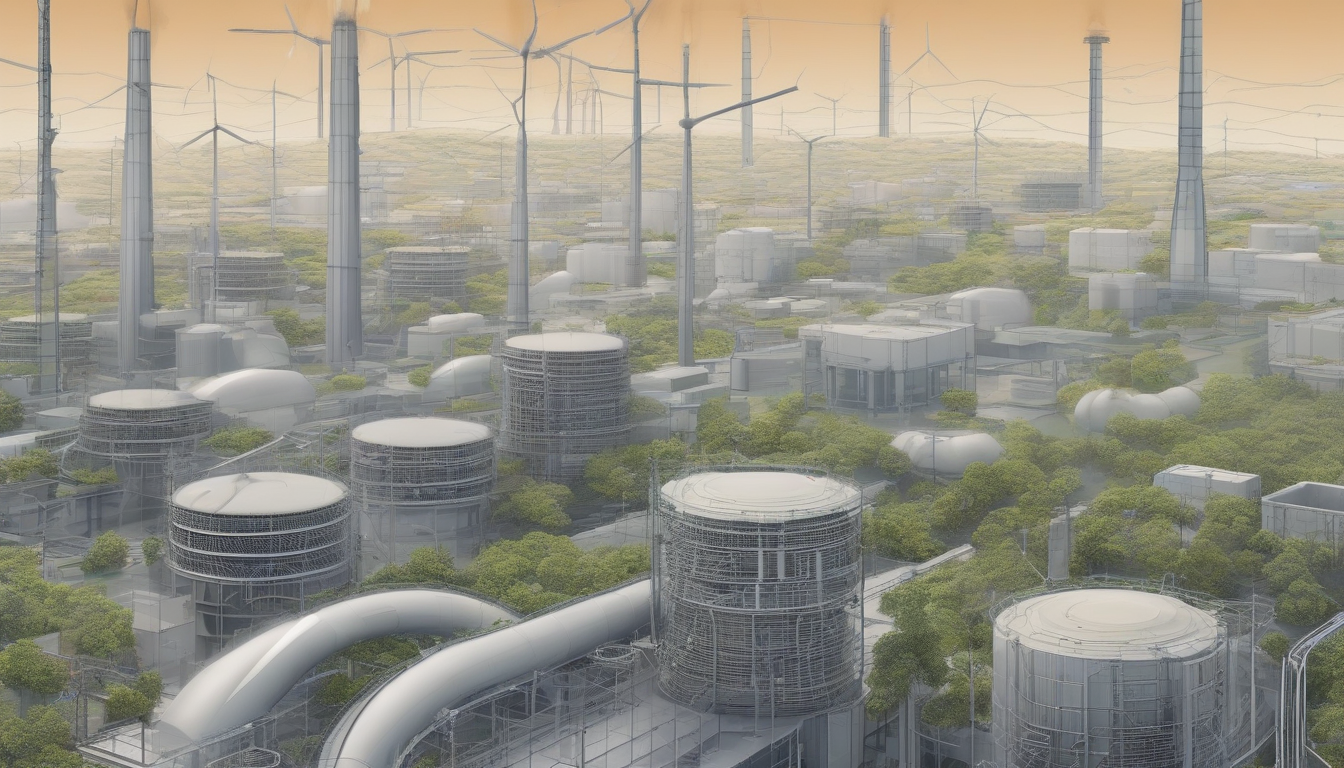
Powering modern AI models is turning out to be far dirtier than cloud providers expected. When Google and Amazon published their latest sustainability metrics, the figures caught the infrastructure industry off guard. According to a detailed report by TechCrunch, Google reported a 25% year-over-year jump in total carbon emissions, while Amazon posted a 16% increase. Both hyperscalers have repeatedly committed to zeroing out net carbon emissions over the next decade. Yet their aggressive pursuit of high-density AI clusters is pushing those targets out of reach.
Neither company explicitly blames AI in their executive summaries, but the underlying telemetry tells the full story. While years of renewable power purchase agreements (PPAs) kept direct Scope 1 and Scope 2 utility emissions somewhat contained, Scope 3 emissions—the broad category of indirect supply chain pollution that tech giants don't directly control—exploded. As industry parallels show, these surges are not unique to one provider.
The Scope 3 Surge Behind Hyperscale AI Expansion
The picture gets clearer the deeper you dig into the emissions data. Google’s Scope 3 output surged by 2.1 million metric tons over the past year alone. That brings their Scope 3 footprint to roughly double what it was during their 2019 baseline year. Although Google combines capital goods and product usage in its public filings, hardware power consumption for small consumer devices is negligible. The main driver is massive compute infrastructure buildout.
Amazon faced a similar spike, fueled by aggressive physical expansion. In 2025, Amazon added more data center capacity worldwide than any other provider, bringing over 1.2 gigawatts (GW) of new compute online in Q4 alone. Most of Amazon's rising Scope 3 footprint comes directly from capital goods—including data centers and logistical hubs—alongside fuel and energy purchases.
For years, cloud providers canceled out operational footprint growth by buying renewable power for offices and modestly sized data centers. AI upended that balance. While tech companies still attempt to pair solar and wind with battery storage, grid constraints are forcing them to fall back on fossil fuels. In fact, major tech firms, including Google, have begun investing directly in natural gas power plants to ensure uninterrupted power for high-density clusters.
Why AI Cloud Infrastructure Companies in India Face Parallel Pressures
The carbon challenges hitting Seattle and Mountain View mirror what AI cloud infrastructure companies in India are navigating right now. As domestic enterprises rapidly adopt enterprise AI and Cloud Computing Services | Google Cloud architectures alongside AWS cloud infrastructure, local data center operators are expanding fast. But regional power grids in developing technology hubs still lean heavily on coal and thermal generation.
To meet zero-downtime SLAs, system architects overseeing AWS cloud infrastructure engineer jobs and hybrid cloud deployments can no longer rely solely on green grid power. When local utility capacity stalls during peak demand, backstop thermal generation fills the gap.
This dynamic complicates enterprise architecture choices. As explored in regional infrastructure analyses like HCL’s Sovereign Datacenter Expansion, maintaining sovereign compute capacity while balancing carbon constraints requires rethinking how workloads get routed and provisioned. Building massive GPU clusters without green supply chains simply shifts the carbon burden downstream.
From Passive Inference to Agentic AI and Embodied Workloads
Why is AI compute so much more carbon-intensive than traditional cloud workloads? The answer lies in the shift from simple batch prediction to continuous agentic architecture. As outlined in fundamental industry definitions such as "What is agentic AI? - IBM" and "What is agentic AI? Definition and differentiators | Google Cloud," agentic AI represents a paradigm shift. Rather than responding to passive, one-shot prompts, agentic systems possess high autonomy, goal-oriented decision making, dynamic tool invocation, and continuous multi-step planning.
The technical distinction between a basic AI agent and full agentic AI—a topic widely debated across architectural literature (including Chinese technical reviews like "综述:AI Agent 与 Agentic AI 有什么区别? - 知乎")—comes down to autonomy and runtime duration. Legacy language models execute brief, stateless inference calls. Agentic AI workflows execute complex, multi-agent orchestrations that run self-correction loops and call external APIs continuously for hours.
Furthermore, enterprise applications are driving the rise of the embodied agent. So, what is an embodied agent? An embodied agent extends autonomous decision-making software into physical platforms—ranging from industrial robotics and smart manufacturing systems to autonomous edge hardware and automated data center thermal management systems—where software directly interacts with physical sensors and mechanical actuators. Whether controlling physical hardware or driving persistent autonomous code loops, embodied agents and agentic workloads generate relentless compute demand that keeps GPUs operating at maximum thermal design power (TDP). This shift represents a fundamental transformation in how infrastructure is consumed.
Silicon, Steel, and Supply Chain Realities
Software optimization alone won't solve the Scope 3 crunch because the biggest carbon bottlenecks happen before a single server powers on. Data center construction requires thousands of tons of structural steel and reinforced concrete. Both industries remain heavy polluters, and zero-carbon startup technologies are not yet ready to deliver at hyperscale volume. Addressing this requires a broader look at how data infrastructure acts as a primary constraint on deployment.
Then there is the silicon supply chain itself. Manufacturing advanced GPUs and high-bandwidth memory (HBM) chips consumes vast amounts of energy. Most leading-edge semiconductor fabrication plants operate in Asia, where electrical grids remain heavily dominated by fossil fuels.
Making matters worse, semiconductor manufacturing relies on complex fluorinated etch gases and chemical solvents. Many of these chemicals are potent greenhouse gases capable of warming the atmosphere thousands of times more than an equivalent amount of CO2. When cloud providers order hundreds of thousands of state-of-the-art accelerators, those manufacturing emissions hit Scope 3 ledgers immediately.
Decarbonizing Compute Demands Structural Engineering Shifts
Eradicating AI's carbon footprint requires moving beyond greenwashing and PR claims about environmental benefits. Hyperscalers and AI cloud infrastructure companies in India must re-engineer how compute clusters are constructed, powered, and retired.
First, cloud providers must scale direct power purchase agreements for clean energy while deploying long-duration battery storage to eliminate reliance on natural gas peaker plants. Second, massive capital investment must flow into green steel and carbon-neutral cement supply chains to lower the embodied footprint of new buildouts. Third, tech firms will need to purchase millions of tons of high-permanence carbon removal credits to offset unavoidable upstream manufacturing emissions.
Infrastructure efficiency can no longer be measured purely in FLOPS per watt. As cloud providers balance performance against environmental constraints, engineering teams must optimize the entire lifecycle of agentic workloads. Without deep supply-chain interventions, the compute powering tomorrow's autonomous systems will remain tethered to yesterday's carbon debt.