
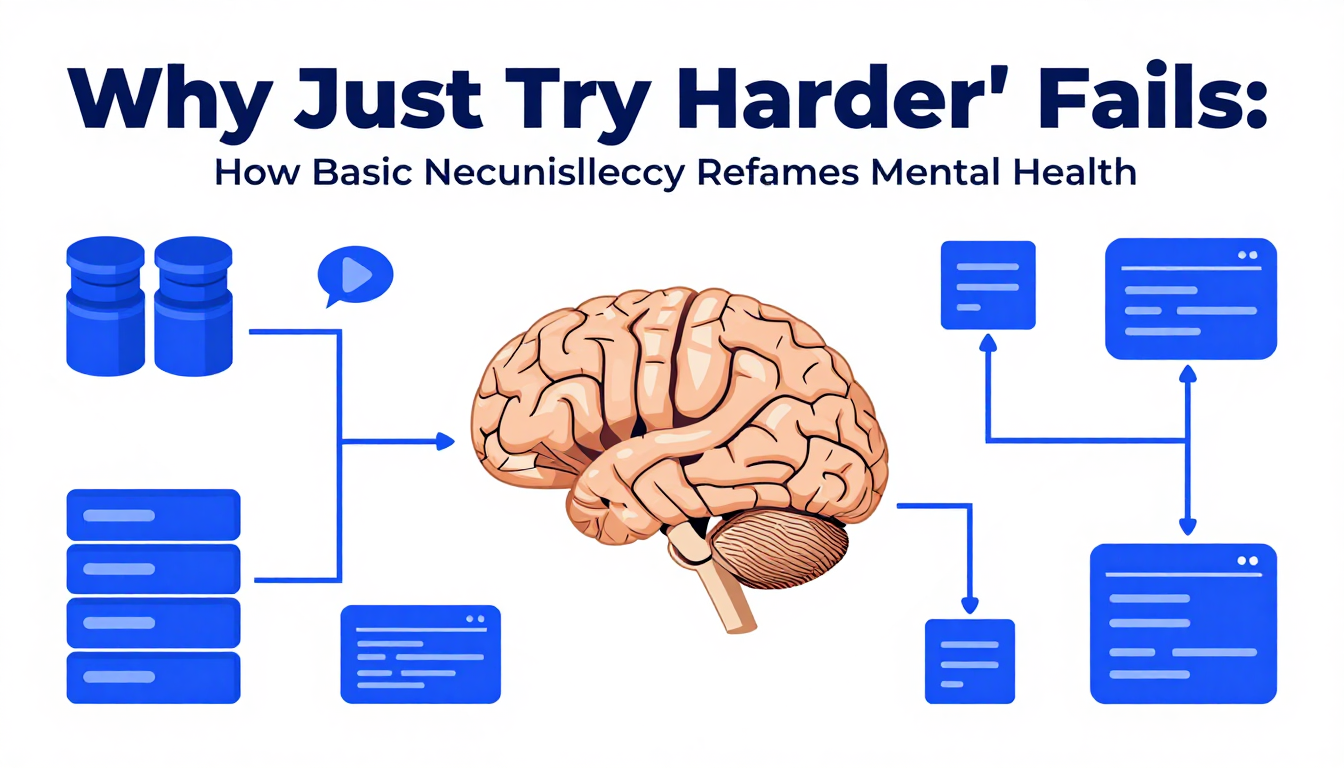
The Real Problem With Telling Someone to Try Harder
Telling a person suffering from acute anxiety or addiction to "just use more willpower" is useless. It misinterprets basic human biology. When you exert willpower, you call on your prefrontal cortex. Neuroscientists often refer to this region as the chief executive officer of the brain. It manages long-range planning, organizes schedules, calculates risks, and reins in sudden impulses.
If your primary issue is missing a project deadline or forgetting your groceries, leaning on your prefrontal cortex works. That is what it evolved to do. But deep emotional panic and compulsive behaviors do not start in executive planning centers. Expecting executive control to quiet a raging internal alarm is like trying to fix an engine failure by cleaning the windshield. It fails completely. Worse, when society treats deep neurobiological distress as a personal defect of character, it creates intense self-blame and feeds unnecessary stigma.
Subcortical Drives, Traumatic Memory, and the Amygdala
Most severe emotional struggles originate far beneath the cerebral cortex. They start in older, primitive structures that evolved long before humans developed abstract reasoning. The amygdala acts as the brain's internal threat monitor and fear center. It logs traumatic experiences and fires off self-protective survival instincts before your conscious mind even notices what happened.
Consider substance addiction. For decades, moralizers dismissed addiction as a simple lack of self-discipline. They blamed a weak prefrontal manager. As clinical psychologist Dorothy Chin notes in her work for Psychology Today, addiction rarely comes down to raw willpower. Instead, people often turn to chemical substances to mute unbearable traumatic memories stored deep in the amygdala. Using a chemical buffer to quiet an overactive fear circuit is a survival strategy, not a refusal to plan ahead. When we understand how disrupted brain wiring in mood disorders reshapes emotional responses, our focus shifts from harsh judgment to targeted biological healing.
Receptors, Neurochemistry, and the Physical Power of Naming Feelings
Pharmaceutical drugs and recreational substances do not invent new biological pathways out of thin air. They work because our brains already possess the target machinery. External molecules fit into pre-existing receptors, triggering specialized circuits and mimicking endogenous chemical messengers. Opiate drugs create intense euphoria because they fit directly into receptors designed for naturally produced endorphins.
The inverse is just as true: conscious physical actions change internal neurochemistry directly. Anti-anxiety medications reduce central nervous system arousal and soothe an overactive amygdala. Yet, saying or writing a simple statement like "I am scared" triggers a remarkably similar physiological shift. Stating your state in plain language recruits cortical processing regions. That cortical activity sends direct inhibitory signals down to emotional centers, turning down the volume on subcortical alarm bells. Naming an emotion isn't just self-help talk. It is a physical handbrake on amygdala reactivity. Recognizing how neurotransmitters shape network flexibility in mental health changes how we approach daily stress.
The Neurobiology Behind Everyday Wellness Advice
We hear standard health advice all the time: exercise more, sleep eight hours, and eat salmon. Without biological context, these suggestions feel like empty nagging. But looking at the exact biological mechanisms turns generic advice into practical tools you can actually use.
Physical exercise releases endorphins, which block pain signals and elevate mood. Eating fatty fish like salmon supplies specific amino acid precursors required to build serotonin—a key neurotransmitter responsible for mood stability—while simultaneously dampening systemic inflammation. Current research links body-wide inflammatory markers directly to psychiatric conditions like depression. When you realize that balanced nutrition and movement directly alter neurotransmitter production and inflammatory pathways, daily self-care stops feeling like an abstract chore. It becomes a precise lever for biological control.
Unsticking Creative Ruts Across Brain Hemispheres
Understanding brain architecture offers practical solutions for common mental roadblocks, including creative burnout. When a writer sits stuck before a blank page, they usually keep firing the exact same overworked neural pathways in their left temporal lobe, where primary language processing sits.
Breaking out of that mental loop requires engaging underused brain regions. Writing exercises that force you to focus on tactile sensations, distinct smells, or ambient sound recruit dispersed sensory networks across the cortex. Even switching your pen to your non-dominant hand breaks the loop. Because motor pathways are contralateral, writing with your left hand forces the right cerebral hemisphere to wake up. That right hemisphere handles spatial and holistic processing networks that stay quiet during standard typing. Instead of sitting idle and waiting for inspiration, you can deliberately activate alternate neural circuits to get unstuck.
How Basic Neural Literacy Builds Practical Agency
You do not need a degree in neuroscience to change how you relate to your mind. Getting familiar with core brain divisions—the hindbrain, midbrain, and cerebral cortex—along with key chemical messengers like dopamine, serotonin, and GABA, gives you a clear manual for daily mental health.
Struggles with mental health reflect specific neural circuits doing their jobs, not moral failings or personal flaws. Grasping the evolutionary cost of complex brains helps us replace shame with practical self-care. Stop demanding that your prefrontal cortex fix subcortical problems it wasn't built to solve. Work with your biological hardware, building daily habits anchored in how your brain actually functions.