
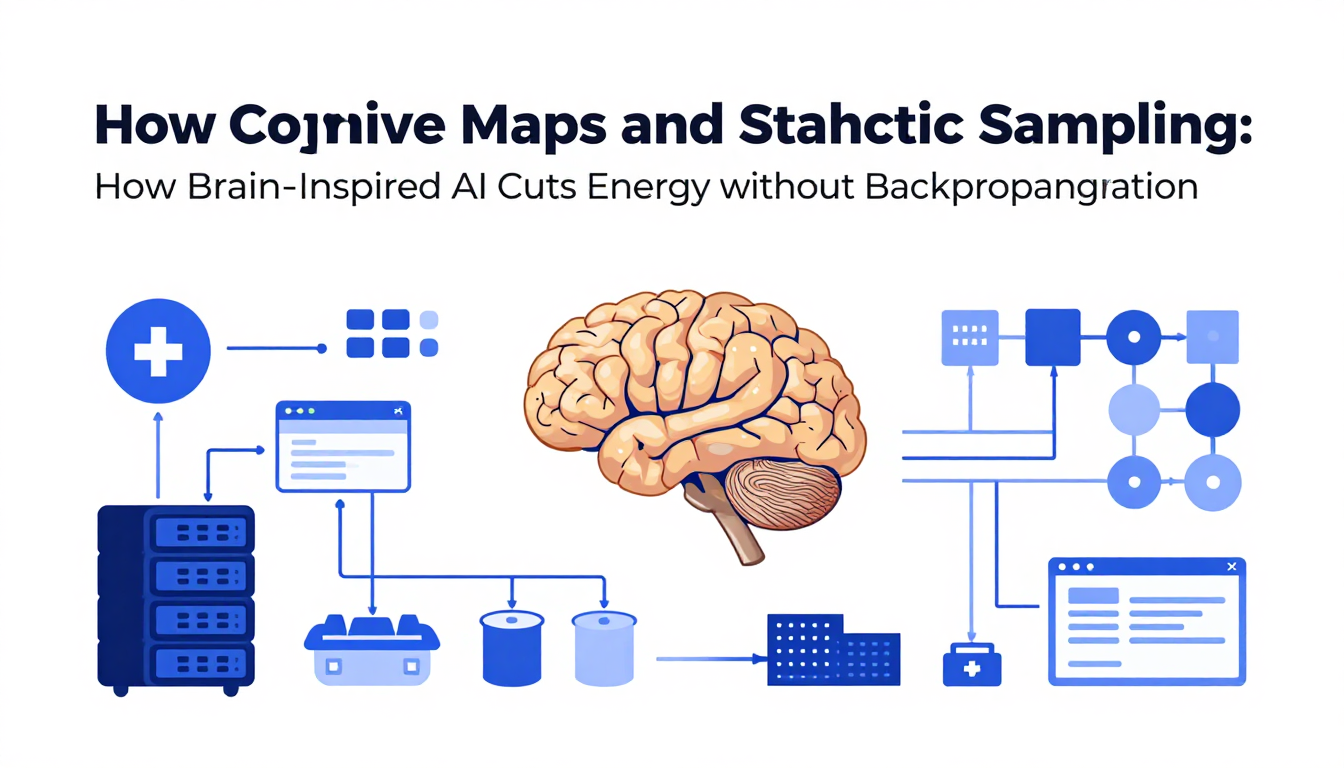
The 20-Watt Constraint: Why Modern AI Needs Cognitive Shortcuts
Running giant language models and deep neural networks to solve simple multi-step planning problems is getting absurdly expensive. Modern data centers suck down megawatts of electrical power just to run brute-force matrix multiplications across thousands of GPUs. Meanwhile, your brain sits inside your skull running complex real-time planning, navigation, and spatial problem-solving on roughly 20 watts. That contrast isn't just an academic curiosity; it's a massive wall for anyone trying to put real intelligence into battery-powered edge hardware like drones or autonomous industrial inspection bots.
To close that gap, researchers Hui Lin, Yukun Yang, Rong Zhao, Giovanni Pezzulo, and Wolfgang Maass at Graz University of Technology (alongside partners at Tsinghua University and the National Research Council of Italy) took a hard look at biological neurobiology. Their goal wasn't to build another trillion-parameter transformer. Instead, they asked a basic question: what data structures and probabilistic sampling tricks does the human hippocampus use to navigate unknown places and invent solutions on the fly without burning through gigajoules of energy?
The answer, published in Nature Machine Intelligence, is a transparent neural network model built around cognitive maps, stochastic neural computing, and compositional coding. By rethinking how an AI evaluates potential actions, the team showed that high-level goal-directed planning doesn't require massive deep neural networks or energy-intensive backpropagation passes.
The Triad Architecture: Maps, Noise, and Reusable Modules
Biological brains don't solve maze problems or puzzle assembly by unrolling massive decision trees all the way to the end. That would exhaust biological energy limits instantly. The Graz university research isolates three distinct biological mechanisms to replace brute-force search:
First, geometric cognitive maps. The biological hippocampus translates abstract relationships between objects or locations into geometric spatial coordinates. In neural systems, this provides a topological sense of direction without requiring a dense grid of explicit Cartesian coordinates.
Second, stochastic neural computations. Rather than executing precise, deterministic searches, biological neural networks leverage internal noise and variability. They sample hypothetical scenarios probabilistically, generating random intermediate steps on the fly.
Third, compositional coding. Action sequences and sensory memories get broken down into modular, reusable components. Instead of learning an entirely new policy for every task variation, the network stitches together pre-existing neural primitives.
When you bring these three mechanisms together into a generative cognitive map learner (GCML), something interesting happens. The model can imagine potential solution steps without calculating the full computational trajectory down to the sub-atomic detail.
Goal-Directed Imagination Without Exhaustive Compute
How does this look in practice during an inference run? Standard reinforcement learning models evaluate thousands of state-action pairs using deep Q-tables or high-dimensional policy networks. Every step requires dense matrix multiplications across multiple hidden layers. If the environment shifts slightly, the model either fails or forces you to run costly fine-tuning loops.
This brain-inspired system works differently, as detailed in coverage by Neuroscience News. When presented with a goal state, the AI generates a candidate intermediate step using stochastic sampling. Next, it queries its internal cognitive map to check a single question: does this random hop move us closer geometrically to the intended goal?
If the geometric evaluation says yes, the model adopts that position as its new baseline and samples the next step. If the hop leads away from the target, the path is dropped immediately before wasting any further compute cycle on downstream predictions. This approach mirrors how humans mentally scout a route across a crowded room. You don't calculate every single footstep; you spot key landmarks and adjust course dynamically.
Crucially, this goal-directed imagination delivers zero-shot adaptability. If an obstacle suddenly blocks a corridor or a structural change occurs in the task environment, the model doesn't lock up or demand retraining. It simply samples new probabilistic steps within the updated geometric constraints of its cognitive map.
Local Plasticity for In-Memory and Neuromorphic Silicon
For hardware engineers building edge systems, the biggest bottleneck in traditional AI is the energy cost of backpropagation and off-chip memory access. Standard deep learning requires shuttling weights back and forth between high-bandwidth memory (HBM) and compute cores—a bottleneck that drains power regardless of model efficiency. We've seen similar biological hardware efficiency efforts when investigating how a brain reflex center cut AI energy use by 10,000 times.
The Graz architecture bypasses backpropagation entirely. The model relies on self-supervised local synaptic plasticity. Weight updates are calculated strictly based on local signals at individual synapses rather than global error signals pushed backward through dozens of network layers.
Because the underlying neural network is fully transparent and local, it is natively compatible with emerging neuromorphic silicon and in-memory computing architectures. Non-volatile memory arrays (like memristors or phase-change memory) can store weights directly at the processing nodes. This matches the vision of decentralized edge computing, though as explored in our reality check on neuromorphic hardware, bridging the gap between lab algorithms and commercial fabrication requires strict system-level design.
Experimental Proofs: Navigation, Abstract Spaces, and Shapes
To test the limits of this cognitive map learner, the research team put the algorithm through three separate benchmark environments:
2D Spatial Navigation: The agent had to locate targets across spatial layouts with unexpected obstacles. The stochastic sampling method allowed it to bypass dead ends without exhaustive grid exploration.
Abstract Multidimensional Orientation: Beyond physical space, the model was tasked with navigating high-dimensional relational graph networks. The cognitive map maintained geometric relationships across abstract variables, proving the system isn't limited to physical map coordinates.
Silhouette Assembly and Disassembly: The system organized primitive building blocks to construct and dismantle complex visual silhouettes. Using compositional coding, the agent reused primitive shape representations to solve entirely novel silhouette targets without prior training.
Across all three benchmarks, the network demonstrated robust problem-solving capabilities while operating with far fewer parameters and memory transactions than deep reinforcement learning alternatives.
Edge Infrastructure: Taking Planning Off Central Data Centers
The long-term value of biological planning algorithms isn't about replacing frontier language models in cloud data centers. As Wolfgang Maass noted, this work points toward an alternative paradigm for constrained edge operational environments.
Consider mobile robotics, autonomous drone fleets, or remote industrial gateways. If an inspection drone inside a steel mill loses cloud connectivity, it cannot afford to run a multi-billion-parameter local model to navigate around a newly placed steel beam. It needs real-time, low-latency trajectory replanning within a micro-watt or milliwatt power envelope.
By decoupling goal-directed planning from deep backpropagation and data-heavy pretraining, cognitive map sampling enables true zero-shot autonomy on local silicon. Real-world deployments—such as Intel and Siemens deploying neuromorphic edge gateways at Rotterdam Port—demonstrate how local bio-inspired compute moves from theoretical papers into mission-critical infrastructure. Combining local synaptic plasticity with stochastic cognitive sampling provides a concrete blueprint for low-power edge intelligence that learns and adapts on the fly.
What This Means for AI's Energy Future
This research challenges a fundamental assumption in modern AI: that bigger models always equal better performance. The Graz team's work suggests that for certain planning and problem-solving tasks, biological-inspired architectures may actually outperform deep neural networks—not just in energy efficiency, but in adaptability and speed.
The key insight is that intelligence doesn't require exhaustive computation. By leveraging cognitive maps, stochastic sampling, and compositional coding, the brain achieves remarkable flexibility with minimal energy. Porting these principles into artificial systems could fundamentally reshape how we think about AI deployment at the edge.
The implications extend beyond robotics. Any system that needs to make real-time decisions under energy constraints—satellites, medical implants, environmental sensors—could benefit from this approach. The question isn't whether we can afford to ignore biology anymore. It's whether we can afford not to.