The Hidden Bottleneck in AI Hardware Deployments
Hyperscalers are spending hundreds of billions on GPU clusters, yet the bottleneck slowing down deployments isn't just power availability or wafer capacity. It's the physical factory floor. Turning raw silicon, dense motherboards, and liquid cooling lines into functional, server-racked compute nodes has become a major operational drag.
When technicians build modern high-density AI servers manually, initial manufacturing quality takes a massive hit. First-pass yield—the percentage of units coming off the line correct on the first attempt without needing rework—can start as low as 20%. Even after teams gradually ramp up production and refine their manual assembly workflows, first-pass yields typically cap out between 60% and 65%.
When an individual AI server chassis costs hundreds of thousands of dollars, letting 35% to 80% of production fail initial testing creates severe financial bleed. Hyperscalers lose millions of dollars every single day that compute sits unready in manufacturing queues. Fully automated robotic operations deliver station-level yields exceeding 98% and overall line-level yields around 97.5% to 97.7%. Robotic lines also boost throughput speed by 50% to 100% over manual work. But complete automation has historically stalled when forced to handle non-standard cabling, delicate mechanical fits, or custom component inserts.
Bridging Automation and Human Manual Steps
Historically, electronics manufacturing presented a zero-sum trade-off whenever automated lines hit steps that required human dexterity. Line managers had to choose between two bad outcomes: halt the automated line entirely to let an operator step in, or pull partially built chassis off the track onto offline manual benches.
Halting the line kills factory throughput. Pulling units off to separate workstations creates a black hole in production data. The continuous data stream—capturing torque settings, optical inspection images, and component serial numbers—gets severed the moment a human touches the unit.
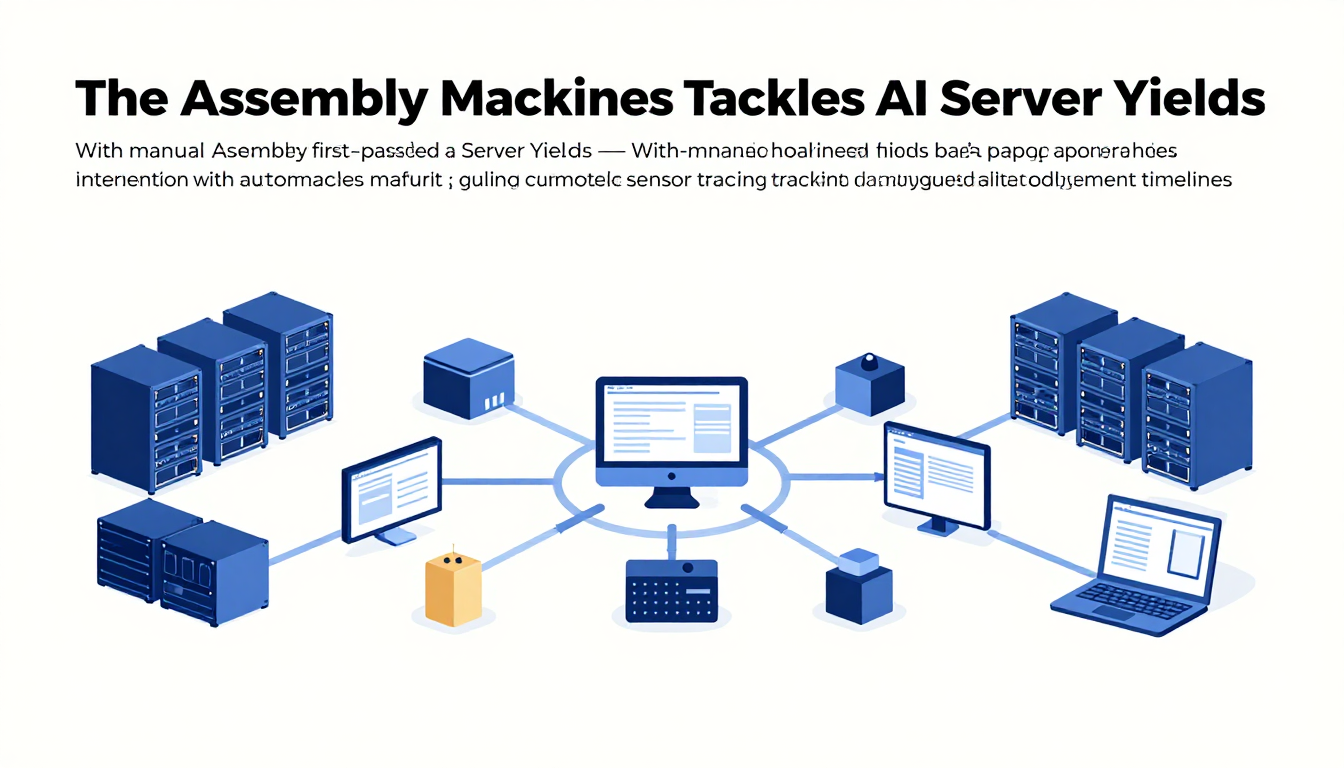
Bright Machines designed the Hybrid BRC (Bright Robotic Cell) to eliminate that compromise. Built as an extension of their Bright Factory platform, the hybrid cell integrates guarded access doors and safety panels directly into the robotic enclosure. When a human technician opens the safety doors, the cell's robotic arm deactivates safely while camera arrays, force-feedback sensors, and tooling monitors remain fully online. Guided by step-by-step on-screen prompts, the operator completes the required physical steps while the system enforces real-time quality control checks identical to automated cycles.
Crucially, the digital traceability record stays attached to the chassis at the serial-number level from start to finish. The assembly sequence continues without losing a single frame of process telemetry.
Digital Traceability and Supply Chain Governance
Point software solutions like Tulip handle operator interfaces, while tools like Instrumental focus strictly on computer vision inspection. But contract manufacturing giants like Flex, Jabil, and Foxconn historically ran full assembly processes on manual labor that generated sparse production data. Bright Machines positions itself as a technology-enabled manufacturer running the complete line from end to end, stitching software, hardware, and floor operators into a unified environment called Bright Insights.
For enterprise infrastructure architects and cloud providers, an unbroken digital thread is as critical as the hardware itself—a key focus in owning AI infrastructure. Field failures six months after deployment require precise root-cause tracing back to specific batches, torque parameters, or assembly stations.
In high-stakes manufacturing, Bright Machines enforces a clean data governance boundary. Everything related to customer IP, device inspection images, and proprietary part specifications remains strictly owned and protected by the customer. Meanwhile, process analytics, robotic operation telemetry, and station efficiency data stay with Bright Machines to fuel continuous platform improvement.
This level of granular verification is vital for defense, government, and high-security workloads. Building hardware for sovereign clouds demands verifiable proof of every component placed inside the chassis. Software-monitored hybrid cells ensure that human intervention doesn't open doors to untracked components or undocumented assembly variations.
Economics of Fast Retooling and Onshoring
The push to bring electronics manufacturing back to North America faces an immediate physical wall: labor availability. Shenzhen-scale hardware manufacturing hubs rely on millions of manual assembly workers—a labor footprint that simply does not exist in Western industrial centers. Rebuilding hardware manufacturing onshore requires solving the labor deficit with AI software and robotics while keeping human operators focused on high-value exception handling.
Speed of retooling matters just as much as yield. The push to efficiently disaggregate compute is transforming how factory lines handle complexity. Chip architects operate on aggressive annual release cycles, forcing factory lines to reconfigure rapidly. Modular, software-defined microfactories allow minor product family modifications to deploy on the floor within a single day. Major architectural transitions—such as shifting from standard air cooling to complex liquid cooling distribution manifolds—require deeper structural line shifts, but the underlying software framework dramatically shrinks changeover downtime.
The technology isn't theoretical. Spun out from contract manufacturer Flex eight years ago, Bright Machines has deployed more than 130 microfactories across 10-plus countries, serving over 60 customers and manufacturing more than 300,000 servers. On its hybrid lines alone, the company has already produced over 10,000 compute nodes and plans to manufacture more than half a gigawatt of compute capacity this year.
To support that growth, the San Francisco firm is moving its offices to a Burlingame facility three to four times larger. That expansion follows a $126 million Series C in June 2024 led by BlackRock funds—with participation from Nvidia, Microsoft, Eclipse, Jabil, and Shinhan Securities—plus $20 million in venture debt from J.P. Morgan, bringing total capital raised past $400 million. As Eclipse CEO and Bright Machines chairman Lior Susan noted, the future of manufacturing isn't choosing between automation and flexibility, but unifying both within a single digital production environment.