The $5.85B Free Cash Flow Deficit Behind $119.8B in Revenue
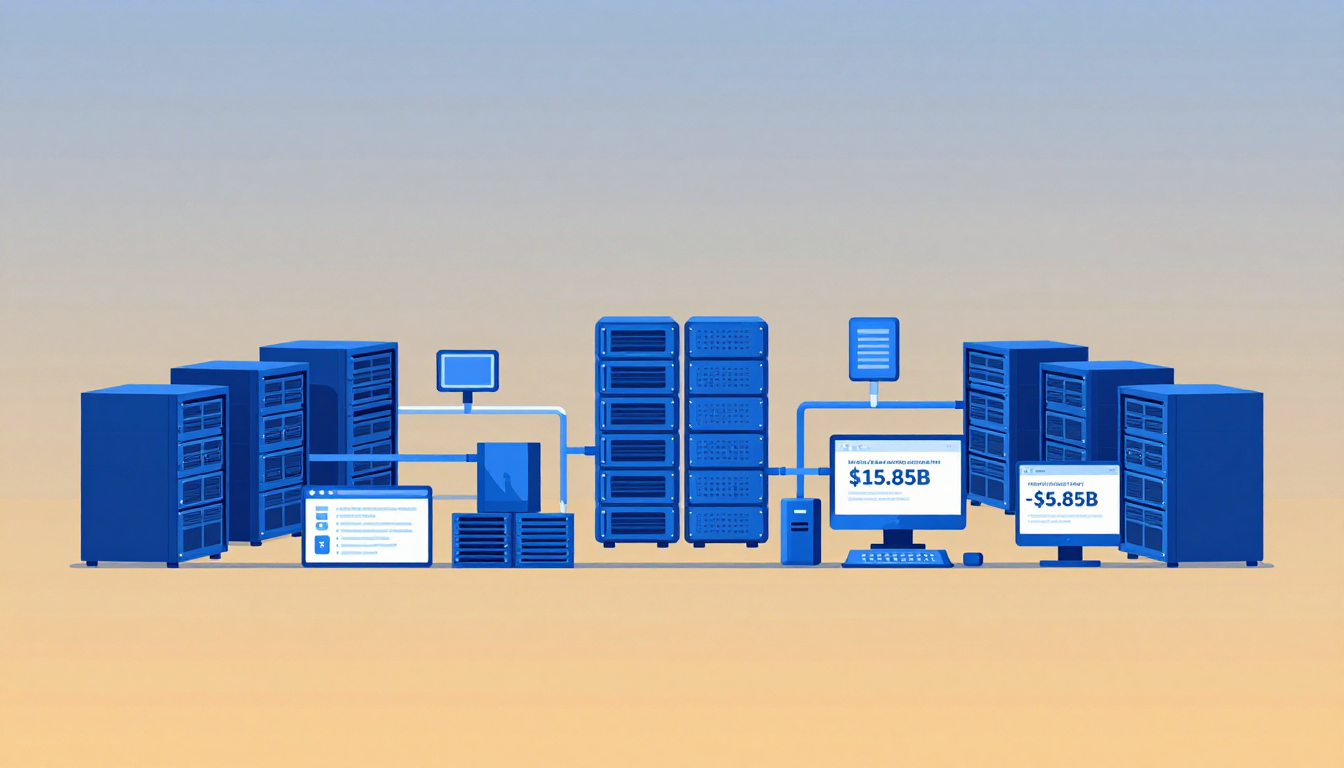
Alphabet brought in $119.8 billion in revenue during Q2 2026. That is a 24 percent jump year-over-year, and on paper, it looks like a landslide victory. But take a look at the statement of cash flows. You will find a stark $5.855 billion deficit in free cash flow.
That is not a math error. Alphabet did not lose money on operations—it generated $39.069 billion in operating cash flow over those three months. But its capital expenditures ran up to $44.924 billion. When your quarterly capital investments exceed your operating cash by almost six billion dollars, you cross into negative free cash flow territory.
For years, big tech operated under a simple cash-generation framework. Search revenues and ad margins comfortably paid for server upgrades, optic cables, and real estate, leaving tens of billions left over for stock buybacks. Generative AI broke that model. Training frontier models like Gemini 3.5 while serving real-time inference to hundreds of millions of users requires a scale of compute that consumes every cent of cash flow—and then asks for more.
According to reporting by Search Engine Journal, this cash burn reflects an unprecedented structural shift in how cloud providers fund their underlying infrastructure, detailed in our analysis of Alphabet's AGI-First Compute Strategy.
Where the Money Went: The 60-40 Hardware and Data Center Split
Alphabet Chief Financial Officer Anat Ashkanazi broke down the $44.924 billion CapEx bill during the Q2 earnings call. The division of capital was precise.
Sixty percent of the $44.924 billion went directly into purchasing servers and custom accelerator hardware. The remaining forty percent paid for physical data centers and electrical power infrastructure.
Q2 2026 Capital Expenditure Allocation ($44.92B Total)
├── Server Procurement & Custom Silicon (60%): ~$26.95 Billion
└── Data Center Real Estate & Power (40%):    ~$17.97 Billion
That 60-40 split tells a clear story about hardware bottlenecks. Physical concrete and steel structures are expensive to erect, but populating those halls with liquid-cooled TPU racks and high-density network fabrics is where the real cash burns.
Compare this quarter to Q2 2025. Just one year ago, Alphabet's quarterly property and equipment purchases sat at $22.446 billion. Spending doubled in twelve months. The hardware renewal cycle for generative AI is moving far faster than legacy enterprise compute ever did. Accelerators depreciate rapidly, power density requirements skyrocket with every new model generation, and the cost of remaining at the frontier leaves zero room for delay.
Revenue Breakdown: Cloud Acceleration and Search Resilience
The cash deficit is not happening because Alphabet's core business is faltering. Revenue grew across every single operational segment between Q1 2026 and Q2 2026.
Google Search and related properties generated $63.3 billion in Q2, up $2.9 billion or 4.8 percent over Q1. YouTube ad revenues hit $11.1 billion, representing a 12.2 percent quarterly increase (+$1.2 billion). Google subscriptions, platforms, and devices brought in $12.9 billion, growing 4.2 percent (+$0.5 billion).
Q1 2026 vs. Q2 2026 Revenue Growth by Segment
Segment                          Q1 2026     Q2 2026     Change ($)   Change (%)
--------------------------------------------------------------------------------
Google Search & Other            $60.4B      $63.3B      +$2.9B       +4.8%
Google Cloud                     $20.0B      $24.8B      +$4.8B       +23.8%
Subscriptions, Platforms & Dev.  $12.4B      $12.9B      +$0.5B       +4.2%
YouTube Ads                      $9.9B       $11.1B      +$1.2B       +12.2%
--------------------------------------------------------------------------------
Total Quarterly Revenue          --          $119.8B     --           +24.0% YoY
Google Cloud delivered the most dramatic growth. Revenue surged to $24.8 billion, gaining $4.8 billion over the previous quarter—a 23.8 percent jump in three months.
Publishers and search marketers have raised sharp concerns over AI Overview answers eating into referral traffic and locking users inside Google's search environment. Yet financially, Google's ad ecosystem and enterprise cloud offerings continue to extract record value from user interactions. The monetization engine is running fine. It is the compute engine underneath that demands a fortune.
External Capital: Why Alphabet Raised $49.6 Billion in Equity
Perhaps the most telling revelation in the Q2 filing was not the negative free cash flow itself, but how management decided to cover it. Alphabet completed a massive $49.6 billion equity offering during the quarter.
The official filing stated that the proceeds were earmarked specifically for "capital expenditures to scale AI infrastructure and global compute."
Think about what that means. A corporation generating over $39 billion in quarterly operating cash had to issue fresh equity to backstop its hardware expansion. Alphabet could not fund its AI ambition purely out of internal operational cash.
For decades, big tech cash flows were insulated. You built software once, distributed it globally over existing fiber, and reaped 70% gross margins. AI infrastructure flips that equation. Inference is an ongoing utility cost, and training requires continuous capital injection. Raising $49.6 billion in equity shows management is willing to dilute or leverage balance sheet strength rather than slow down accelerator deployments. They know that falling behind in silicon density means losing the enterprise AI market altogether.
Sixfold Spending Surge: What 2026 and 2027 CapEx Means for Cloud
Management's forward guidance leaves no doubt: the spending curve is steepening. In 2022, at the start of the current generative AI push, Alphabet's full-year capital expenditure was roughly $31 billion.
For full-year 2026, Alphabet projects CapEx will land between $180 billion and $190 billion. That is six times the 2022 level and double what the company spent in 2025. And management noted on the call that 2027 capital spending will increase significantly over 2026.
Alphabet Annual CapEx Trajectory (2022 - 2026E)
2022:  $31 Billion    ███
2025:  ~$92 Billion   █████████
2026E: $180-$190B     ████████████████████
What does this mean for enterprise leaders, infrastructure architects, and engineering teams relying on public cloud infrastructure?
First, expect cloud margins and pricing structures to tighten. Hyperscalers cannot absorb hundreds of billions in hardware depreciation without passing those costs downstream. Discounting on GPU and TPU instances will diminish, and multi-year committed spend contracts will become the baseline requirement for reserving dedicated accelerator clusters.
Second, the barrier to entry for building frontier-class AI models has effectively closed to anyone without sovereign or mega-cap balance sheets. When staying competitive requires a $180+ billion annual capital commitment, even large enterprise tech companies will operate primarily as tenants on hyperscaler infrastructure.
Alphabet's negative $5.85 billion free cash flow is not a temporary hiccup. It is the new math of enterprise compute, forcing a shift in AI cost control across the sector.