Ditching On-Prem Hardware for Commercial Cloud Compute
For decades, national meteorology centers treated custom, on-premises supercomputers as non-negotiable. Building, housing, and cooling massive silicon clusters was the only way to run tightly coupled numerical weather prediction models. That era is officially ending. The National Oceanic and Atmospheric Administration (NOAA) is retiring its dedicated hardware and migrating its entire Weather and Climate Operational Supercomputing System (WCOSS) to Google Cloud by December 2027.
This isn't a partial hybrid experiment. NOAA will become the first national weather center in the world to move operational numerical weather forecasting entirely to commercial public cloud infrastructure. While the UK Met Office has pursued cloud adoption through a hybrid setup on Microsoft Azure, NOAA is shutting down its physical footprint.
That physical footprint was substantial. NOAA currently relies on twin HPE Cray supercomputers named "Dogwood" and "Cactus," managed under contract by General Dynamics Information Technology (GDIT). Deployed across data centers in Virginia and Arizona, these dual systems received a major hardware refresh in August 2023 that boosted their capacity to 14.5 petaflops each—giving NOAA a combined operational ceiling of 29 petaflops, according to FedScoop hardware records.
Yet despite that compute power, fixed physical supercomputers created rigid operational constraints. Modernizing physical clusters meant multi-year procurement cycles, static capital allocations, and hardware lock-in that delayed scientific upgrades. Moving WCOSS to hyperscale cloud infrastructure strips away those physical boundaries.
DeepMind AI and the Shift to Machine Learning Forecasts
Moving existing physics-based models to off-premises hardware is only half of the strategy. The core driver behind the migration lies in NOAA's access to Google DeepMind’s specialized artificial intelligence stack. Under the new contract, NOAA is leveraging DeepMind tools to build out its first machine-learning-driven global forecast suite: the AI Global Forecast System (AI GFS).
Physics-based numerical weather prediction relies on solving complex atmospheric partial differential equations across global grid cells. It is computationally brutal. In contrast, neural network forecasting models learn directly from historical reanalysis datasets. According to NOAA's transition announcement, deploying AI GFS reduces the compute cycles needed for global weather predictions by a staggering 99.7%.
That reduction transforms operational timelines. Forecast generation cycles that previously required hours of heavy supercomputing math can now finish in minutes or seconds.
Crucially, AI GFS does not immediately replace traditional physics models. Instead, NOAA is migrating its core physics-based operational suites—including the flagship Global Forecast System (GFS) and the Global Ensemble Forecast System (GEFS)—to Google Cloud through late 2027. Running machine learning models alongside traditional ensemble physics gives forecasters a dual-engine architecture, combining statistical neural speed with traditional deterministic modeling. For deeper context on hybrid forecasting approaches, see Hybrid Forecasts: How Climate Scientists Are Taming AI with the Laws of Physics.
H4D Virtual Machines and RDMA Cluster Networking
Running high-performance computing (HPC) workloads on commercial cloud has historically run into severe latency bottlenecks. Standard cloud virtual machines fail when forced to exchange state across thousands of nodes every millisecond. To match on-premises Cray interconnects, Google Cloud is deploying its custom H4D virtual machine instances for NOAA's workload.
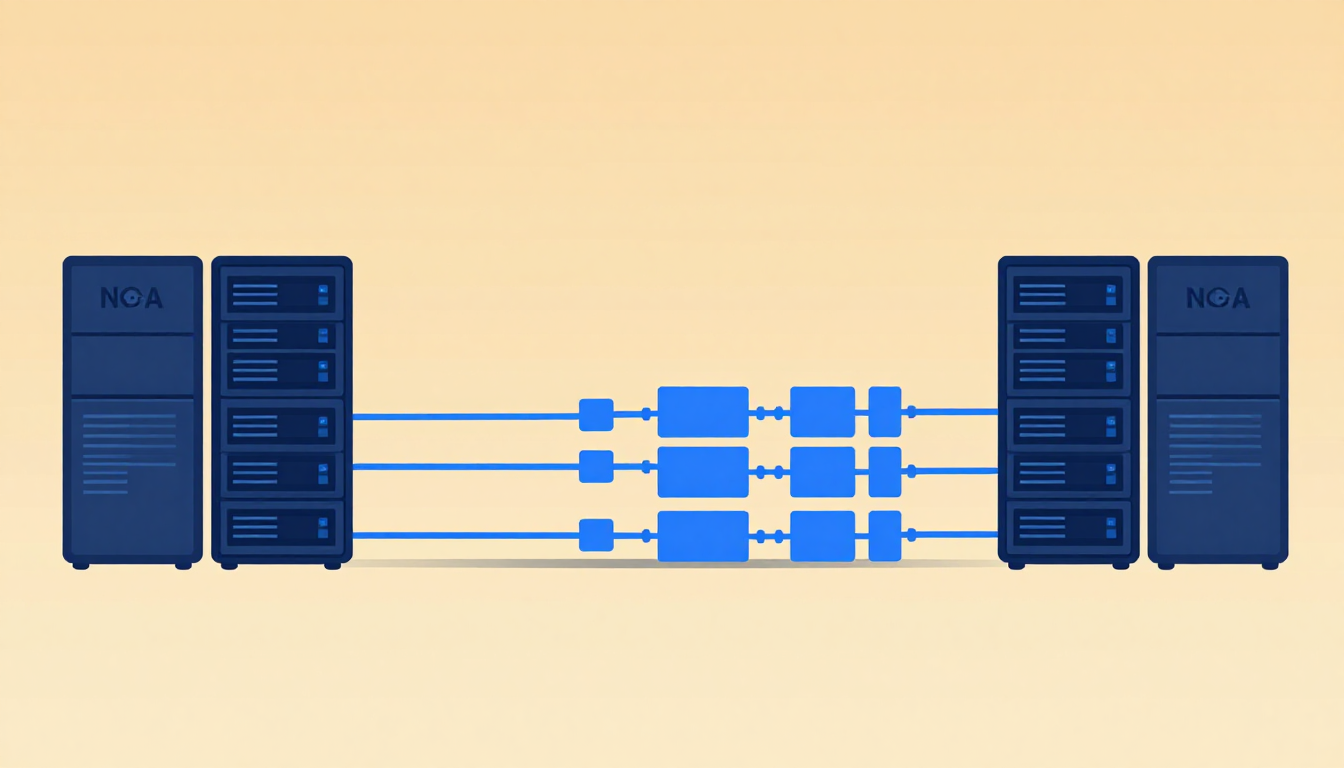
According to Google Cloud HPC documentation, H4D virtual machines are built on high-core-density AMD Epyc processors connected via custom hypervisors and Titanium network adapters. These hardware components support low-latency Cloud Remote Direct Memory Access (RDMA). By bypassing the guest operating system's network stack, Cloud RDMA lets tens of thousands of CPU cores synchronize data with ultra-low latency, replicating the fabric performance of an on-premises supercomputer.
Cluster management and scheduling are handled through Google's HPC software stack:
- Google Cloud Cluster Toolkit: Automates cluster provisioning and infrastructure configuration.
- Cluster Director: Monitors and maintains high-density node clusters.
- Cloud Batch & Dynamic Workload Scheduler: Manages job queuing, resource allocation, and on-demand compute scaling.
Financial flexibility is another advantage. H4D instances allow organizations to access high-performance hardware for as low as 3 cents per core-hour without requiring long-term upfront hardware investments.
Overhauling Downstream Alert Systems at Field Offices
Upgrading the central forecasting engine means little if local weather offices cannot ingest data quickly enough to issue timely tornado or flash flood warnings. Heavy model output creates massive bandwidth challenges when pushed out to field locations. To prevent downstream bottlenecks, the National Weather Service (NWS) is modernizing its local operational software stack in parallel.
In March 2026, NWS awarded major software development contracts to Accenture and Booz Allen Hamilton. These contracts focus on building two cloud-native software suites—dubbed HIVE and CIRRUS—designed specifically for local field office operations.
Currently, 122 local Weather Forecast Offices and regional NWS Centers rely on legacy in-house software to analyze raw model runs and generate localized hazard alerts. HIVE and CIRRUS replace those legacy applications with cloud-native workflows. By running directly inside the cloud environment alongside WCOSS and AI GFS, forecasters can slice through terabytes of ensemble forecast output without pulling raw files across local office network connections.
This architectural alignment ensures that severe weather alerts reach emergency managers and the public within seconds of model completion.
Phased Rollouts and Elastic Compute During Storm Season
Transitioning a national critical safety system off legacy infrastructure requires zero operational downtime. NOAA is managing the WCOSS cloud migration through a strict two-phase rollout schedule running through December 2027.
Phase 1 establishes the baseline high-performance computing infrastructure within Google Cloud, conducting extensive validation tests to ensure computational parity with legacy systems. Phase 2 executes the migration of individual operational models—moving GFS, GEFS, and auxiliary regional models into live cloud production step by step.
The strategic benefits of elastic cloud compute extend beyond raw benchmark scores. On-premises supercomputers must be sized for peak capacity, leaving millions of dollars in compute hardware sitting underutilized during quiet weather months. Elastic cloud infrastructure flips that cost model entirely.
As NOAA Administrator Neil Jacobs noted, cloud infrastructure allows NOAA to scale compute resources up dramatically during peak tropical storm season, when multi-model ensemble runs spike. When weather patterns calm down, NOAA scales down its node footprint, eliminating the overhead of idle silicon.
Removing physical hardware bottlenecks bridges the long-standing gap between research and operational deployment. Meteorologists can test new experimental algorithms in isolated cloud environments and push proven innovations straight into live forecasting without waiting for the next hardware refresh cycle. For more on the mathematical constraints of AI in chaotic systems, see You Can't Train Your Way Past Mathematical Impossibility in Chaotic Systems.