
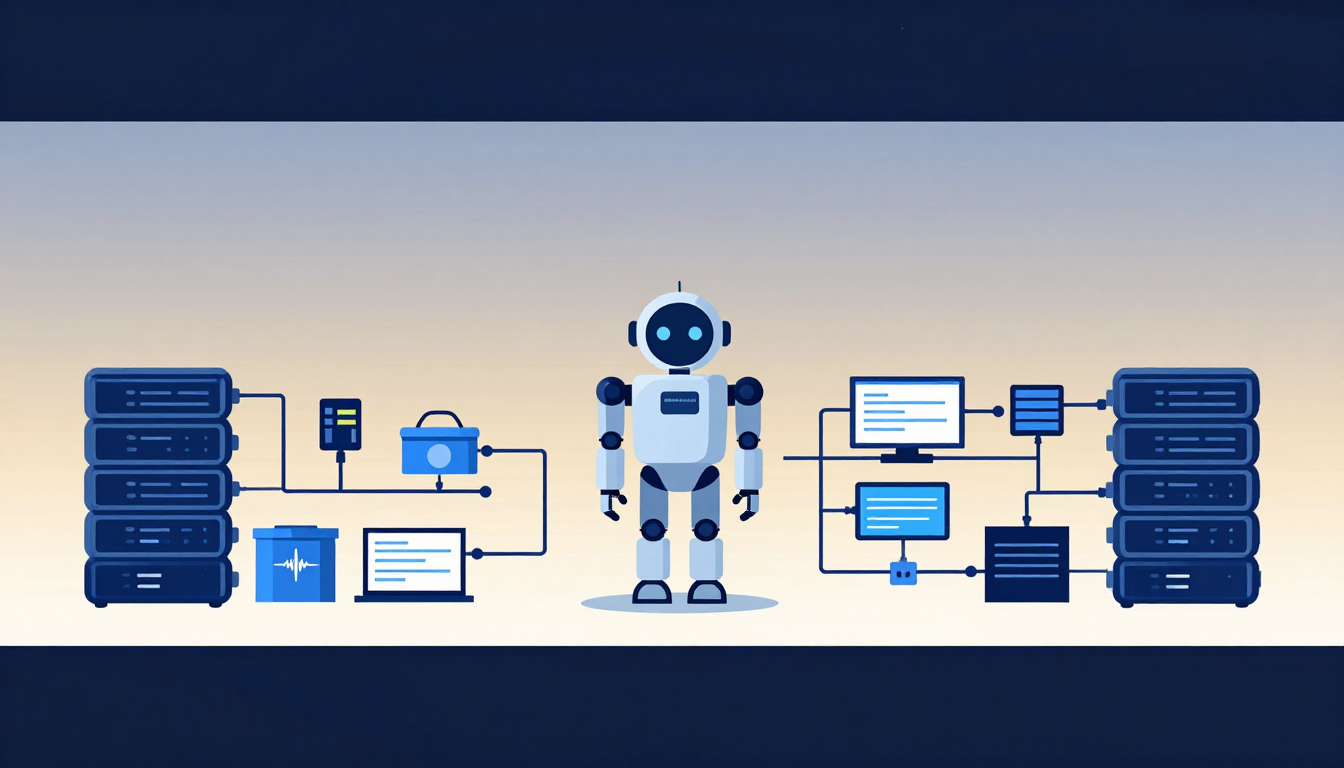
The Hard Wall Facing Physical AI Scaling
Language models got lucky. They grew up on a digital buffet of free internet text—trillions of words pulled from Reddit threads, open code repositories, and digitised book collections without paying a dime for data creation.
Humanoid robotics doesn't have a free buffet. You can't scrape a warehouse floor or download the physical sensation of plugging a sticky ethernet cord into a crowded server rack.
That structural bottleneck is forcing a pivot across the robotics industry. Startup teams have realized that tweaking model architectures isn't enough anymore. If you want general-purpose robots that can handle household chores or industrial assembly, you have to build facilities to manufacture the physical data itself.
In a quiet industrial building in San Leandro, California, data tooling firm Encord is trying to solve this shortage. They're not just annotating video anymore; they are creating data from scratch using multi-camera rigs, muscle sensors, and even brain wave monitors worn by human trainers.
Reading Intent from Brain Waves at the Jenga Station
Inside Encord’s test space, trainer Andrew Ceja sits focused over a wobbly tower of wooden blocks. He wears a custom headset outfitted with a forward-facing camera and brain wave sensors designed by Zander Labs, a German neuroscience startup.
Ceja is a "pilot"—Encord’s title for the human operators teaching robot models how to move. As he carefully pulls a wooden block from the Jenga tower, the EEG sensors measure changes in his cognitive load, tracking subtle spikes in mental stress and intent.
The physics of grabbing a wooden block looks simple on video, but the cognitive decision-making behind it is dense. Lucas Gehrke, a neuroscientist at Zander Labs supervising the trial, points out that measuring brain activity reveals exactly when a task requires maximum concentration. For robotics engineers, those neural spikes act as signal flares, signaling when an AI system needs to switch to high-effort, high-compute reasoning modes instead of relying on cheap muscle memory.
Right now, the brain wave project remains an early experiment. Encord plans to build a trial dataset tagged with electroencephalogram data, run it through their clients' robotics models, and test whether neural context actually yields cleaner robot execution. If it works, measuring brain waves could move from neuroscience labs directly onto the factory floor.
Egocentric Video, Muscle Sensors, and Dense Annotation
When Ceja isn't playing Jenga in a brain cap, he and his fellow pilots collect standard egocentric video. Workers strap on multi-angle cameras and carry out mundane physical tasks across mock environments.
Walk through Encord’s facility and you won't see pristine high-tech cleanrooms. You'll see shelves packed with thrift-store chaos: plastic vegetables, artificial flowers, kitty litter scoops, used books, and messy bundles of electrical wire. It is the unglamorous fuel required to teach neural networks how to handle everyday objects.
At another station, pilot Sofia Infante maneuvers a set of dual mechanical arms known as a leader-follower rig. One arm is guided by her hands while the paired secondary arm mirrors every twitch. She spends hours guiding pincers to plug and unplug network cables from server backplanes.
Controlling pincers reveals just how primitive current hardware remains. Human wrists and fingers possess dozens of micro-degrees of freedom; rigid metal claws do not. To help bridge that gap, Encord’s head of robot learning, Vineeth Velmurugan—a former engineer at OpenAI's robotics lab and warehouse automation firm Berkshire Grey—is expanding the sensor stack.
Beyond video and brain waves, Encord is mounting electromyography sensors on pilots' forearms to measure electrical signals in human muscles. Cameras frequently lose sight of fingertips when hands grasp objects. Forearm muscle signals fill in those blind spots, giving models a 3D picture of hand tension even when occlusion hides the fingers.
Raw video alone, however, is what Velmurugan calls "junky ego data." To make it valuable for transformer models, Encord attaches dense physical annotations to every second of footage—labeling micro-actions like "right hand tightens bolt with 15-degree turn." Velmurugan estimates that densely annotated data is worth 100 times more than raw footage for fine-tuning specific tasks, even though it costs 20 times more to produce.
The High Cost of Manufacturing Physical Realities
That 20x cost multiplier brings us to the core economic difference between software AI and physical AI. Scraper bots ingest billions of tokens for minimal compute cost. Manufacturing physical data requires real estate, robotic hardware, specialized sensors, and human pilots who need to be paid hourly wages.
Velmurugan estimates that the robotics industry will need a dataset roughly five times larger than YouTube's entire video library before physical AI reaches its ChatGPT moment. You cannot crowd-source that volume overnight.
Both Ceja and Infante came to Encord from Scale AI, bringing deep experience in manual data labeling. Ceja previously managed robotic trash-sorting machinery at a waste management firm before transitioning to AI data collection. The work is painstaking, but building physical datasets has become an industry of its own.
The financial reality is plain: frontier robotics labs can no longer treat data collection as an afterthought or a side project. If you don't own a factory floor dedicated to capturing physical interactions, your models will run out of fuel.
Why Shared Data Pipelines Will Define the Robotics Race
Because Encord builds data pipelines for multiple robotics teams across the industry, they hold a unique vantage point. They can see which sensor modalities—whether dual-camera setups, forearm muscle tracking, or dense text labels—yield measurable performance gains across different hardware platforms before anyone else does.
This trend mirrors the broader shift detailed in OpenAI's Robotics Relaunch: How Data Infrastructure Is Becoming the New Frontier in Physical AI. As baseline model architectures normalize, data infrastructure and generation quality become the primary competitive moat.
Whether brain waves turn out to be an essential unlock or an expensive novelty, one thing is clear: the path to autonomous physical agents won't be solved purely in code. It will be built by hand, step by step, inside data factories turning raw human motion into machine intelligence.
Source: Are brain waves the next unlock for physical AI? (Tim Fernholz, TechCrunch, July 26, 2026)
Additional references: Encord, Encord on Y Combinator