Broadcom didn't just buy VMware; it reshaped how enterprise IT budgets work. By shifting focus toward the comprehensive Cloud Foundation private cloud suite and slapping a strict 72-core minimum licensing threshold on vSphere deployments, Broadcom effectively forced smaller virtualized shops to re-evaluate their entire virtualization stack. For companies running modest workloads, paying for 72 cores per server node is a non-starter. Tens of thousands of IT organizations suddenly need a new home for their virtual machines.
Moving virtual machine disk images around isn't the hardest part of an infrastructure migration. A VM image is ultimately just a disk image wrapped in metadata. Converting that file format to run on a new hypervisor takes time, but it's well-understood engineering. The real headache is everything around it: the monitoring agents, orchestrators, compliance routines, and backup tools. When IT leaders change hypervisors, they don't want to scrap their data protection framework and retrain their storage teams on half a dozen point solutions. That context makes Veeam's latest update a pragmatic tactical play.
What Is an Enterprise AI Platform in a Fragmented Infrastructure Era?
To understand why hypervisor mobility matters now, you have to look at how enterprise infrastructure is changing under AI workloads. An enterprise AI platform is an integrated foundation of data systems, compute orchestration, metadata governance, and model runtimes designed to deploy, run, and manage artificial intelligence applications safely across corporate environments. Rather than serving as an isolated sandbox for standalone models, a modern enterprise AI platform connects transactional databases, vector indices, file stores, and agentic workflows to operational systems.
When enterprise data lives across multi-cloud environments and on-premises virtualized clusters, AI agents rely on underlying infrastructure tools to guarantee data availability, point-in-time recovery, and consistent metadata tracking. As detailed in Data Fragmentation Stalls Enterprise AI, if data assets locked in legacy VMware environments, Red Hat clusters, or cloud archives are siloed by incompatible backup mechanisms, autonomous AI agents cannot inspect or process enterprise context reliably. Enterprise data platforms must bridge disparate hypervisors so governed data remains accessible for model fine-tuning, RAG pipelines, and agentic execution.
Six New Hypervisors in Veeam Data Platform 13.1
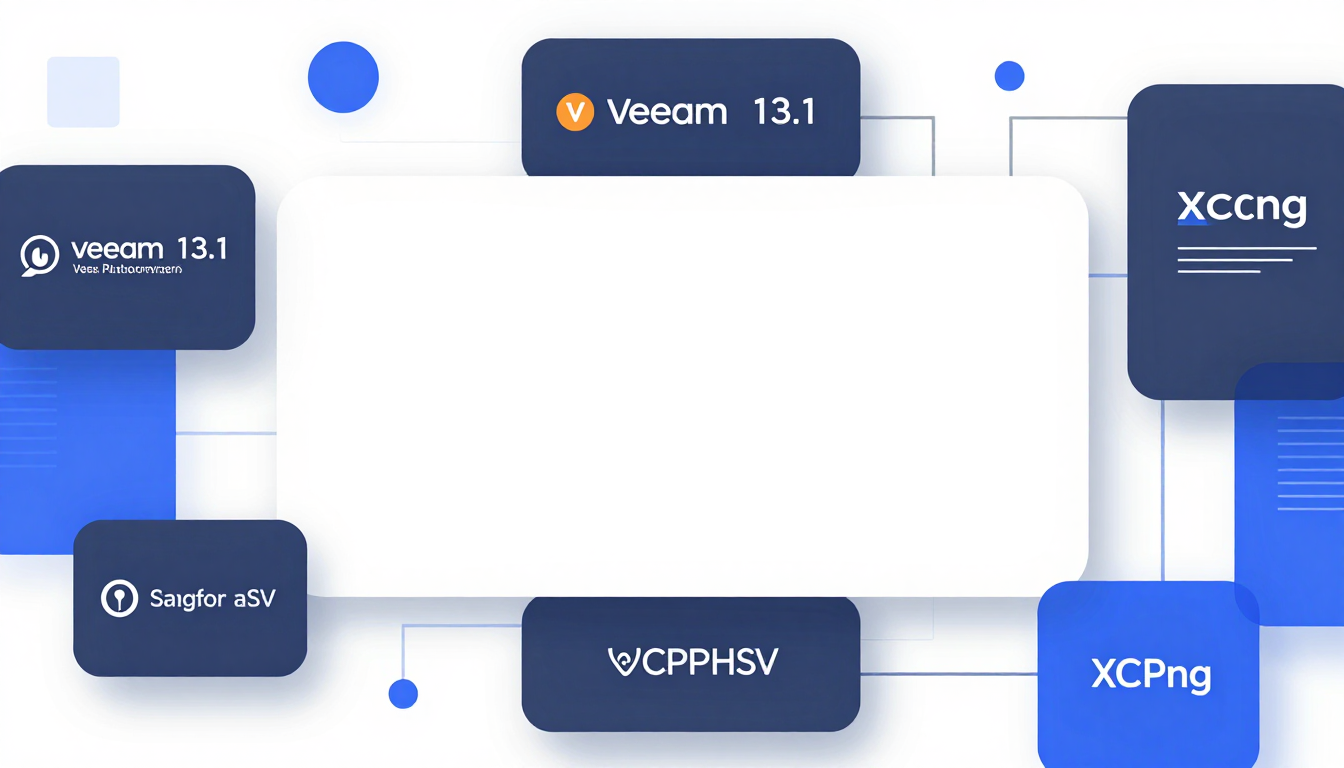
Veeam's response to the VMware shakeup arrives in version 13.1 of its flagship Data Platform. The release adds official support for six additional hypervisors: Red Hat OpenShift Virtualization, Sangfor aSV, XCP-ng, Citrix XenServer, VergeIO, and Platform9.
This expansion aims to give organizations migration choices without forcing them to rebuild their backup operations. Veeam president of products and technology Rehan Jalil highlighted that enterprise users want to protect VMs running on different hypervisors from a single management console. By extending native backup coverage to these six engines, Veeam lets infrastructure teams swap hypervisors under the hood while maintaining unified policy enforcement, immutability rules, and recovery workflows across their fleet.
Xen versus KVM: Navigating Technical Architecture Differences
Adding six hypervisors in a single update sounds massive, but it aligns directly with Veeam's existing technological footprint. The six newly supported platforms fall cleanly into two primary virtualization camps: Xen-based and KVM-based architectures.
Citrix XenServer and the open-source XCP-ng project rely on the Xen hypervisor. Veeam previously offered methods to back up Xen virtual machines, but those approaches lacked deep hypervisor-level integration. Version 13.1 integrates native API hooks directly into the Data Platform console, standardizing backup scheduling, change-block tracking, and granular restores for Xen environments.
The remaining four platforms—Red Hat OpenShift Virtualization, Sangfor aSV, VergeIO, and Platform9—are built on top of Linux KVM (Kernel-based Virtual Machine). Because Veeam already supported KVM-based platforms such as Proxmox VE and Nutanix AHV, extending Data Platform 13.1 to support additional KVM distributions built on familiar engine internals. For organizations migrating containerized workloads and VMs onto Kubernetes-native platforms like Red Hat OpenShift Virtualization, having native Data Platform backup hooks removes a major blocker to cloud-native adoption.
Unifying Data Protection Across Agentic Data Platforms
As enterprises construct agentic data platforms—data architectures engineered so autonomous software agents can retrieve, process, and govern context across multi-cloud environments—infrastructure portability becomes vital. Modern AI agents require unified metadata catalogs, audit logging, and rapid data access regardless of where the underlying virtualized hosts reside.
As organizations re-evaluate private compute infrastructure (see Owning AI Infrastructure Beyond the Cloud), data protection cannot exist in isolated silos. If an enterprise splits its operational workloads across Red Hat OpenShift Virtualization for cloud-native apps, Nutanix for core databases, and VergeIO for edge locations, agentic data platforms depend on consistent point-in-time snapshots and centralized protection policies to verify that training sets, vector stores, and transactional records remain compliant and recoverable. Veeam's single-console multi-hypervisor management prevents backup sprawl, ensuring that automated agents operate against validated enterprise state across heterogeneous infrastructure.
Cloud Archive and the Retirement of Tape Backups
Alongside hypervisor additions, Veeam launched Cloud Archive, a service designed to offload long-term backup data into secondary cloud tiering. While Veeam did not name a single sole provider for the underlying storage layer, Jalil pointed out that Amazon Web Services pioneered archive-grade storage with AWS Glacier, while Microsoft operates Azure Archive Storage under their close partnership.
Cloud Archive targets redundant, obsolete, and trivial (ROT) backups that organizations must retain for long-term legal or regulatory compliance but rarely access. These cold storage tiers operate with recovery time objectives (RTOs) spanning several hours, making them unsuitable for rapid operational restores but highly cost-effective compared to traditional physical tape libraries. By replacing manual tape rotation with automated cloud tiering, enterprise teams reduce physical datacenter footprints while retaining verifiable long-term backup archives.