
The VLC Guy Who Refused to Stop Solving Latency
Jean-Baptiste Kempf didn't set out to build robot infrastructure. He just couldn't stand watching video buffer.
You've probably used VLC Media Player without thinking about it — that orange traffic cone icon has been downloaded over six billion times, mostly because Kempf spent years making sure video just worked. No matter the format. No matter the platform. No matter how garbage the connection.
That obsession with eliminating friction between input and output is exactly what he's now applying to the physical world. His new startup, Kyber, is building the infrastructure layer that physical AI needs to actually function at scale. And if you've been wondering why robotics companies keep hitting the same wall — latency, synchronization headaches, control loops that stutter — you're looking at the problem Kempf already solved for pixels.
The connection isn't as stretchy as it sounds. Streaming video at six billion downloads means you've already solved the hard parts: keeping data moving fast, staying consistent across wildly different hardware, and making sure what the user sees matches what's actually happening in real time. Robots just happen to need the same thing, except instead of pixels you're moving pistons.
"If you control things in the real world, every millisecond matters."
Kempf doesn't sugarcoat it. For a robot, lag isn't buffering — it's missed steps, dropped payloads, or worse.
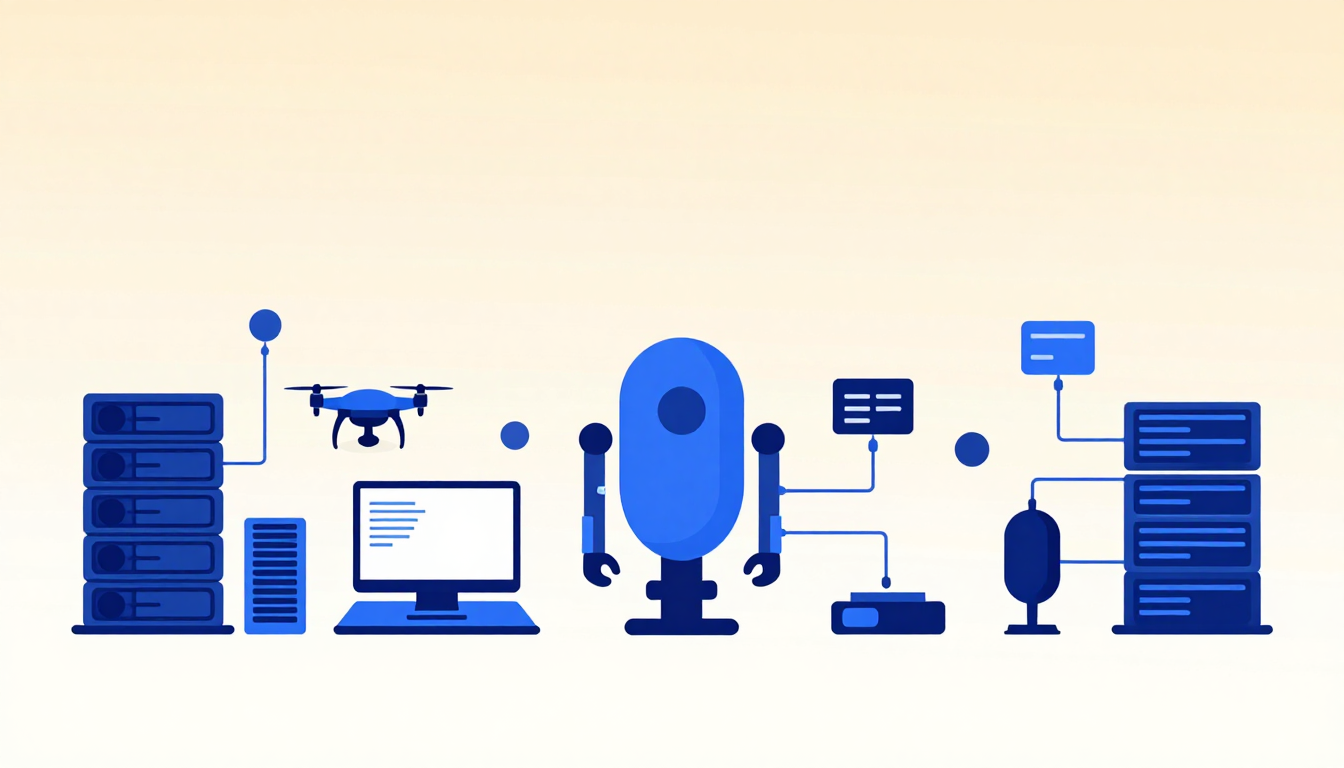
Kyber is an infrastructure layer and SDK for controlling remote devices in real time, synchronizing video, audio, sensor data, and control inputs with minimal latency. The company raised a $5 million funding round led by Lightspeed, which has also backed Anthropic and Mistral AI.
Kyber's name is a nod to the lightsaber crystals in Star Wars, reflecting Kempf's belief that every millisecond matters when controlling things in the real world.
The 3,000-Vehicle Ceiling Nobody Talks About
Here's the thing about robotics scaling that most people miss: it's not a linear problem.
You can go from one robot to ten robots and everything feels fine. Ten to a hundred? Still manageable if you're clever. But somewhere around two or three thousand units, the whole architecture starts to groan. Latency compounds. Synchronization drifts. The control loops that worked beautifully in simulation start stuttering in the real world.
Kempf ran into this exact wall at Shadow, the cloud gaming startup where he was CTO before Kyber. Streaming high-quality gameplay across continents taught him how to squeeze every last bit of speed from a network stack — and how to design around the limits of real hardware. The same principles now shape Kyber's SDK.
But here's where it gets interesting. Video streaming and robotics share DNA, but they're not the same problem. A drone might have 1/100th the CPU of an industrial robot. Kyber has to tune itself to whatever compute is available on the endpoint — throttling high-bandwidth video feeds on constrained devices while keeping the control loop buttery smooth. It's not just low latency. It's consistent latency across wildly different hardware.
"The largest fleets today have maybe 2,000 or 3,000 vehicles. Imagine you need to manage millions of them; that's not the same thing."
That jump in scale also raises the stakes on observability. When you're managing thousands of devices, you need to know systems are actually working — and that becomes even more critical when AI agents, not people, are managing entire fleets. Even at smaller scale, there's a real benefit: not needing to physically reach every device just to push a software update.
The companies that tried to solve this before Kyber spent years and tens of millions building custom solutions they'll never share. Kempf's take, straight from the company's careers page: "We're building the version everyone else can use."
What ai cloud infrastructure companies in india Are Racing Toward
The infrastructure problem Kyber is solving doesn't exist in a vacuum. While the Paris-based startup focuses on robotics and drones, the broader AI infrastructure ecosystem is shifting fast — especially in markets like India.
Companies like HCL are getting into the AI datacenter business, recognizing that the compute backbone for physical AI needs to be built out globally. The same synchronization challenges Kyber tackles apply wherever you're running distributed AI workloads across remote endpoints.
India's tech services giants are positioning themselves at the intersection of cloud infrastructure and AI deployment. And while they're building datacenters, not robotics SDKs, the underlying problem is identical: how do you keep systems synchronized when the person operating isn't in the same place as the compute, which isn't in the same place as the action?
Kyber's approach — open source core with commercial enterprise support, forward-deployed engineers, adaptive compute tuning — could serve as a template for how ai cloud infrastructure companies in india scale their physical AI deployments. The market's too big for custom solutions alone.
<a href="/articles/kyber-remote-it-access-citrix-challenger-kempf-infrastructure">Kyber</a> enables real-time control for India’s AI infrastructure. <a href="/articles/ai-datacenters-hcl-india">HCL’s AI datacenters</a> are the backbone where this infrastructure must scale.
The Open Source Bet That Actually Makes Sense
Most startups raise venture capital and immediately lock their code behind a paywall. Kyber did the opposite.
The core project is open source. Anyone can pull the repo, deploy a test fleet of ten devices, and contribute improvements back to the community. But for anyone who needs reliability at scale — enterprises, defense contractors, telcos — Kyber sells a commercial variant bundled with forward-deployed engineer (FDE) support.
Think of it this way: you get the same SDK, but Kyber's team lives inside your deployment pipeline for as long as needed. They help you tune the system for your exact network topology, hardware constraints, and security protocols. Palantir does this — now Kyber is doing it for robotics infrastructure.
This hybrid approach solves two problems at once:
- Open source builds trust and broad adoption among developers.
- FDE services protect margins and deliver high-touch value where it matters most: reliability under pressure.
Kyber's team currently stands at 25 full-time staff, with headquarters in Paris and outposts in San Francisco and Singapore — a small team meant to scale fast when demand spikes. And that demand is already showing up in deployment contracts across defense, telco, and robotics verticals.
The funding round that made this possible came from Lightspeed, which has also backed Anthropic and Mistral AI. The VC firm put it bluntly in a LinkedIn post announcing the investment: "Physical AI is only as good as the underlying systems running it."
That's not just marketing copy. It's the entire thesis.
Three Segments, One Infrastructure Layer
Kyber isn't trying to be everything to everyone. The company has been deliberately prioritizing three segments where its technology creates the most immediate value:
Robotics. Industrial arms, autonomous mobile robots, warehouse automation — anywhere you need precise control over physical movement with minimal latency. This is the segment that gets the most attention, and for good reason.
Drones. Kempf specifically says "drones of every kind" — from small quadcopters to larger unmanned aircraft. The synchronization challenges are similar but the hardware constraints are even tighter, which is exactly where Kyber's adaptive compute tuning shines.
Remote IT access. This one might surprise you, but Kempf says demand has been "particularly strong" here. Think of it as the enterprise version of remote control — IT teams managing devices, servers, and workstations from anywhere in the world. Kyber aspires to be more than just a Citrix challenger, but even that comparison alone points to a sizable total addressable market.
The common thread across all three? The person operating isn't in the same place as the compute, which isn't in the same place as the action. That's Kyber's sweet spot.
The Prediction That Sounds Insane Until It Doesn't
Kempf predicts hundreds of millions of robots and drones will be roaming the streets in a few years.
I know what you're thinking. That sounds like science fiction. But consider this: we already have billions of connected devices. Smartphones alone number in the billions globally. The infrastructure to manage that scale didn't appear overnight — it took years of building, iterating, and solving the exact problems Kyber is tackling now.
The difference between robots and smartphones? Robots move. They interact with the physical world. And when they do, latency isn't just annoying — it's dangerous.
That's why Kyber exists. Not because the technology doesn't work in isolation, but because it doesn't work at scale without the right infrastructure layer. And that's exactly what Kempf built for video, then adapted for robotics.
It's a bold bet. But then again, so was building an open-source video player that would eventually be downloaded six billion times. Kempf has a history of betting on infrastructure that everyone else ignores until it's too late.