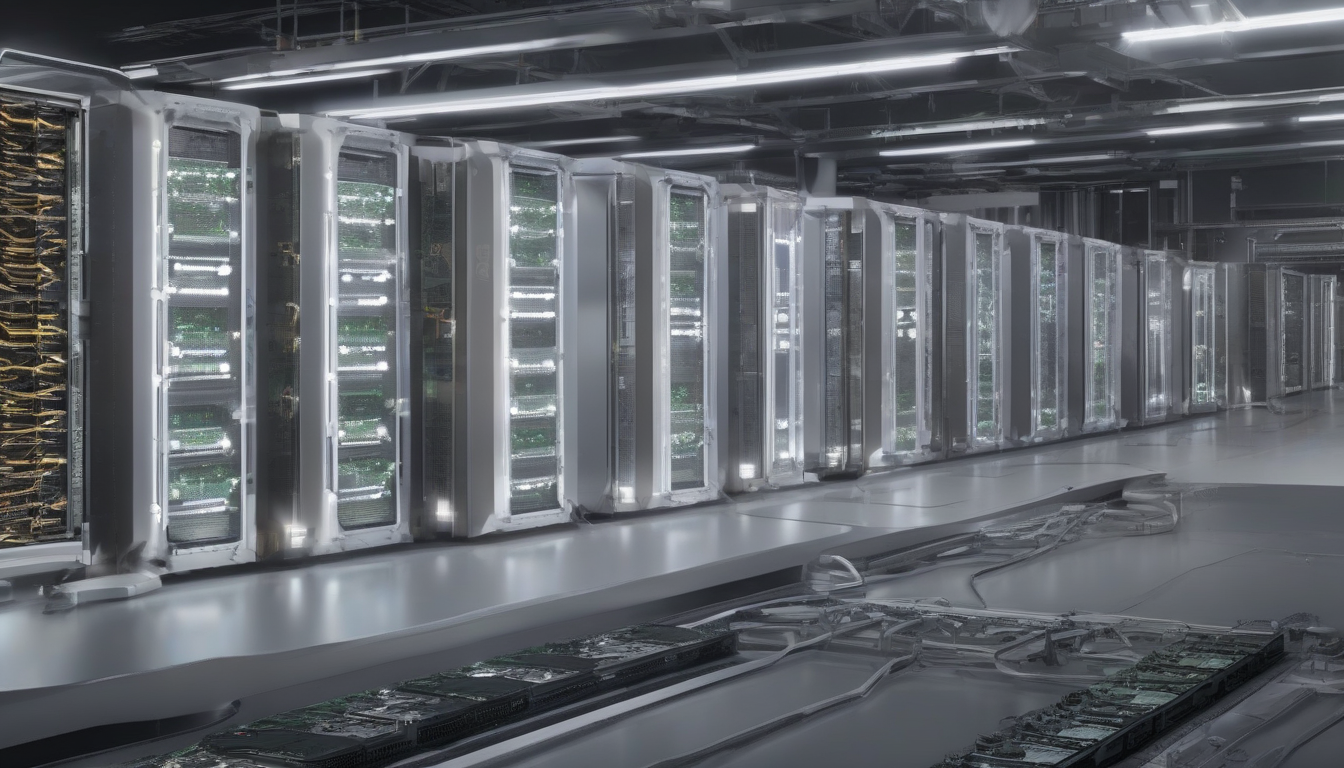
Nvidia's grip on top-tier data center hardware has felt practically unbreakable for years. If you wanted to run massive model training or heavy inference clusters, you bought Nvidia rigs, swallowed the lead times, and paid the margin. That dynamic just got hit by a sledgehammer. At AMD's Advancing AI conference in San Francisco, CEO Dr. Lisa Su showed off the company's Helios rack-scale system. It isn't just a prototype or a distant roadmap item. AMD plans to ship Helios to customers later this year, taking direct aim at Nvidia's dominance.
Building hardware for modern AI isn't about selling individual chips anymore. It's about delivering entire integrated racks where networking, compute, and memory act as one giant engine. AMD first previewed Helios in 2025 and brought it onstage at CES in January 2026, but the latest showcase confirms major customer commitments. Tech heavyweights like OpenAI, Meta, Oracle, Anthropic, and Microsoft have already signed up to deploy the hardware. Microsoft CEO Satya Nadella confirmed Azure will expand its infrastructure using Helios, while Anthropic locked in a strategic deal with AMD to deploy up to two gigawatts of GPUs across these rack systems.
The Gigawatt Hardware Race in Global Datacenters
The sheer scale of these deployments points to a massive structural shift in how data centers are designed. AMD claims Helios is the highest-performance AI rack in the tech industry, specifically engineered to train and deploy frontier models at gigawatt scale. Reports from The Register indicate that Helios actually outperforms Nvidia's Vera Rubin system across several key benchmark metrics, giving hyperscalers a genuine alternative to Nvidia's Grace Blackwell and Vera Rubin architectures.
Alongside Helios, AMD unveiled its Venice-X CPU, built for data centers to manage extreme compute workloads and scheduled for release in 2027. Lisa Su projected that the AI accelerator market will reach roughly $1.4 trillion by 2030—nearly matching the size of the entire global semiconductor market today. GPUs will make up the vast majority of that total because software algorithms and model architectures are still evolving rapidly, which keeps programmable silicon far more attractive than rigid fixed-function ASICs.
Understanding Agentic AI and the Compute Explosion
Why is compute demand skyrocketing at this relentless pace? As Su highlighted during her keynote, the industry is experiencing a fundamental step change driven by the rise of agentic AI.
To understand why this matters for cloud architecture, we have to look at what agentic AI actually is. Major industry definitions—such as those published in technical overviews by IBM and Google Cloud—distinguish agentic AI from traditional generative models based on autonomy and operational loops. Early LLM deployments were mostly transactional: a human typed a prompt, the model generated a single completion, and the execution stopped there. Agentic AI flips this paradigm.
Instead of generating passive text, an agentic system takes a broad, high-level goal and breaks it down into multiple internal steps. It plans actions, calls external APIs, queries databases, evaluates intermediate output, and loops continuously until it solves the assigned problem. A single user request might trigger dozens of underlying tool-use calls and reasoning cycles. Multiply those iteration loops across thousands of enterprise workloads, and the hardware requirement explodes exponentially.
What Distinguishes Software Agents from Embodied Agents?
As enterprise engineering teams build out AI capabilities, a frequent point of confusion is the distinction between cloud-native software agents and an embodied agent. Clarifying this difference helps teams architect their underlying infrastructure correctly.
- Software Agentic AI: These systems exist purely in digital environments, running inside cloud data centers on platforms like AWS cloud infrastructure or Google Cloud AI and Cloud Computing Services. They interact with software tools, write code, query data warehouses, and execute multi-step business logic via API endpoints.
- Embodied Agent: An embodied agent merges artificial intelligence models with physical hardware components, such as robotic arms, autonomous vehicles, or industrial sensors. It perceives physical reality directly through sensors and acts upon the physical world through physical actuators.
While an embodied agent relies on local edge compute or real-time low-latency links to handle physical physics constraints, pure software agents rely on massive rack-scale infrastructure like AMD Helios to execute high-throughput reasoning loops across cloud services.
What This Means for AI Cloud Infrastructure Companies in India
The arrival of alternative gigawatt-scale hardware options creates massive ripples for global cloud operators, especially for AI cloud infrastructure companies in India. Indian datacenters are currently expanding at record speeds to meet both regional enterprise demand and global sovereignty requirements.
For years, Indian cloud providers faced severe supply bottlenecks trying to procure high-end Nvidia clusters. The introduction of AMD Helios gives operators a viable, high-performance alternative to diversify their supply chains. We are already seeing aggressive infrastructure expansion in the region, such as Meta's strategic AI infrastructure partnership in India and major IT service pivots like HCL's sovereign AI datacenter strategy.
As AI cloud infrastructure companies in India scale up their facilities, having competitive rack-scale options from both AMD and Nvidia will reduce capital expenditure per TFLOPS while accelerating delivery timelines for enterprise clusters.
Hyperscaler Strategies and Architectural Realities
This hardware transition is also reshaping internal team capabilities across the cloud industry. Engineering roles are shifting rapidly. For instance, traditional job descriptions for AWS cloud infrastructure engineer jobs now increasingly emphasize distributed GPU interconnects, liquid cooling management, and host-to-rack thermal optimization over basic virtual machine provisioning.
Hyperscalers are realizing that winning the next era of cloud computing services isn't just about owning the fastest individual accelerator chip. It's about rack density, power efficiency, and seamless software stacks. AMD's ROCm software ecosystem has matured significantly, enabling partners like Microsoft Azure and Anthropic to drop Helios systems into existing workflows without rewriting their base software layers.
As Helios begins shipping later this year, the competition between AMD and Nvidia will force faster hardware innovation cycles, lower compute costs, and unlock the massive hardware scale required to run autonomous agentic systems worldwide.