
Most cloud architectures were built around a simple assumption: a client sends a request, a server processes it, and the connection closes. That pattern powered web apps, REST APIs, and early chatbot widgets for fifteen years. It breaks the moment you ship autonomous multi-agent systems into production.
When an AI agent runs an open-ended workflow, it doesn't just return a quick JSON payload. It reasons, queries databases, invokes external tools, checks intermediate outputs, and loops back on itself for minutes or hours. Put ten of these agents into a collaborative mesh, and traditional request-response infrastructure collapses under orchestration latency, unmonitored agent drift, and compounding compute expenses.
If enterprise AI autonomy is failing in your stack right now, it isn't a prompt engineering problem. It's an infrastructure problem.
The Request-Response Fallacy
First-generation generative AI implementations treated model integration like any standard third-party API call. You sent a prompt, waited two seconds, received a completion, and rendered it on a screen. Legacy cloud environments—built on ephemeral serverless functions, basic API gateways, and stateless microservices—handled these single-turn interactions reasonably well.
Autonomous agentic loops operate under completely different rules. As discussed in a VentureBeat panel on agentic infrastructure, multi-agent deployments face immediate operational failure when hosted on legacy stacks because traditional environments fail to support long-running, autonomous state loops. When multiple agents collaborate to resolve a complex enterprise task, orchestration latency inside standard web layers compounds quickly. A single blocked sub-agent stalls the entire execution chain, triggering network timeouts and leaving orphan processes running across your cluster.
Without infrastructure designed for stateful, multi-step orchestration, engineering teams hit severe visibility blind spots. Agents drift from their original intent across iterative loops, executing unauthorized sub-tasks or repeating failed tool calls. Standard web application firewalls and network monitors won't flag these anomalies until downstream databases or APIs suffer damage.
Inference Economics and Compounding Token Costs
Managing inference economics across multi-agent environments requires discarding standard single-call cost metrics. In a basic chat interface, token usage grows linearly with conversation length. In autonomous multi-agent loops, token spend compounds exponentially. Every internal monologue, system prompt re-injection, tool response, and error recovery step must be fed back into the context window of subsequent model calls.
To prevent runaway cloud bills, platform engineering teams are experimenting with targeted optimization techniques. Speculative decoding—where a smaller, fast draft model predicts output tokens while a larger model verifies them—can lower per-token latency significantly. Similarly, swapping general-purpose frontier models for small language models (SLMs) tuned for specific tasks (like SQL generation or schema routing) can slash compute costs.
However, substituting SLMs across an agentic chain comes with hidden trade-offs. While purpose-built SLMs reduce raw inference fees, they add heavy architectural complexity. Platform teams must maintain complex routing layers, dynamic fallback logic, and separate fine-tuning pipelines. If an SLM fails to parse a complex output structure, the fallback logic triggers an expensive call to a full frontier model anyway—doubling the cost of that single step.
Underneath the software layer, physical hardware footprint dictates whether your workloads stay economically viable. As outlined in NVIDIA's guide to autonomous AI agents, building enterprise agent deployment environments requires modernizing data centers around accelerated computing. Optimizing for cost-effective token processing—measuring efficiency in tokens per megawatt and cost per token—demands high compute density, specialized GPUs, Grace CPUs, and high-bandwidth interconnects to keep continuous inference loops affordable. You can read more about stateful storage integration in our analysis of data fabric infrastructure. For insights on how enterprises are standardizing their AI infrastructure to reduce this complexity, see our coverage of OpenClaw's infrastructure shift.
Orchestration Topologies and Compute Density
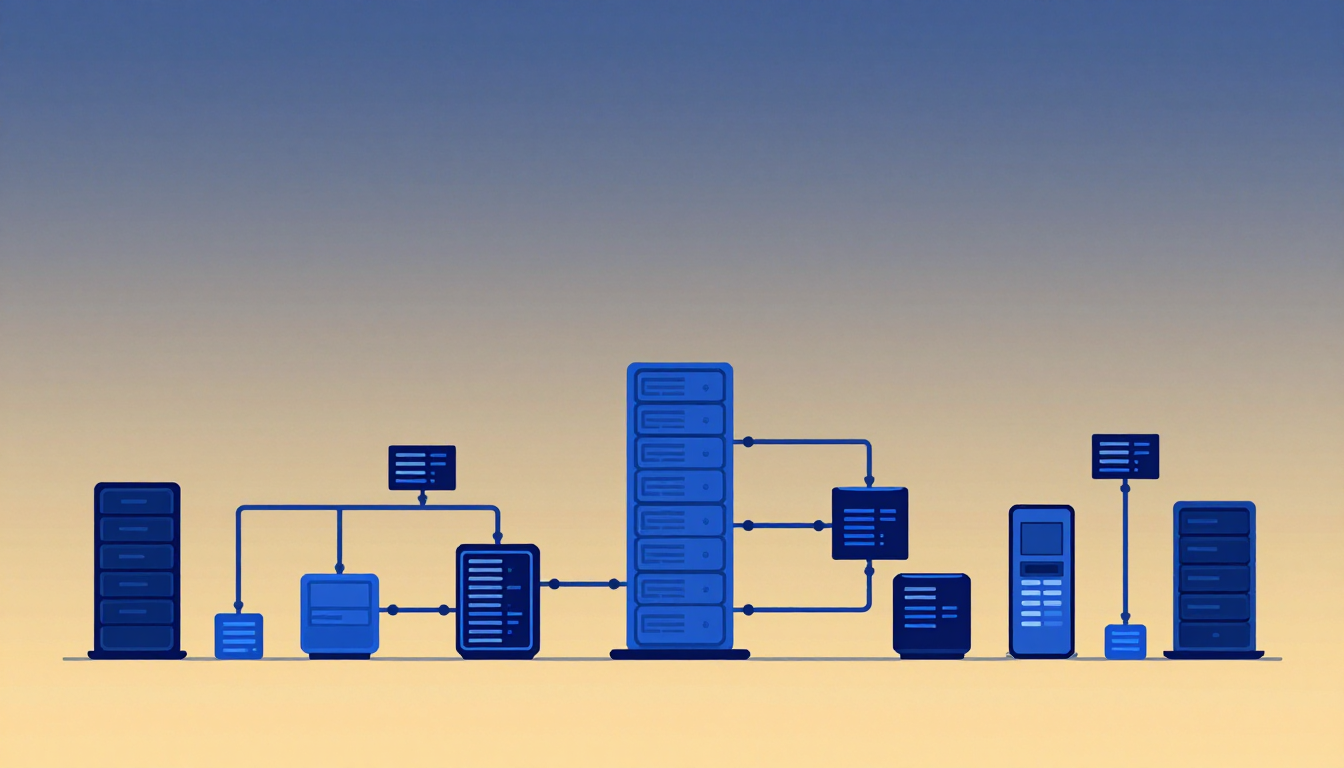
Selecting the right orchestration topology determines whether your multi-agent infrastructure scales cleanly or locks up under load. Platform teams generally choose between two primary structural designs:
- Centralized Master-Worker Architecture: A master agent receives top-level goals, breaks them into sub-tasks, and delegates work to specialized sub-agents. This pattern simplifies state tracking and central monitoring, but it creates a single point of failure. If the master agent's context window degrades or its process hangs, the entire workflow halts.
- Decentralized Agent Mesh: Agents communicate directly with each other over a message bus or event channel, negotiating task handoffs autonomously. While this eliminates central bottlenecks, it introduces heavy network coordination overhead. Message serialization, inter-agent latency, and race conditions across shared state stores can paralyze production clusters.
To sustain either topology, physical data center configurations must adapt. Standard rack compute density cannot supply the memory bandwidth or ultra-low-latency inter-node communication required for real-time agent handoffs. High-performance GPU nodes connected by low-latency fabrics are essential to prevent orchestration bottlenecks from stalling long-running tasks. For an in-depth look at building durable execution environments, see our overview of resilient enterprise architectures.
Embedding Governance into the Infrastructure Layer
Security in early AI deployments was treated as an application wrapper—prompt filtering, static RBAC policies, or post-execution log reviews. For autonomous agents operating with actual execution privileges, application-level guardrails are far too weak.
As noted in IBM's analysis of AI infrastructure, the threat landscape for autonomous agents is developing in real time, meaning governance and risk controls cannot be isolated from core infrastructure strategies. When agents possess active tool-use privileges, a runaway loop or prompt injection attack can execute thousands of destructive database mutations or API calls within seconds.
Governance must be embedded directly into the infrastructure layer. That means implementing hard controls at the network and compute boundary:
- Infrastructure-Level Kill Switches: Out-of-band monitoring processes that immediately terminate an agent's hardware process thread or revoke its API tokens when predefined anomaly metrics trigger.
- Hard Rate Limits and Budget Caps: Gateway-enforced execution ceilings that restrict maximum token spend, API request velocity, and total financial cost per task loop.
- Immutable Action Trace Layers: Cryptographically verifiable audit trails recorded at the network proxy layer, capturing every tool call, payload, and inter-agent message exchange independently of the model's internal logging.
Moving action accountability down into the hypervisor, proxy, and container orchestration layers ensures that runaway agent loops are halted deterministically, regardless of what the model's software logic attempts to execute.
Navigating the Shift to Infrastructure-First Autonomy
Moving from experimental AI agents to production-grade multi-agent autonomy isn't a matter of writing better prompts or stringing together open-source frameworks. It requires treating infrastructure as the primary driver of model behavior.
Platform architects must step away from legacy request-response patterns. Building viable multi-agent systems requires purpose-built accelerated compute clusters, careful optimization of inference economics across heterogeneous model tiers, resilient orchestration topologies, and governance enforced directly inside the underlying network and hardware layer. Until your infrastructure is engineered for continuous, stateful, and self-correcting loops, autonomous multi-agent systems will continue to break against the limits of legacy stacks.