Google's Fast-Paced Model Strategy
The rate of model iteration across major labs has shifted from sporadic announcements to a steady engineering cadence. Back at Google I/O in May, the release of Gemini 3.5 Flash signaled that Google wanted to compete aggressively on latency and developer adoption. But they aren't lingering on that baseline. Today's release of Gemini 3.6 Flash makes it clear that the focus has moved beyond basic chat interfaces into the mechanical realities of running agentic software pipelines at scale.
This release isn't about chasing vanity leaderboards. It targets the actual cost bottlenecks of running autonomous AI systems. As engineering orgs move from single-turn prompts to long-running, multi-step agents, the choice of model comes down to raw execution speed, context stability, and token pricing. Google designed 3.6 Flash around that exact total-cost-of-ownership math, pushing down output costs while boosting task completion rates on long-horizon reasoning.
Dissecting the Agentic Engineering Benchmarks
Evaluating a model for agentic workloads requires looking past traditional Q&A evaluations. System engineers need models that can inspect large code repositories, maintain plan state over dozens of sequential steps, and execute shell or browser actions without breaking.
According to technical documentation published on Google DeepMind's Gemini portal, Gemini 3.6 Flash delivers measurable gains across developer-focused benchmarks:
- SWE-Bench Pro: 3.6 Flash reached a 58.7% success rate, up from 55.1% on Gemini 3.5 Flash. For context, it also outpaces Gemini 3.1 Pro (54.2%), proving that a Flash-tier model can handle multi-file software engineering tasks with higher accuracy than older flagship models.
- DeepSWE v1.1: On this long-horizon software engineering benchmark, 3.6 Flash hit 49.0%. That is a massive leap from the 37.0% recorded by 3.5 Flash, demonstrating far better context retention over multi-hour debugging sequences.
- OSWorld-Verified: On complex computer-use and desktop automation tasks, the model scored 83.0%, compared to 78.4% for 3.5 Flash.
- GDPVal-AA v2: On knowledge and multi-domain reasoning tasks, 3.6 Flash logged a score of 1421 Elo.
For dev teams running automated pull request reviewers or autonomous bug-fix bots, those extra percentage points mean fewer stuck agent loops and fewer broken commits. Additional model technical specifications are available via the Gemini API model documentation.
The Economics of a 16.7 Percent Output Discount
If you operate production infrastructure, the benchmark gains are nice, but the pricing schedule is what shifts your architectural decisions. The standard paid API tier for Gemini 3.6 Flash sets input tokens at $1.50 per 1M and output tokens at $7.50 per 1M.
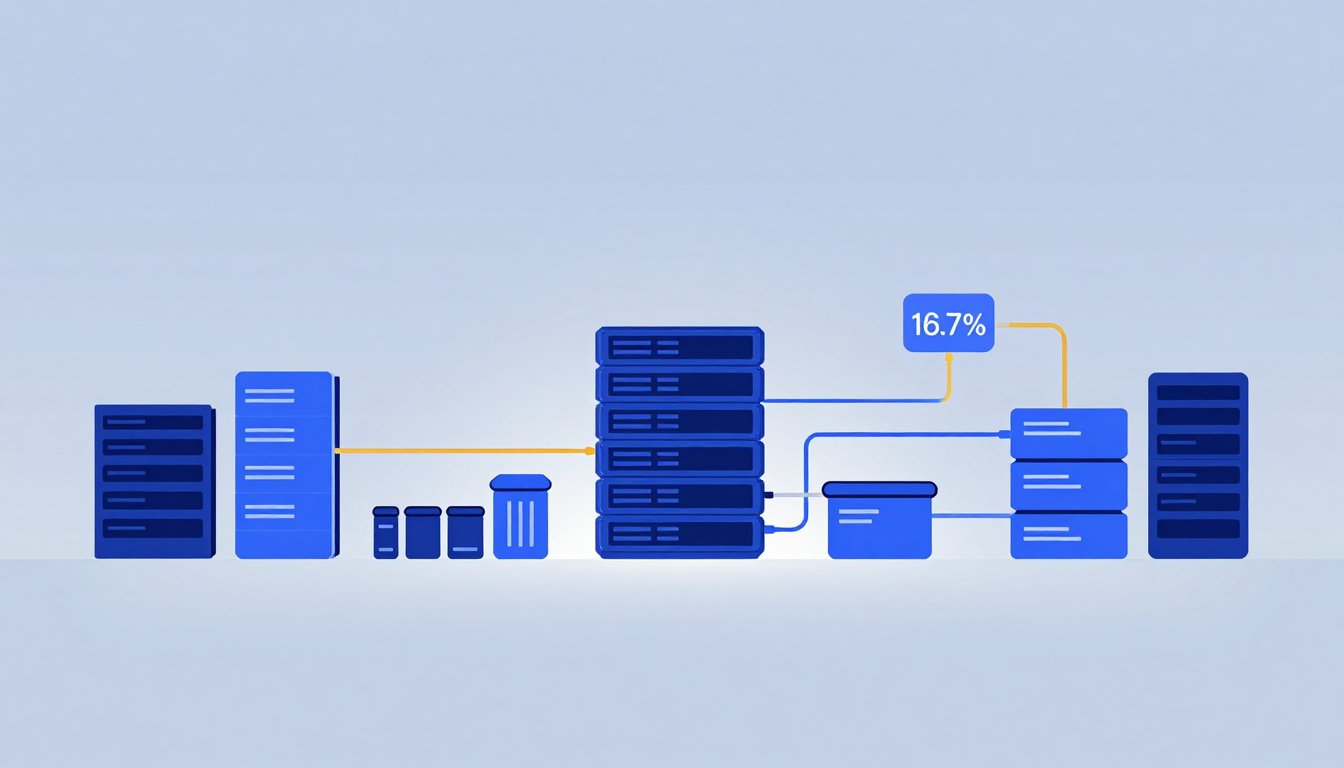
Comparing this against the previous Gemini 3.5 Flash pricing—which charged $9.00 per 1M output tokens while keeping input at $1.50—reveals an immediate 16.7% price cut on output token volume.
That discount matters because agentic workflows consume tokens unevenly. An autonomous coding agent might ingest a modest prompt, but it regularly outputs thousands of lines of intermediate planning logs, step-by-step code drafts, and verbose tool calls. In high-volume systems, output tokens dominate the monthly bill. Addressing the agentic token amplification crisis requires exactly this kind of structural cost reduction. When your agents run in tight feedback loops, shaving nearly two dollars off every million generated tokens compounds quickly.
Context Caching and Operational Tiers
Google also structured API pricing to encourage heavy use of long context windows and batch execution. The official details listed on the Gemini API pricing table outline several operational tiers for 3.6 Flash:
- Context Caching: Charged at $0.15 per 1M input tokens, plus $1.00 per 1M tokens per hour for active memory storage. For systems that feed entire codebases or system design docs into prompt context repeatedly, intelligent token caching slashes input costs by 90%.
- Batch and Flex Tiers: Tasks that can tolerate asynchronous execution receive a 50% discount across the board, dropping input costs to $0.75 per 1M tokens and output costs to $3.75 per 1M tokens.
- Priority Tier: Low-latency, high-priority workloads are priced at $2.70 per 1M input tokens and $13.50 per 1M output tokens.
- Grounding Costs: Search and Maps grounding integrations offer 5,000 free requests per month (shared across Gemini 3.x models), after which standard pricing applies at $14.00 per 1,000 queries.
By offering aggressive discounts on cached context and batch requests, Google is nudging developers away from short, stateless prompts. They want you building stateful agents that maintain active memory buffers inside the model's 1M+ token window.
Real-World Partner Performance in Production
API benchmarks don't always capture the friction of enterprise deployment, but early partner metrics show tangible operational improvements.
Harvey, an enterprise legal platform, reported that complex document analysis and drafting workflows completed 12% faster on 3.6 Flash compared to prior models. In legal tech, speed isn't just about latency; it's about reducing the time an attorney sits waiting for an agent to cross-reference multi-page contracts.
In developer tools, JetBrains tested 3.6 Flash within their Junie agentic platform. They observed a 10% to 20% performance improvement on low-reasoning, highly repetitive coding tasks like boilerplate generation, unit test creation, and syntax updates. Trimming 15% off repetitive task runtime keeps developers inside their flow state instead of waiting on spinner icons.
Furthermore, 3.6 Flash continues Google's push into direct GUI automation. Building on earlier developments where Google moved computer use into Gemini 3.5 Flash, the performance gains on OSWorld-Verified signal that browser-based web agents and workspace automations are becoming more stable for production use.
Architectural Recommendations for Infrastructure Teams
With Gemini 3.6 Flash joining 3.5 Flash-Lite in production and 3.5 Pro remaining in testing, infrastructure architects should adjust their routing topologies:
- Use Flash-Lite for Triage: Use Gemini 3.5 Flash-Lite for initial request classification, basic intent extraction, and light metadata tagging where execution cost must stay near zero.
- Standardize on 3.6 Flash for Agents: Route long-horizon agent loops, multi-file code editing, and tool-use reasoning to 3.6 Flash. The combination of 58.7% on SWE-Bench Pro and $7.50/1M output tokens makes it the primary workhorse model for software operations.
- Leverage Context Caching: If your agents reuse system prompts, repo trees, or large documentation sets, implement explicit context caching to capture the $0.15/1M input rate.
- Hold Pro Tiers in Reserve: Keep 3.5 Pro reserved for high-complexity architectural design or edge cases where Flash models fail, while monitoring its ongoing test updates.
The trajectory of AI infrastructure is clear: success relies on orchestrating specialized models where execution cost matches task complexity. Gemini 3.6 Flash delivers the right balance of speed, reasoning, and token pricing to keep high-throughput agent networks running efficiently.