
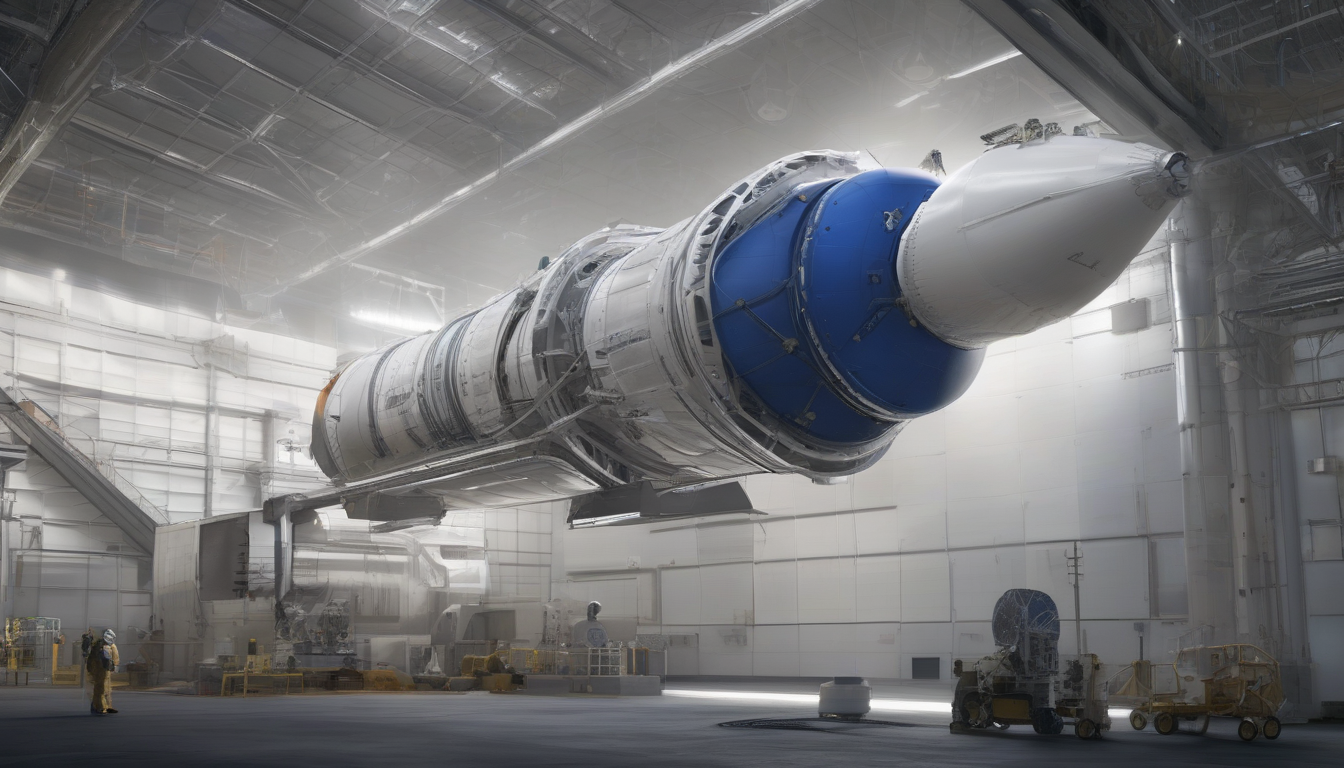
The Apollo program put humans on the Moon with one Saturn V rocket per mission. Artemis requires half a dozen heavy launches just to get a single lander fueled and ready in orbit. Former NASA boss Jim Bridenstine didn't mince words when he called the current lunar architecture extraordinarily complicated compared to the 1960s. He was right. We aren't launching a single capsule on a straight shot anymore. We are staging an industrial supply chain in low Earth orbit before anyone even points a nosecone toward the Moon.
SpaceX and Blue Origin hold the contracts for NASA's Human Landing System (HLS). Both companies have promised unprecedented heavy-lift capabilities, but both face the exact same physical reality. Before any astronaut steps onto the lunar south pole, these commercial landers have to prove they can launch, dock, loiter in orbit without boiling off cryogenic fuel, and leave their launch pads intact for the next vehicle in line. Miss any one of those steps, and the entire mission collapses.
For a full breakdown of the timeline, crew assignments, and lander requirements heading into the next lunar attempt, see our tracker on Artemis III Mission Details.
Space.com: NASA, Space Exploration and Astronomy News on Orbital Docking
Anyone following Space.com: NASA, Space Exploration and Astronomy News knows that in-orbit docking used to be an occasional maneuver. On Artemis, it's the core operational requirement. The architecture relies on rendezvous operations occurring hundreds of miles above Earth and near-rectilinear halo orbits around the Moon.
When reporting across outlets like NPR and NASA's official mission updates, the technical risk concentrates in three specific phases: docking alignment, long-duration orbital loitering, and propellant transfer. A lander cannot simply arrive in orbit and wait passively. It must maintain active attitude control, manage thermal gradients between sunlit and shadowed orbit segments, and link up precisely with incoming tanker flights or crew capsules.
NASA's decision to select Blue Origin as a second lunar lander provider under its Sustaining Lunar Development contract—detailed in our review of NASA's Artemis hardware costs and official statements at the NASA Press Center—was designed to foster commercial competition. But adding a second lander provider doesn't change orbital mechanics. Both landers must demonstrate that automated docking systems function cleanly under high-stress conditions without thruster plume impingement damaging delicate solar arrays or docking rings.
SpaceX Starship and Cryogenic Refueling Bottlenecks
SpaceX has turned rapid rocket launches into routine news, but Starship's lunar assignment demands maneuvers the company has never executed with crew on board. Because Starship is so heavy, it exhausts almost all its propellants just reaching low Earth orbit. To head out toward the Moon, it needs to meet a depot ship in orbit and refill its tanks through a series of Starship tanker flights.
Some estimates suggest SpaceX will need anywhere between ten and twenty individual tanker launches for a single HLS mission. That cadence creates zero margin for error on the ground. If a launch aborts or an engine needs replacing—as seen during Starship Flight 13 preparations reported by Richard Speed at The Register—the entire refueling timeline stretches out. The FAA's recent clearance for Starship to return to flight after booster issues, covered in our analysis of FAA Clears SpaceX Starship to Fly Again, highlights how critical ground infrastructure and vehicle readiness remain for the lunar program.
Loitering in orbit while waiting for the next tanker sounds simple until you consider thermodynamics. Liquid methane and liquid oxygen boil off when exposed to solar radiation over days or weeks. If SpaceX can't master active cryogenic cooling and zero-boiloff storage in orbit, the lander will run dry before Orion ever arrives. The docking mechanisms themselves must also handle repeated mechanical latches under cryogenic thermal expansion. It's a rough engineering challenge that can't be solved with software patches alone.
Blue Origin and the Ground Pad Damage Equation
Blue Origin's approach with its Blue Moon lander and New Glenn launcher faces an equally steep curve. While Jeff Bezos's space firm has emphasized methodical ground testing, recent hotfire campaigns demonstrate how unforgiving high-thrust engines are to pad infrastructure. Hotfires at Stennis Space Center and Cape Canaveral have sent shockwaves through launch mounts and flame trenches, showing that keeping ground assets intact is half the battle.
If your lunar architecture requires multiple launches in short order, your launch pad cannot take three months of repairs after every blast-off. High-thrust engines like BE-4 generate acoustic energy and heat capable of scouring concrete and tearing up steel ground hardware. Blue Origin must prove that launch sites like LC-36 can handle rapid recycling without structural degradation.
Blue Origin's Blue Moon lander also uses liquid hydrogen and liquid oxygen. Hydrogen is notoriously difficult to store; its tiny molecules leak through microscopic gaps, and its boiling point sits just above absolute zero. Loitering a hydrogen-powered lander in orbit presents thermal management issues that make methane look easy. Blue Origin's official developments, tracked via Blue Origin News, show ongoing work on cryogenic fluid management, but flight demonstrations in actual space conditions remain the ultimate test. The company's recent massive $10 billion funding round signals investor confidence, but hardware testing in actual space conditions remains the ultimate validation.
The Physical Realities of Loitering and Docking
Loitering in orbit isn't waiting around in a parking lot. Orbiting Earth at 17,500 miles per hour means passing into Earth's shadow and back into blistering sunlight every ninety minutes. Spacecraft metals expand and contract with every temperature swing.
When two spacecraft dock—whether it's Starship joining a propellant depot or Orion connecting with an HLS lander in lunar orbit—those mechanical latches must seal tightly despite severe thermal stress. Rubber O-rings harden in cold shadow; metallic sealing faces expand in direct sun. If the alignment is off by fractions of a degree, orbital mechanics will send the two vehicles drifting apart or, worse, bouncing off one another with enough force to breach pressure hulls.
This is why NASA's insistence on full-scale orbital docking and loitering demonstrations before Artemis III is non-negotiable. The agency cannot afford to risk crew lives on theoretical modeling. Both SpaceX and Blue Origin must execute uncrewed orbital rehearsals where landers dock, transfer propellants, remain dormant for extended periods, and successfully restart their engines for trans-lunar injection.
Why This Proving Ground Matters for Lunar Exploration
The transition from single-launch Apollo architecture to multi-launch commercial architecture is the biggest operational shift in spaceflight history. It trades short-term simplicity for long-term scalability. If SpaceX and Blue Origin can master orbital propellant transfer, loitering, and docking, humanity gets a permanent, reusable transport system to the Moon and beyond.
If they fail, NASA's lunar timelines will slip deep into the 2030s. The commercial space industry has built impressive hardware, but hardware sitting on a launch pad doesn't land on the Moon. Until these rockets prove they can launch repeatedly, hold position in vacuum without losing fuel, and dock with zero defects, Artemis remains a high-stakes gamble waiting for physics to settle the score.