
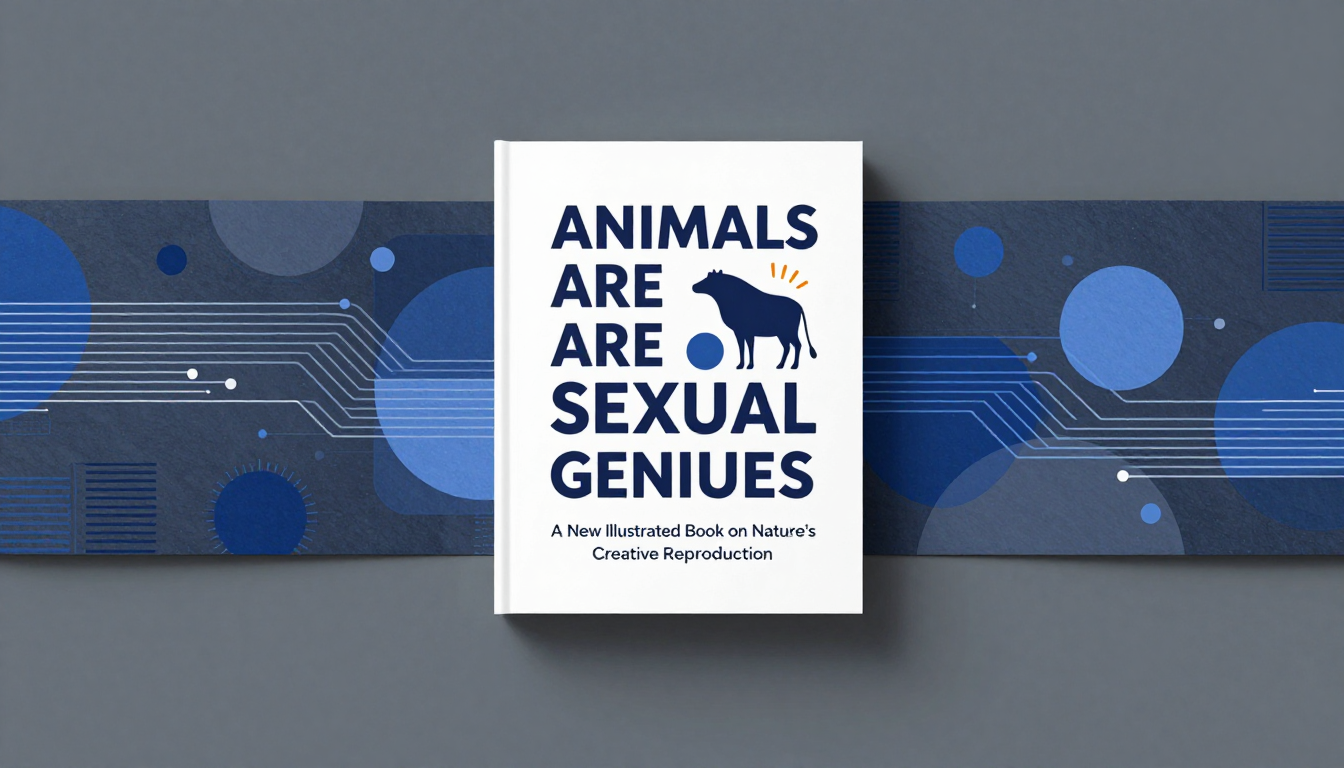
Animals Are Sexual Geniuses
Let's get one thing straight right out of the gate: animals are way more creative in bed than we gave them credit for. I mean, who would've guessed that two genetic male bearded lizards in Australia could become the star breeding couple of their study? That's not a typo. That's just Tuesday in the animal kingdom.
Perrin Roosevelt Ireland knows this better than almost anyone, and she's spent the last few years translating that wonder into something genuinely beautiful. Her new book Poking the Squid: What We Can Learn from Animal Sex (W.W. Norton & Company) is a hand-drawn watercolor nonfiction comic that makes academic science feel like hanging out with a really smart friend who happens to also be an artist. And honestly? We need more of this.
Ireland studied developmental biology at Brown University, spent a decade communicating about environmental issues at the Natural Resources Defense Council, and later took classes on feminist science and technology studies at the Brooklyn Institute for Social Research. Her artwork has appeared in Discover, Nature, Scientific American, and The Rumpus. She's served on the Roosevelt Institute board, was the inaugural Artist in Residence at the New York Aquarium, and is a Banff Graphic Novel Resident. That's not just credentials—that's a life built around making the natural world feel accessible and alive.
The book arrived at exactly the right moment. We're in the middle of a sixth mass extinction event, and Ireland argues that taking pleasure in the wonder of animals isn't frivolous. It's essential. Can you believe we live at the same time as two-toed sloths and chain-mail snails? Of course you can. But do we pause long enough to actually let that sink in?

A Watercolor Guide to the Wild Side of Nature
Here's what makes this book genuinely unusual: it's a hand-drawn watercolor nonfiction comic book about animal sex, and it takes academic science seriously without ever feeling stuffy. Ireland learned by drawing. She's explicit about that. Her cats Ursula and Pudge literally join her and the reader on the journey, having conversations with real scientists, theorists, philosophers, and journalists as they go.
This is someone who wants general readers to have access to rigorous science through friendly comics. She's no expert pretending otherwise—she's a curious person who pays attention, and she invites you to do the same. Nature makes the best jokes, she says. She just wants to pay enough attention to catch the punchline.
The format matters more than you'd think. Ireland's work bridges developmental biology, environmental communication, and feminist science critique in a way that feels organic rather than forced. She entered the world of thoughtful critique of evolutionary biology and ethology through feminist biologists, social scientists, and theorists at the Brooklyn Institute for Social Research with Danya Glabau. That intellectual lineage shows up in every page—not as academic posturing, but as a genuine commitment to asking better questions about how we study animals and why it matters.
The book covers everything from queerness to infidelity, consent to divorce, sex change to sexual cannibalism. It's a wild biodiversity ride through the kinkiness of animal sexual behavior, and it doesn't flinch. Marc Bekoff, professor emeritus of ecology and evolutionary biology at the University of Colorado Boulder, called it a "stunning fact-and story-filled beautifully illustrated new book"—and he's not wrong. When an academic who's taught introductory and advanced animal behavior courses says students "woke up" when he talked about animal sex lives, you know the topic has legs. Ireland just gave those legs a beautiful watercolor coat of paint.
When Biology Refuses to Play by the Rules
The animal kingdom doesn't do binary. Not even close.
Ireland devotes serious attention to the fact that there is no mutually agreed-upon scientific definition of "sex." The variables don't always align in the same repeatable ways across different animal bodies. Spent time with the diversity of animal sexual expression and you start to see that nature is far messier—and far more interesting—than any textbook category system wants to admit.
Take the bearded lizards in Australia. A long-term study revealed that their star breeding couple—two genetic males—were making tons of babies together. Not an anomaly. Not a fluke. Just animals doing what animals do when the rules we keep trying to impose on them don't actually apply.
Then there's the frog genitalia question. Frogs have a remarkable variety of genitalia, and for a while there was this narrative that toxic chemicals were causing the diversity. Ireland pushes back on that. Environmentalists should absolutely push back against chemical companies dumping into fresh water bodies, sure—but not for trans-exclusionary radical feminist reasons built on a debunked premise. The science doesn't support it, and weaponizing bad science against marginalized people is a particularly ugly move.
The book also covers consent behaviors, infidelity patterns across species, sex change capabilities, and sexual cannibalism. For every rule that exists in nature, Ireland shows us there are many more examples of animals breaking them. Animals are sexual geniuses, and life has manifested astonishingly myriad ways to keep making more of itself. That's not a controversial statement if you actually look at the data. It's just biology.
Climate Change Is Already Rewriting the Mating Rules
Here's where the book gets urgent. Climate change has already impacted animal sex and changed mating patterns across species, and the evidence is staring us in the face.
Scientists studied a breeding colony of black-browed albatrosses on the Falkland Islands. These birds historically mate for life. But they've seen a large uptick in what researchers call "divorce"—pairs breaking up and finding new partners. The correlation? Divorce rates are higher in years when the ocean surface temperature is warmer.
That's not a theoretical projection. That's an observed shift happening right now, driven by something we're actively causing. Warmer oceans. Higher divorce rates in species that were supposed to be mate-for-life animals. The implication is staggering when you think about it: climate change isn't just altering habitats or food chains. It's rewriting the fundamental social contracts of animal life.
Ireland doesn't let readers off the hook here. She wants a world where critters get their rocks off in as many ways as possible. Don't you? The question isn't whether we should care about animal mating patterns. It's whether we can afford not to.
The albatross study is just one data point, but it's a canary in the coal mine. When species that have maintained stable pair bonds for millennia start breaking them apart due to environmental stress, something fundamental is shifting. And if we don't address the root causes—greenhouse gas emissions, ocean warming, habitat destruction—we're going to see more of this. More disruption. More loss.
Agency Beyond Reproduction
One of the book's most powerful arguments is that studying animal sex restores a sense that animals have agency. They're not just reproducing machines. They're making choices for themselves about their lives all the time.
Ireland highlights female Japanese macaques cuddling—not for reproductive purposes, but because they choose to. Because social bonding matters. Because pleasure and connection aren't exclusive to the act of making babies.
This might sound obvious to anyone who's spent time with animals, but it's radical in a scientific tradition that has historically treated animal behavior as nothing more than instinct-driven reproduction. Ireland's framework—drawing on feminist science critique and queer theory—challenges that reductionism at every turn.
Animals are incredible shapeshifters, pranksters, creative geniuses at how they conduct their sex lives. They cannot be reduced to biological functions. They make choices. They form bonds. They explore. They enjoy themselves.
And here's the thing: learning about animal sexual diversity changes you. Ireland says she really sees the world differently today after writing this book. She cannot imagine ever thinking she could presume to know how one "ought" to bury their boner, or how a body "should" be organized, ever again. That's not just intellectual growth. That's a fundamental shift in how you relate to the nonhuman world.
The book invites readers into that same expansive experience. Let your freak flag fly, baby, she says. Not just for animals—for everyone.
Why This Book Matters Right Now
We're living through a sixth mass extinction event. The ongoing news of a biodiversity crisis brings sad tidings, Ireland acknowledges. But she argues that taking pleasure in the wonder of animals isn't a luxury—it's a survival strategy.
The book's central mantra—"sexual diversity is biodiversity"—is more than a catchy phrase. It's a scientific observation with profound implications. More diversity in who makes science means we see animals better. The book features an incredible group of scientists trying to understand animal sex, whether they're making vaginal popsicles with dental silicone or video recording worms sucking sperm out of their bodies to avoid getting pregnant after sex.
These scientists should be worldwide celebrities. Instead, they're largely unknown. Ireland wants to change that.
The book is for animal lovers, or the animal-curious. It's for people who love sex, and for asexuals. It's for people that love comics, or are new to the genre. It's a juicy watercolor "come on in, the water's warm!" argument for how diversity in any discipline improves research.
But it's also an invitation to remember something fundamental: you are an earthling, and you belong here. That's not poetic filler. It's a call to action wrapped in wonder.
Ireland's hope is that readers share the expansive experience she had while writing this book. That they come away seeing the world differently. That they develop a deeper appreciation for sexual diversity—in nature and in human society.
Let's let animals change us, she says. And then let's fight like hell to stop them from going extinct.