
We've spent decades staring at the wreckage of Alzheimer's and frontotemporal dementia, trying to figure out why neurons simply vanish. Apoptosis—the neat, programmed cellular cleanup we all learned about in intro biology—doesn't explain the scale of the carnage. It's too slow. It's too orderly. The numbers don't add up. When clinical cognitive decline sets in, we see massive, catastrophic waves of cell death that look less like a planned retirement and more like a cascading infrastructure failure.
Now, a team from King's College London and the UK Dementia Research Institute has mapped a different pathway. They've named it karyoptosis, a brutal process of nuclear disintegration. When toxic proteins accumulate within a neuron, they don't just clutter the cytoplasm; they trip a molecular switch that causes the cell's command center to warp, shrivel, and burst. This isn't just an auxiliary symptom of aging. It's a terminal system crash.
For too long, the neurodegeneration research community treated neuron death as a secondary symptom—an inevitable downstream consequence of amyloid accumulation that we'd clean up later. That was a mistake. If the brain lost neurons solely through the tidy, sluggish progression of classical apoptosis, the rapid cognitive collapse we observe in late-stage Alzheimer's patients simply wouldn't fit the timescale of clinical data. Karyoptosis changes how we map this progression. It's a rapid-onset cellular suicide. By focusing on the structural integrity of the nucleus itself, this new research shifts the spotlight from diffuse protein trash to the physical destruction of the cell's kernel.
Anatomical Rupture of the Nuclear Firewall
To understand karyoptosis, you have to think like a structural engineer. The cell's nucleus isn't a passive bag of DNA. It's a highly pressurized, membrane-bound compartment protected by a complex scaffold called the nuclear lamina. This lamina, composed primarily of Lamin proteins, acts as both a physical shield and an organizing grid for the genome. If the lamina fails, the entire command center collapses.
In a healthy neuron, this structure maintains absolute compartmentalization. It keeps transcription factors, genetic material, and translation machinery exactly where they belong. But under proteotoxic stress—the technical term for the heavy, toxic protein clumping seen in Alzheimer's (AD), frontotemporal dementia (FTD), and amyotrophic lateral sclerosis (ALS)—the lamina starts to warp. The nuclear envelope, once a smooth sphere, begins to buckle.
The structural failure is dramatic. Under the microscope, neurons undergoing karyoptosis display a distinct physical signature: the nucleus shrivels, losing its volume as the membrane folds in on itself. Then comes the final blow: the cellular system expels nuclear material into the surrounding cytoplasm. Imagine a database server's memory space getting completely corrupted and dumped into the public web directory. It's non-recoverable. Once the genetic core is broken and its contents are spilled, the neuron is instantly non-viable. It can't run transcription. It can't repair its own membranes. The cell is dead, cleared away by microglia, leaving behind the empty spaces that define dementia's physical footprint in the brain.
This process is fundamentally different from other cell death pathways. In necroptosis or lytic forms of cell death, the outer membrane ruptures first, causing widespread inflammation. In apoptosis, the cell divides itself into neat, membrane-bound packages. Karyoptosis, however, starts from the inside out, targeting the command center first while leaving the outer cell membrane temporarily intact. It's an internal structural collapse, a direct hit to the cell's primary processing unit.

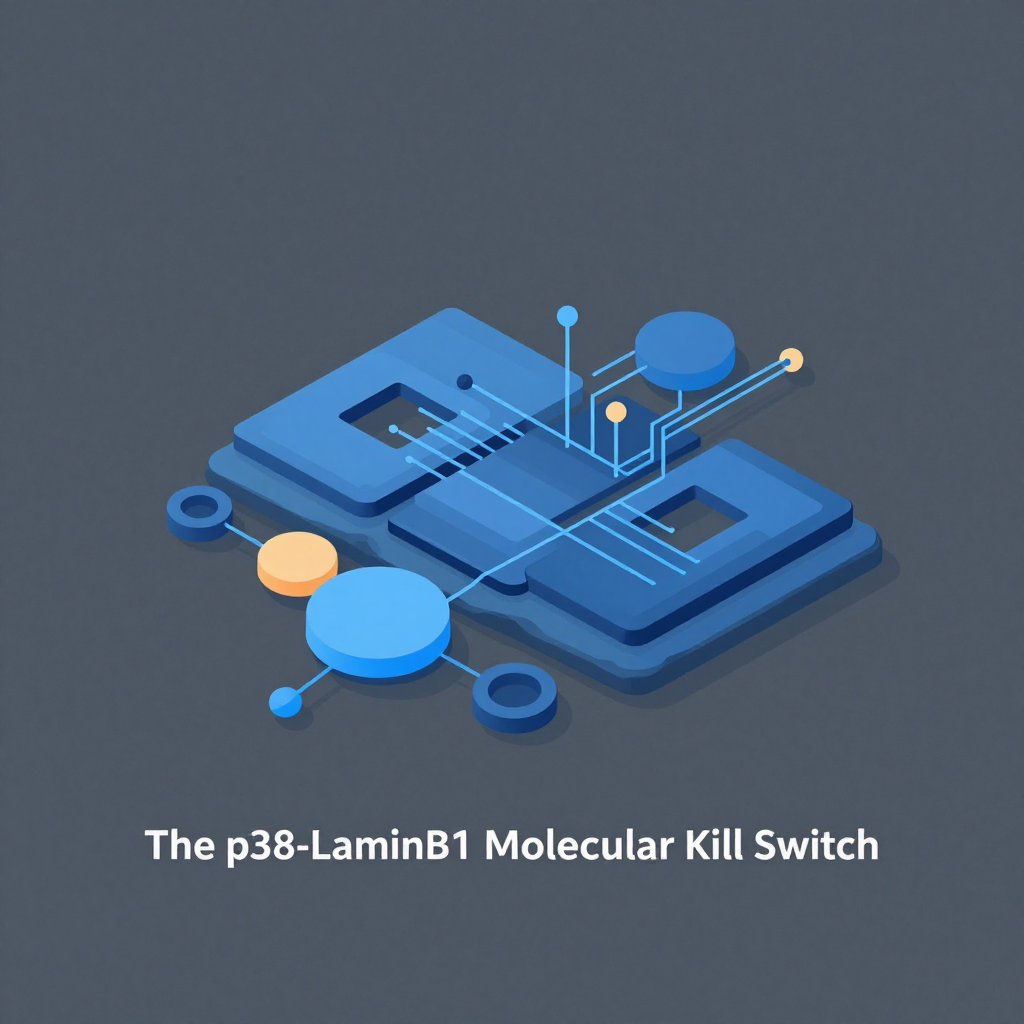
The p38-LaminB1 Molecular Kill Switch
Biologists like to talk about cascades, but what we're really looking at here is a faulty logic gate. The King's College London study, published in Nature Communications, successfully traced the exact molecular wiring that connects protein aggregation to nuclear collapse. The pathway centers on an enzyme called p38 MAP kinase and its structural target, LaminB1.
Under normal conditions, p38 MAP kinase is involved in stress response. It's a sensor. When the cell detects minor stressors, p38 activates to coordinate basic maintenance. However, when toxic proteins clump together in high volumes, they overload the cell's clear-out mechanisms, trigger a massive signal, and knock the p38 kinase into overdrive. It's a classic resource leak that leads to runaway execution.
The hyperactive p38 kinase seeks out LaminB1, the structural protein maintaining the nuclear walls. By directly phosphorylating LaminB1, p38 destabilizes the protein's assembly. Think of it as systematically removing the support pins from a bridge. The LaminB1 scaffold begins to dissolve, and the nuclear envelope loses its structural integrity.
This specific molecular interaction is the core link. Historically, we knew that kinase activity was elevated in diseased brains, as documented in historical research on PubMed, but we didn't know what it was actually destroying. We thought it was just a general inflammatory signal. Now we know it is a targeted demolition. The p38 kinase acts as the trigger, and LaminB1 is the structural pillar that gets knocked down.
Similar studies in cellular neurobiology highlight how specific kinase pathways, such as those discussed in our GABA and Glioblastoma study, can drive critical disease progression through targeted molecular modification.
What's fascinating here is that this pathway is highly specific. It isn't a general, chaotic degradation of the cell. It's a precise, biochemical chain reaction. This specificity is exactly what makes it such an attractive target for intervention. If we can write a patch to prevent p38 from interacting with LaminB1, we can theoretically keep the nuclear division wall standing, even when toxic proteins are piling up in the yard.
Computational Single-Cell Audits of the Frontal Cortex
How did we miss this for so long? The answer lies in the sheer difficulty of auditing individual cells in human tissue. Traditional pathology looks at brain tissue in bulk, averaging out the signatures of thousands of cells. It's like looking at a city from a satellite; you can see that buildings are gone, but you can't tell if they collapsed because of a structural defect or a fire.
To bypass this limit, the research team used advanced computational single-cell algorithms to process post-mortem brain tissue. They analyzed over 3,000 distinct neurons from the frontal cortices of 28 individuals, comparing terminal-stage Alzheimer's and frontotemporal dementia patients against healthy, age-matched controls. The data they uncovered was staggering.
In the frontal cortex of patients who died with Alzheimer's or FTD, 35% of the analyzed neurons showed clear, active markers of karyoptosis. In contrast, healthy aged controls showed these markers in only 15% of cells. Let's look at those numbers. That is more than a twofold increase in active nuclear breakdown. It proves that karyoptosis isn't some rare, pathological quirk. It's a primary driver of tissue loss in the areas of the brain responsible for executive function, personality, and memory.
Using algorithms to sort through these single-cell datasets allowed researchers to separate karyoptosis from other types of cell death. The genetic and structural profiles of these cells didn't match the signature of apoptosis. They didn't match necroptosis. The software flagged a distinct cluster of cells characterized by degraded nuclear envelopes, downregulated LaminB1, and leaking genomic material. This computational audit isn't just academic validation; it provides a map of the front lines in the brain. It shows us exactly where the structural failures are happening and tells us that more than a third of the neuronal losses in these critical regions are tied to this single, previously unmapped pathway.
This data also highlights the role of lifestyle and general resilience. While genetic anomalies play a role, building systemic defense is vital. In our deeper analysis of cognitive resilience and protective strategies, we've seen how keeping vascular pathways clear and maintaining cognitive reserves can help neurons manage stress. But when the p38–LaminB1 switch is thrown, local resilience isn't enough. We need targeted molecular intervention.
Decoupling the Kill Switch and Widening the Clinical Window
The goal of defining karyoptosis isn't just to add another term to textbooks. It's to figure out how to stop it. And this is where the research shifts from diagnostic to therapeutic.
In laboratory experiments on rat neurons, the team introduced targeted compounds designed to block the interaction between p38 MAP kinase and LaminB1. The result? The nuclear breakdown stopped. Even in the presence of high proteotoxic stress—where toxic proteins were clumping together inside the dish—protecting the LaminB1 protein prevented the shriveling and disintegration of the cell's nucleus. We successfully decoupled the stress signal from the physical demolition.
Let's be clear about what this means. It doesn't cure Alzheimer's or FTD overnight. The toxic proteins are still there. The underlying metabolic errors that cause those aggregates are still running. But by protecting the nuclear envelope, we prevent the neuron from committing suicide. We keep the system online.
In a clinical setting, this is a massive win. Neurodegenerative diseases are slow-motion train crashes. If you can stop the actual death of the brain cells, you buy time for patients. You widen the clinical window. This extra time allows doctors to deploy other treatments, such as therapies aimed at clearing amyloid plaques or stabilizing tau proteins, before the underlying neurological architecture is permanently destroyed.
The next step is translating this from rat neurons in a dish to human patients. That isn't a quick process. Designing a molecule that can cross the blood-brain barrier, target the p38-LaminB1 interaction, and leave normal p38 signaling intact is a major engineering hurdle. But we now have a specific target. We aren't just firing blindly at general inflammation; we are aiming at the specific joint where the cell's nucleus is torn apart. For a field that has spent decades chasing aggregate clearance with mixed results, this structural, performance-based approach feels like a major step forward.