
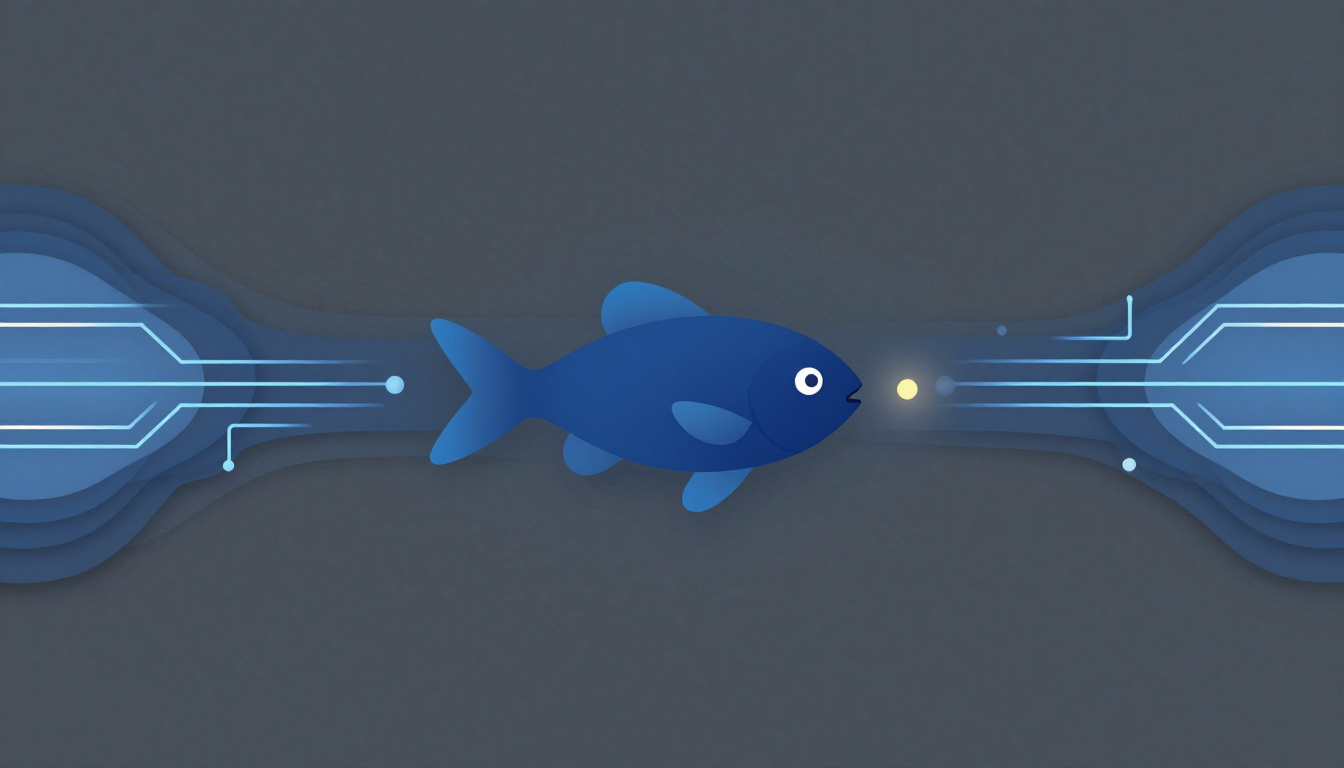
Under the mountain range of northeastern Mexico, the blind cavefish (Astyanax mexicanus) has spent hundreds of thousands of years in absolute dark. They lost their eyes. They lost their pigment. That's the easy part of the story—everyone knows about the eyeless cavefish. But the real surprise is happening deep in their brains, where evolution has pulled off a full behavioral U-turn.
If you take a normal, sighted surface version of the species and suddenly turn off the lights, it panics. It starts swimming around like crazy, searching for a patch of light so it can find food, stay oriented, and dodge predators. Biologists call this reflex "dark photokinesis." It is a common survival strategy in eyed fish. If the lights go out, move fast until you find them again. Keep moving or you die.
But put a blind cavefish in the same situation, and the behavior flips. In the pitch black, the cavefish is perfectly calm, gliding along at a leisurely pace. They do not need eyes or light to navigate; they use their lateral line system to sense vibrations. If you suddenly turn on the lights, however, the cavefish goes into overdrive. It begins thrashing and darting around in a frantic burst of hyperactivity.
This is "light-evoked photokinesis." For a creature that has lived for thousands of generations in subterranean gloom, light is not a guide. It is a threat. Light means you have drifted too close to a cave entrance, a high-stakes border zone where visual predators from the surface are waiting to eat you, and where the dry, hot air of the outside world can kill you. So, the cavefish reacts to light the way the surface fish reacts to darkness: it runs.
This complete behavioral inversion is documented in detail by Florida Atlantic University researchers in a study published in Science Advances (which you can read about in Neuroscience News and explore on the FAU News Desk). But the big question has always been: how do you completely reverse a congenital behavioral reflex without building a new brain?
Re-purposing the Midbrain Instead of Rebuilding It
The naive assumption is that evolutionary change requires a major structural overhaul. You want a new behavior? Well, you better build new neural hardware, add some extra lobes, or sprout a dedicated light-sensor network.
That is not how it works. Evolution does not write new code from scratch; it forks the existing repository and messes with the inputs.
To figure out how this flip happened, a team of researchers from FAU, Texas A&M, and other institutions turned to a suite of advanced neuroimaging techniques. They bred transgenic cavefish and surface fish that express a fluorescent calcium indicator called GCaMP directly within their neurons. Every time one of these cells fires, calcium floods in, and the neuron glows under a microscope. This allows researchers to watch the brain in action in real time, capturing cellular-resolution light shows of neural activity while the fish react to shifting light conditions.
GCaMP, for the uninitiated, is a molecular fusion of green fluorescent protein (GFP), calmodulin (CaM), and a peptide sequence called M13. When calcium binds to calmodulin, it causes a structural shift that increases the fluorescence of the GFP. In action, this means a researcher sitting at a confocal microscope doesn't just see a static slice of tissue. They see a shimmering, dynamic map of neural activity. They can watch individual neurons fire, quiet down, and fire again as the ambient lighting changes from dark to light.
Mapping these scans onto a standard Astyanax brain atlas was a mammoth task. Brains differ from fish to fish, and alignment requires sophisticated warping algorithms to make sure a neuron in Fish A matches the coordinates of Fish B. Once aligned, the signal from the caudal posterior tuberculum (PT) was too loud to ignore.
In sighted surface fish, a specific cluster of neurons in the posterior tuberculum is highly sensitive to darkness. Turn off the lights, and these cells fire rapidly, driving the muscle movements that cause the fish to search for light. But when the researchers imaged the cavefish, they found that these exact same neurons fired in response to light. The physical structure of the posterior tuberculum had not changed. The cells were still there, in the self-same location, connected to the same motor outputs. But their input sensitivity had been evolutionary swapped. The darkness-responsive circuit was now light-responsive.
Think about the implications of this. It is like taking a home security system where a sensor is wired to trigger an alarm when a door opens, and instead rewiring the sensor to blast the siren when the door stays closed. You do not need to buy a new alarm; you just swap the input polarity. We see similar rewirings in other sensory setups where the brain struggles to adapt to deep deprivations, such as the neurological fallout from chemosensory deprivation.
For the cavefish, this non-visual light detection does not even rely on their missing eyes. The photoreceptors driving this response are located elsewhere—likely in the pineal gland or deep within the brain itself. This retinal-independent pathway is what has been re-routed straight into the posterior tuberculum, converting what was once a search-for-light reflex into a run-for-your-life escape response.
Dopamine: The Neurochemical Switchboard
How do you actually rewire a neural circuit like this? You do not use a soldering iron; you use neurochemistry.
The researchers discovered that this entire behavioral pivot depends on dopamine. We usually think of dopamine as the brain’s reward chemical—the molecule that makes us feel good when we eat sugar or check our phones. But in the wider vertebrate world, dopamine is also a fundamental controller of motor output. It is the grease that lets the brain translate a sensory signal ("hey, it’s bright!") into a physical action ("time to swim!").
By applying pharmacological blockers and genetic modifications to the dopamine pathways, the scientists could dial the light response up or down. If you block certain dopamine receptors in cavefish, their light-evoked hyperactivity vanishes. Conversely, if you boost dopaminergic transmission in surface fish, you can nudge their behavioral responses closer to those of their cave-dwelling cousins.
Dopamine isn't a simple on-off switch; it operates through a family of receptors (D1 through D5) that either excite or inhibit downstream neurons. The researchers pinpointed that this specific behavioral flip involves changes in receptor sensitivity rather than a massive increase in the absolute number of dopamine cells. They confirmed this by feeding the fish specific dopamine agonists and antagonists. When they blocked the D1 receptor class, the light-evoked hyperactivity in cavefish flattened. They stopped running from the light.
This suggests that the evolutionary shift in Astyanax mexicanus is not a radical structural rewiring, but a adjustment of the neurochemical gain-settings. The caudal posterior tuberculum is packed with dopamine-producing neurons. By modifying how these cells release dopamine or how the surrounding motor circuits respond to it, evolution flipped the behavioral polarity of the entire circuit.
It is an elegant solution. By changing the chemical volume knobs rather than building new biological logic gates, the cavefish evolved an adaptive escape reflex in a fraction of the time it would take to build a visual system from scratch. The same theme of fine-tuned neurochemical adjustment shows up across all motor control systems, a concept we explored in our analysis of closed-loop neural stimulation for motor stability, where millisecond-by-millisecond adjustments keep systems in balance.

The Genetic Ledger and Human Brain Disease
This behavior is not a habit the fish pick up in the dark. It is written directly into their DNA.
To prove this, the research team bred surface fish and cavefish together, creating F1 and F2 hybrids. If the behavioral flip were controlled by a single genetic on-off switch, the hybrid offspring would have sorted into neat, binary categories: either they panicked in the dark, or they panicked in the light.
Instead, they got an entire gradient. The hybrid F1 and F2 crosses are where the genetic reality hits the table. If this behavioral shift were a simple mendelian trait—say, a single recessive gene that turns off sight and swaps the behavioral circuits—we would expect the F1 hybrids to all look like one parent and the F2 generation to split into neat 3:1 ratios.
But nature is rarely that obliging.
The hybrid fish exhibited a wide spectrum of photokinesis index scores, showing varying levels of sensitivity to light and dark. Some behaved like surface fish, some like cavefish, and many landed somewhere in the messy middle. This kind of inheritance pattern is a classic sign of a multigenic trait. It means multiple genes, each contributing a small part of the puzzle, are coordinating the development of these dopaminergic circuits. The full genetic details of this study can be found in the peer-reviewed paper on PubMed Central.
Why should we care about a few blind fish swimming in circles in a lab?
Because your brain is built on the exact same architecture.
The dopamine pathways that control movement, sensory gating, and motor response are highly conserved across all vertebrates. From fish to rodents to primates to humans, the basic plumbing of the midbrain is virtually identical. When these dopamine-regulated sensorimotor loops go haywire in humans, the results are devastating. We do not just run away from lights; we develop debilitating neurological and psychiatric conditions.
Think about Parkinson's disease, where the loss of dopamine-producing cells freezes motor action. Think about ADHD, where dopamine dysregulation disrupts sensory gating and focus. Think about schizophrenia and autism, where the brain struggles to filter and process sensory inputs from the outside world.
By studying how evolution successfully rewired these identical dopamine pathways in cavefish—making a drastic behavioral shift without breaking the brain—scientists are gaining a blueprint for how these circuits are built and regulated. If we can understand how evolution tweaks the dopamine dials to safely invert a behavior, we might learn how to tune those same switches when they break in human brains. Contrast this deep subcortical rewiring with other brain adaptations, like how the bilingual brain builds specialized hippocampal neural maps to navigate multiple languages.
In the end, the blind cavefish is not just a curiosity of natural history. It is a mirror. It shows us that our most complex behavioral circuits are not set in stone—they are plastic, evolutionary malleable, and governed by chemical switches that we are only just beginning to map.