The Brain Decides Before You Know You've Decided
You're standing at the edge of a crosswalk. The light just turned, traffic is approaching, and something in your brain has already made the call — dash or wait — roughly half a second before your foot twitches. That's not metaphor. That's a measurement.
Researchers at UCSF, publishing in Nature Neuroscience, pulled off something that's been technically elusive for decades: they recorded electrical activity directly from the human orbitofrontal cortex while people made risk-laden choices, and they watched a decision crystallize in real time. Not the slow, blurred approximation you get from fMRI. Actual millisecond-resolution data streaming from electrodes sitting on cortical tissue in patients undergoing epilepsy surgery.
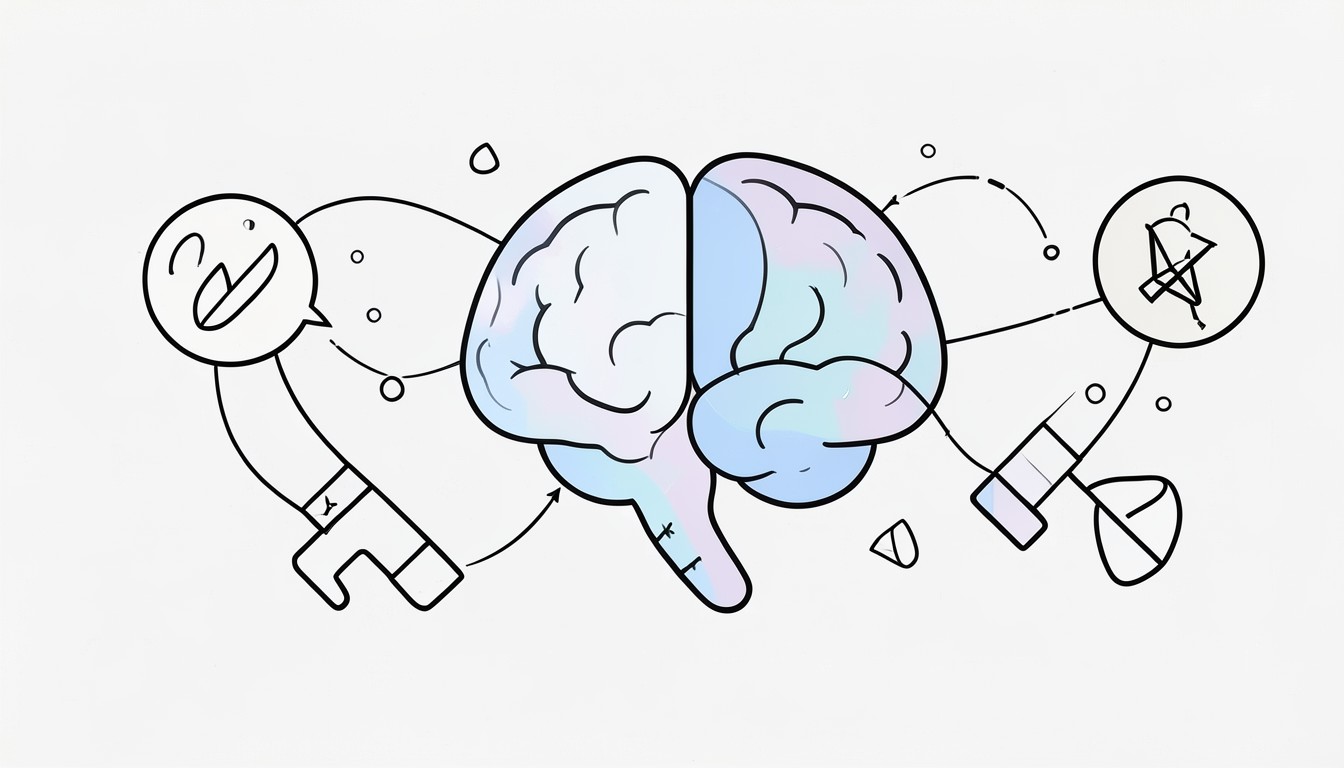
The finding is deceptively simple to describe and genuinely consequential to interpret. Two adjacent patches of cortex, separated by roughly two centimeters, engage in a rapid push-pull contest. One favors risk. One favors avoidance. Whichever wins that millisecond-scale tug-of-war predicts the behavioral outcome before the person is even consciously aware of choosing.
The Dual-Circuit Mechanism in the Orbitofrontal Cortex
The medial orbital sulcus — a fold on the inner surface of the OFC — lights up when a person opts toward a risky option. A lateral patch, just two centimeters away on the outer surface, fires in the opposite direction when the person pulls back from potential danger. These aren't slow metabolic signals or diffuse activation patterns. They oscillate rapidly, switching states in bursts that the research team describes as closer to an electrical toggle than a gradual dial.
That distinction matters enormously. The "gradual dial" model — where risk and reward accumulate until a threshold is crossed and the decision emerges, has been the dominant narrative in computational neuroscience for years. Drift-diffusion models, accumulate-to-threshold architectures, all of them assume something like this. What UCSF recorded doesn't match that picture. It matches something more like a bistable switch, where the brain snaps between pro-approach and pro-avoidant states.
This introduces a new functional architecture within the human OFC during decision-making, and it complicates every computational model that assumed smooth integration of value signals in this region.
Why Direct Recording Changes Everything
Let me be blunt about fMRI's limitations here. BOLD signals lag neural activity by seconds. They blur spatial resolution to millimeters. They conflate excitatory and inhibitory processes into a single hemodynamic proxy. For questions about whether two circuits toggle in alternating bursts at millisecond timescales, fMRI is structurally blind. It cannot see what this study saw.
The UCSF team used intracranial electrodes already implanted for clinical seizure monitoring, a method called stereo-EEG or direct cortical recording, which gives them temporal precision in the single-millisecond range and spatial precision down to individual electrode contacts. The trade-off is obvious: you can only do this in patients who already need electrodes for medical reasons, so sample sizes are small and the population isn't representative of healthy variation. But for questions about mechanism, not population generalization, nothing else works.
The decoding analysis was the clincher. When the researchers trained classifiers on the neural patterns in each patch, they could predict the upcoming choice with accuracy well above chance, 500 milliseconds before the person physically acted. That's not prediction in the vague, post-hoc sense. That's a causal window. The brain has committed before consciousness catches up.
Implications for Behavioral Economics
Anyone who works in behavioral economics, who builds models of risk preferences, loss aversion, probability weighting, needs to sit with this carefully. Prospect theory describes how people weight losses more heavily than equivalent gains. It's descriptive, not mechanistic. It tells you the shape of the curve, not what produces it.
The OFC dual-circuit finding suggests a candidate mechanism: the relative gain of the medial versus lateral OFC patch at any given moment might instantiate the moment-to-moment variability in risk preference that economists treat as noise or framing sensitivity. If the switch is bistable rather than integrative, then small contextual cues that push the toggle one way or the other could produce outsized behavioral shifts, which is exactly what framing effects look like from the outside.
This doesn't replace behavioral economic models. It offers a possible implementation layer beneath them. The decision under uncertainty literature, Preuschoff and Mohr's editorial work, for instance, has long argued that neural correlates of risk and uncertainty are dissociable from value signals. A bistable OFC architecture would be consistent with that dissociation: one circuit encoding the approach signal, the other encoding the avoidance signal, and the behavioral output determined by which one captures the network state.
Clinical Targets: Neuromodulation Gets a Pin
The translational angle is where this research stops being a pure neuroscience story and becomes something with clinical teeth. Conditions like OCD and depression are characterized by pathological avoidance, the system stuck in a pro-avoidant state. Addiction is its mirror image — compulsive risk-taking that often has an early, preclinical warning stage — with the switch locked in approach mode despite escalating consequences.
If you have a biomarker, a specific oscillatory signature in a specific OFC patch that predicts which state the brain is about to enter, you have a calibration signal for targeted neuromodulation. Deep brain stimulation and focused stimulation techniques exist today, but they're often adjusted by clinical observation over weeks. A real-time neural biomarker could let the device detect the pathological state and intervene within milliseconds rather than waiting for the behavioral consequence to manifest.
The Frontiers systems neuroscience literature on cortico-striatal-thalamic loop circuits already frames the OFC as a therapeutic hub in psychiatric illness. This UCSF finding sharpens that framing considerably. It tells you exactly which subregion to target, what frequency signature to look for, and what behavioral outcome to expect if you succeed.
Decoding How Brain Circuits Control Behavior at Scale
Here's the broader intellectual context. For years, the field's ambition has been to move from correlation to causation, from "this region is active when you do that" to "this circuit's activity pattern determines that behavior." Single-unit recordings in non-human primates got us parts of the way. Human intracranial studies like this one close the gap between primate mechanistic detail and human cognitive architecture.
The causal half of that ambition is already being tested in animals, where chemogenetic tools switch defined circuits on and off on demand — a push-pull logic that mirrors, in reverse, what the UCSF team observed being pushed and pulled naturally in the human OFC. And for anyone asking the more basic question — what is neuroscience, really, and how do its practitioners even locate a circuit? — our companion introduction to the field walks through an engineered interface that tunes signals between the gut and brain, a reminder that "circuit" now stretches well beyond the skull.
The dual-patch architecture in the OFC fits a larger pattern we're seeing across the brain: competing populations, winner-take-all dynamics, discrete state transitions rather than smooth integrators. The same logic shows up in the habit literature: two distinct neural pathways that separately control habit initiation and execution intensity suggest that competing-circuit architectures are a general motif, not an orbitofrontal quirk. Serotonin's role in shifting the balance between cognitive flexibility and belief stickiness reinforces the same theme from the neuromodulatory side, and even the recently completed fruit fly central nervous system connectome points toward decentralized control rather than a single command center.
The brain, it seems, loves a good toggle switch.
What We Still Don't Know
Five hundred milliseconds is half a second. It's not "before you decide" in some philosophical sense that eliminates agency, the person still experiences the decision as their own, still has time to veto the impulse at a later stage. The finding doesn't reduce free will to a cortical toggle. It says that the initial commitment, the first neural step toward a risky or safe choice, is determinable and predictable.
That's plenty. And it's a useful corrective to the hype cycle that always accompanies "brain predicts behavior" headlines.
What we don't know: how this architecture scales to naturalistic, multi-step decisions. The experimental paradigm was constrained, binary choices between safe and risky options with explicit feedback. Real life rarely hands you clean binary gambles. How does a bistable OFC switch handle ambiguity, temporal delay, social context? Those questions require either larger intracranial datasets or careful cross-species modeling.
We also don't know how state-dependent this is. Sleep, stress, hunger, and medication all shift cortical excitability. If the switch threshold moves with physiological state, then risk preference becomes a moving target, which is clinically important and methodologically annoying.
And there's the durability question. Is the oscillatory signature a stable biomarker within an individual, or does it drift across sessions in ways that would frustrate any neuromodulation calibration strategy?
The Takeaway
A half-second of visible deliberation, decoded from two rival patches of orbitofrontal cortex, is a genuine advance in the neuroscience of economic decision-making: it identifies a specific circuit architecture, a specific timescale, and a specific predictive window. It reframes risk preference from a stable trait into a rapidly-switching state. And it hands clinicians something they've never had for approach-avoidance disorders — a target with coordinates.
For a field that spends most of its time arguing about whether we can ever read a decision from a brain, this is a rare, clean "yes, and here's when."