The puzzle hiding behind 1,200 genes
Autism genetics has a numbers problem. More than 1,200 risk genes are now tied to the condition, and that list creates a genuinely awkward question: do those hundreds of mutations each wreck the brain in their own special way, or do they all funnel down through a handful of shared biological pathways? If it's the first, treatments have to be invented gene by gene, an endless grind. If it's the second, there's a shortcut hiding somewhere in the wiring.
A team led by Eunjoon Kim at the Institute for Basic Science (IBS) in Korea decided to stop guessing and go measure it. Rather than staring at single mutations in isolation, they took the systems view and analyzed more than 1,000 mouse brain transcriptomes across 17 genetically engineered mouse lines. The result, published in Nature Neuroscience, is that those diverse mutations do not scatter into 1,200 separate biological disasters. They collapse into two broad, opposing molecular states in the prefrontal cortex.
I find this kind of result more interesting than the breathless "scientists find autism gene" headlines, precisely because it isn't about a single gene. It's about convergence. And convergence is the only thing that makes a shared treatment plausible.
Two states, pulled in opposite directions
The 17 mouse models carried mutations in genes involved in core neurodevelopmental jobs. The study and its reporting name heavy hitters like SHANK3, CHD8, and SCN2A, genes that touch everything from synaptic function to how genes get switched on and off. When the researchers clustered these animals by their gene-expression fingerprints rather than by their mutations, two recurring patterns popped out.
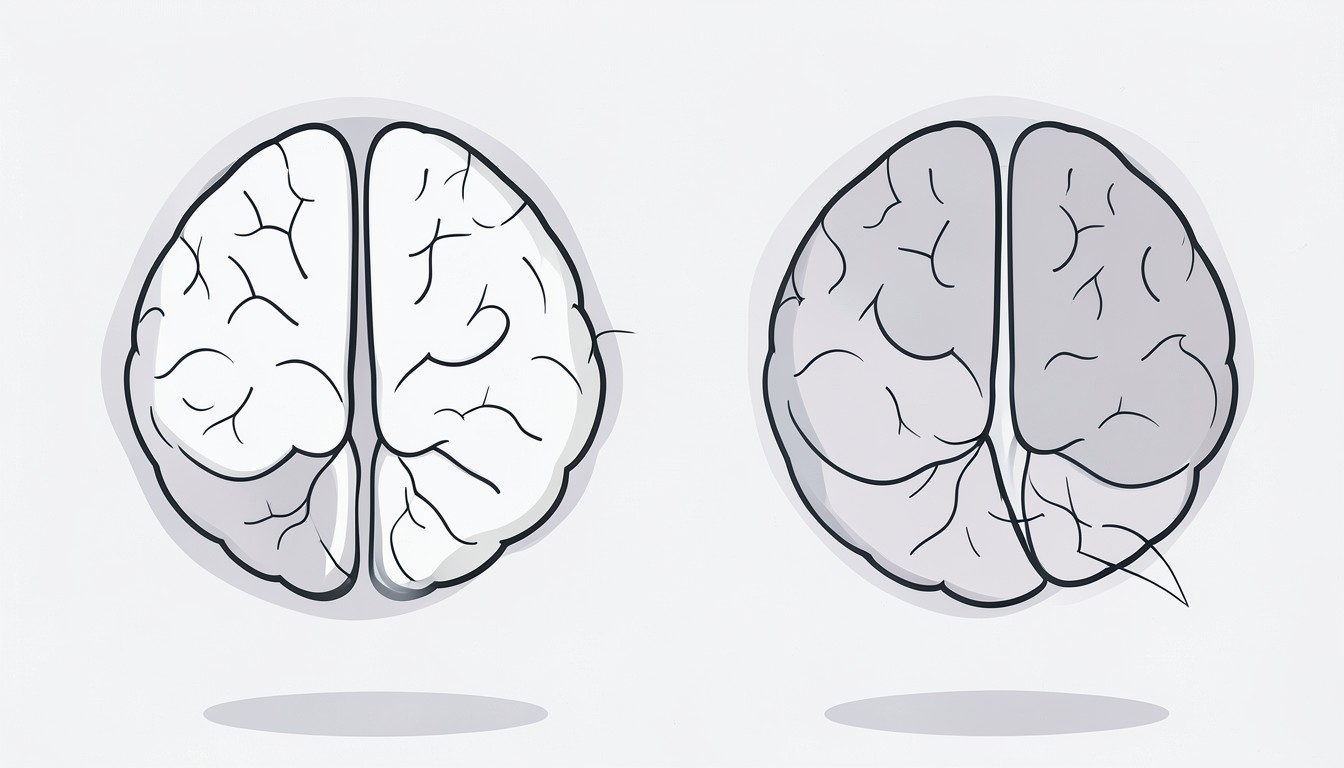
Call them Group 1 and Group 2. Group 1 shows depressed activity in the genes that handle synaptic communication, paired with elevated activity in genes governing chromatin regulation and RNA processing. Group 2 flips that balance: more synaptic signaling, less gene-regulatory noise. The researchers describe it as a seesaw between synapses and gene regulation.
Co-corresponding author Mihyun Bae framed the point cleanly: genetic discoveries have revealed enormous diversity in autism, but diversity alone doesn't explain the biology. The team's read is that many different mutations converge into a limited number of molecular brain states. That's a claim about shared biology, not about individual genes, and it's the part worth holding onto.
Your mutation doesn't pick your team
Here's the wrinkle that keeps this from being a tidy "two types of autism" story, and I'm glad the authors didn't sand it off. Which side of the seesaw an animal lands on isn't dictated by its DNA alone. In 7 of the 17 mouse strains, males and females carrying the exact same mutation ended up in opposing groups. The pattern also drifted across developmental stages and across brain regions.
So the molecular grouping is real, but it's contextual. Sex, age, and location in the brain all get a vote. Single-nucleus sequencing added another layer, showing broader cell-type remodeling in Group 1 than in Group 2, with cell-type-specific modules that mirrored the bulk signatures in opposite directions. This is not a diagnosis you can read off a genetic test, and anyone who tells you otherwise is ahead of their data.
A test with fluoxetine and lithium
A molecular classification is only useful if it predicts something you care about. The team asked whether the two states respond differently to drugs, and they picked two compounds with history behind them: fluoxetine (a common antidepressant) and lithium (a mood stabilizer). Neither is an approved treatment for the core features of autism, but both had previously shifted behavior in select animal models, which made them fair game for a probe.
The answer depended on the group. Group 1 models showed a more consistent normalization, with certain gene-expression programs nudged closer to what neurotypical control mice look like. Group 2 models responded variably, in a patchwork across cell types and gene networks. And critically, neither compound fixed the underlying imbalance in cell-type proportions. Their effect was narrow, limited to specific transcriptional circuits in particular subsets of neurons, not a master reset.
That last caveat is the one I'd lead with. These are old psychiatric drugs moving a few expression programs, not reversing the condition.
The mouse-to-human gap
The authors didn't stop at mice. They looked at prefrontal cortex transcriptomic data from 40 autistic individuals and 17 neurotypical controls, and they found two human subgroups with opposing patterns of synaptic gene activity. That's the hopeful part: the same axis showed up in people.
The honest part is the mismatch. The human postmortem samples carried much stronger immune and inflammatory pathway signals than the mouse models did, a difference that echoes what other work has flagged, including studies tying autism's two biological subtypes to connectivity and to immune overdrive alongside synaptic silence. The human subgroups also can't yet be traced back to specific upstream mutations. The authors are explicit that this remains exploratory, meaning it cannot today be used to diagnose a clinical subtype, predict someone's support needs, or pick their medication.
I respect a press release that says that out loud. The temptation, with a Nature Neuroscience paper and 1,200 genes in the headline, is to oversell the clinical horizon. They didn't.
Why this matters for finding a treatment
Step back and the value here is methodological. The study hands researchers a stratification framework, a way to sort genetically distinct models into molecular groups that share a direction of synaptic change, and then to test whether a drug's effect is consistent within a group instead of averaged into mush across a heterogeneous cohort. That's how you rescue a signal from noise, which is the whole game in a field where every promising compound seems to die at the same stage.
Will a fluoxetine-like drug help a specific autism subgroup someday? Maybe. The data points that direction for Group 1, weakly, in mice, for two repurposed drugs that don't even address core features. That's a long chain of "maybe." What's solid is the structural insight: a sprawling list of risk genes may organize into a small number of actionable states. Kim put it as asking not which gene is mutated, but whether different mutations produce common molecular patterns in the brain. That reframe, and the convergence it exposed, is the real finding. Everything downstream is still to be earned.
Source: Neuroscience News / IBS press release